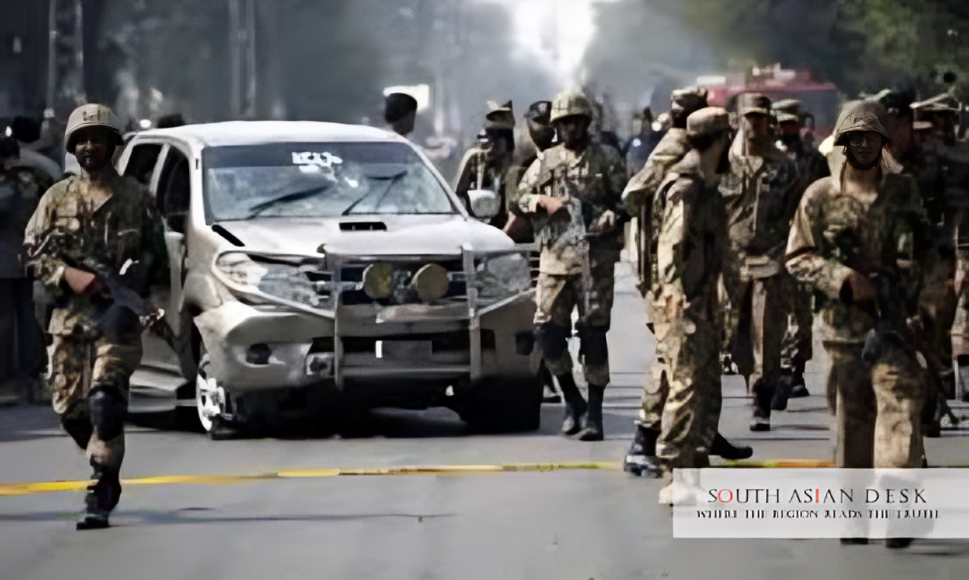
Three suicide bombers targeted the Federal Constabulary headquarters in Peshawar early on Monday, killing three officers at the gate and injuring six civilians in the densely populated area. Security forces shot dead the remaining assailants, cordoned off the site, and launched operations suspecting further threats inside the complex.
This Peshawar paramilitary attack underscores the escalating militancy in Khyber Pakhtunkhwa, where such incidents have surged since 2021. The violence heightens tensions between Pakistan and Afghanistan, complicating border security and regional stability across South Asia, as cross-border militant operations fuel a cycle of reprisals and diplomatic strains.
Details of the FC Headquarters Peshawar Assault
The FC headquarters Peshawar assault unfolded in the early hours of November 24, 2025. Peshawar, the capital of Khyber Pakhtunkhwa province, hosts the Federal Constabulary complex in a bustling neighbourhood. This location makes it a high-value target for militants seeking maximum disruption.
Reports indicate three assailants approached the gate. One detonated explosives immediately, breaching the outer perimeter. The blast claimed the lives of three FC officers on duty. Shrapnel and shockwaves affected nearby residents, leading to civilian casualties. Peshawar Capital City Police Officer Mian Saeed Ahmad described the sequence. “Initially, three militants tried to attack the headquarters,” he stated. “One bomber blew himself up on the gate, while two others tried to enter the premises but were gunned down by FC personnel.”
The rapid response prevented deeper penetration. FC troops engaged the second and third bombers, neutralising them before they could detonate. This action contained the immediate threat, though the site required a thorough sweep.
The area around the headquarters saw immediate lockdown. Law enforcement, including army units and police, established a cordon. An anonymous security official noted the precautions. “Law enforcement personnel, including the army and police, have cordoned off the area and are carefully handling the situation as we suspect there are some terrorists inside the headquarters,” the official said.
This FC headquarters Peshawar assault highlights vulnerabilities in paramilitary installations. Peshawar has long been a focal point for such operations due to its proximity to the Afghan border. The incident adds to a pattern of targeted strikes on security assets.
Civilian impact extended beyond the blast. At least six bystanders suffered injuries from the explosion. They received prompt medical attention. All were reported in stable condition upon arrival at treatment facilities.
Emergency protocols activated swiftly. Declarations of emergency went into effect at key hospitals in Peshawar. This ensured coordinated care for the wounded.
Casualties and Medical Response in the Suicide Bombing Khyber Pakhtunkhwa
The suicide bombing Khyber Pakhtunkhwa event resulted in six deaths overall. Three came from the FC ranks, stationed at the vulnerable entry point. The three bombers perished in their failed bid—one by self-detonation, the others by gunfire.
Injuries numbered six among civilians. These occurred in the surrounding streets, where daily life intersects with security zones. The blast’s radius caught passers-by and residents off guard. Lady Reading Hospital admitted the majority of the injured. A hospital spokesman confirmed their status. All six remained stable, receiving treatment for wounds consistent with explosive trauma—shrapnel lacerations and concussive effects.
Khyber Teaching Hospital supported the effort, standing ready for overflow cases. The dual-hospital emergency declaration streamlined triage and resource allocation. This response minimised secondary complications from the suicide bombing Khyber Pakhtunkhwa.
Medical teams prioritised blast-related injuries. Protocols focused on haemorrhage control and infection prevention. The swift transfer from the scene aided outcomes. This incident reflects broader challenges in the suicide bombing Khyber Pakhtunkhwa landscape. Provincial health systems strain under repeated attacks, diverting resources from routine care.
Security Measures and Official Reactions to the Pakistan Taliban Peshawar Incident
The Pakistan Taliban Peshawar incident prompted a multi-agency operation. Post-assault, forces cleared the headquarters perimeter. Suspicions of lingering threats inside prompted methodical searches. Army and police units dominated the cordon. Their presence deterred follow-on actions. The controlled environment allowed investigators to process the site without interference.
No group claimed the Pakistan Taliban Peshawar incident at the time of reporting. However, patterns point to familiar actors. The Tehrik-e-Taliban Pakistan, or Pakistani Taliban, stands accused in comparable strikes. Their tactics—suicide vests and gate assaults—match this profile.
The violence traces to a post-2021 uptick. Since the Afghan Taliban takeover, cross-border havens have enabled operations. Pakistan attributes this surge to unchecked militant sanctuaries in Afghanistan. Diplomatic frictions have followed, with Islamabad pressing Kabul for action.
Prime Minister Shehbaz Sharif addressed the nation promptly. He lauded the defenders. “Timely action taken by security forces saved us from major harm,” Sharif said in an official statement.
President Asif Ali Zardari echoed the sentiment. In a social media post, he extended condolences to the bereaved families. Zardari highlighted the resolve of the personnel involved, calling their response a testament to duty. These statements signal unified leadership. They aim to bolster public confidence amid the Pakistan Taliban Peshawar incident.
The FC headquarters Peshawar assault demanded heightened vigilance. Provincial authorities reviewed protocols for similar sites. This includes reinforced barriers and surveillance enhancements.
Broader Implications of the Peshawar Paramilitary Attack
The Peshawar paramilitary attack occurs against a backdrop of intensified militancy. Khyber Pakhtunkhwa bears the brunt, with Peshawar as a recurrent flashpoint. Security installations face persistent probes, testing defensive postures.
Civilian exposure remains a concern. The dense urban setting amplifies risks. Evacuations and alerts now form standard procedure in such zones. Economically, disruptions ripple outward. Local commerce halts during cordons, affecting livelihoods in the vicinity. Recovery efforts focus on normalcy restoration.
Regionally, the suicide bombing Khyber Pakhtunkhwa feeds into South Asian security dialogues. Neighbours monitor developments, given shared borders and migration flows. The Pakistan Taliban Peshawar incident underscores unresolved grievances. Historical insurgencies linger, exacerbated by geopolitical shifts.
Investigative teams now comb the site for forensics. Explosive residues and assailant identifiers could yield leads. Intelligence sharing across agencies accelerates. Community leaders urge calm. Mosques and civic groups disseminate safety advisories, emphasising reporting of suspicious activity. The FC headquarters Peshawar assault, while contained, exposes ongoing threats. It prompts reflections on long-term strategies against root causes.
Background
The Tehrik-e-Taliban Pakistan has orchestrated similar assaults in recent years. A surge in attacks followed the 2021 Afghan Taliban takeover. Pakistan alleges these groups operate from Afghan soil, straining bilateral ties. No claim emerged for this specific Peshawar paramilitary attack, but tactics align with TTP methods.
What’s Next
Ongoing operations at the site will continue until cleared. Authorities anticipate forensic results to guide investigations. Enhanced border measures may follow to curb cross-border incursions in the Peshawar paramilitary attack context.
Published in SouthAsianDesk, November 24th, 2025
Follow SouthAsianDesk on X, Instagram, and Facebook for insights on business and current affairs from across South Asia.