

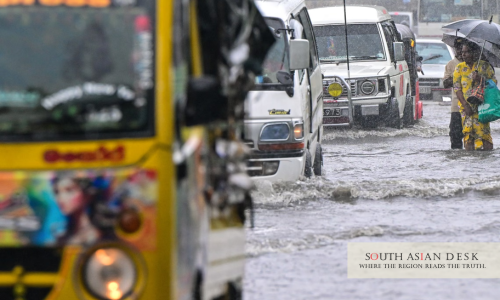
Cyclone Ditwah in Sri Lanka’s eastern coast on 28 November 2025 with winds of 65 km/h. Torrential rains triggered Sri Lanka cyclone floods across all 25 districts. The Disaster Management Centre reported 410 deaths by 2 December. Over 1.4 million people suffered impacts. Rescue teams accessed remote areas. President Anura Kumara Dissanayake declared a state of emergency. The cyclone moved to southern India, easing immediate threats.
Cyclone Ditwah Sri Lanka highlights South Asia’s vulnerability to intensifying storms, with shared coastlines amplifying risks from the Bay of Bengal. Regional aid from India and Pakistan underscores solidarity, yet climate-driven disasters strain economies already recovering from past crises.
Cyclone Ditwah in Sri Lanka: Landfall and Initial Fury
Cyclone Ditwah formed as a depression offshore Sri Lanka’s southeast coast on 26 November 2025. The India Meteorological Department tracked its intensification. It hit land early on 28 November near Batticaloa. Winds reached 70-90 km/h over three days. Rainfall exceeded 300 mm in many areas.
The storm crossed the island, entering the Bay of Bengal on 29 November. It weakened into a deep depression by 30 November due to wind shear and cooler seas. Floods submerged Colombo suburbs. Landslides buried villages in central hills.
The Disaster Management Centre activated emergency protocols. Military helicopters dropped supplies. Over 565 houses faced total destruction. Another 20,271 suffered partial damage. Power outages hit a third of the country.
President Dissanayake addressed the nation on 30 November. “This is the largest and most challenging natural disaster in our history,” he stated. He urged global support for rebuilding.
Sri Lanka Cyclone Floods Devastate Communities
Sri Lanka cyclone floods affected 407,594 families by 2 December 2025. Nearly 233,000 people sought refuge in 1,441 shelters. Schools and temples converted to relief centres.
In Ratnapura, JA Nilanthi, 45, sheltered her family on a roof for two days. “We did not sleep the whole night because it was raining continuously. No one told us to evacuate,” she said. “I have never been this scared my whole life.” Upon return, mud covered their possessions. “Our sofa, cupboards, plates, and even our clothes – all covered in thick mud.”
Biyagama saw rapid inundation. Siriyalatha Adhikari, 74, lost everything. “We did not have time to remove anything from the house. Everything happened so fast. Our whole house was under water,” she recounted. “We did not think it would flood so quickly.”
Badulla district recorded 71 deaths. Layani Rasika Niroshani, 36, survived a landslide. “By some miracle, my brother managed to pull her out of the house through a broken window,” she described. “We were all very scared.” Her home vanished under earth. “We have to rebuild from scratch. Sometimes that’s even worse than living.”
Kantharuban Prashanth, 32, a school teacher in Badulla, sheltered 125 families. “They are very vulnerable and in need of help for about four days now,” he said. “We need help.”
Cyclone Ditwah Death Toll Climbs Amid Searches
Cyclone Ditwah death toll stood at 56 on 28 November, per initial reports. It rose to 153 by 29 November, with 191 missing. On 30 November, officials confirmed 212 deaths and 218 missing.
By 1 December, the figure hit 355, with hundreds displaced. The Hindu reported 390 deaths that day. WHO data on 2 December fixed it at 410 confirmed, plus 336 missing. Badulla and Kandy saw the highest losses from landslides.
Rescue operations continued into inaccessible zones. Over 360 remained unaccounted for as of 2 December. The UN noted 998,918 affected across districts. Floodwaters receded slowly, per the irrigation department.
Health risks mounted. WHO warned of vector-borne diseases. “Floods significantly raise the risk of vector-borne, food-borne and water-borne diseases,” the agency stated. Communities received advice on mosquito prevention and safe water.
Sri Lanka Cyclone Aid Mobilizes Regionally
Sri Lanka cyclone aid efforts accelerated after the government’s international appeal. President Dissanayake sought assistance for half a million impacted. The UN activated its coordination system on 30 November.
India responded first. Prime Minister Narendra Modi pledged support on 28 November. “My heartfelt condolences to the people of Sri Lanka who have lost their loved ones due to Cyclone Ditwah,” he posted on X. “I pray for the safety, comfort and swift recovery of all affected families. In solidarity with our closest maritime neighbour, India has urgently dispatched relief.”
New Delhi sent 21 tonnes of supplies via two military aircraft on 29 November, following six tonnes the prior day. An Indian warship donated rations in Colombo. National Disaster Response Force teams aided rescues.
Pakistan deployed PNS Saif for search operations. A navy helicopter airlifted stranded residents in Kolonnawa. Islamabad finalised relief and a rescue team. Dawn covered the mission as a gesture of South Asian unity.
The UN’s OCHA scaled responses. UNICEF delivered water to 25 centres in Badulla. IOM provided non-food items and shelter, supporting 209,000 displaced. “We are entering a critical phase of this emergency,” IOM stated. “Mobilising humanitarian assistance is essential to reduce the suffering.”
WHO released US$175,000 from its South-East Asia Regional Health Emergency Fund on 2 December. Funds supported rapid response teams for trauma care and surveillance. “The funds will be used for rapid response teams to support essential health services,” said Dr Rajesh Pandav, WHO Representative to Sri Lanka.
Other pledges followed. The US committed $2 million for urgent relief. Ambassador Julie Chung posted: “Sri Lanka is facing difficult days as communities continue to be affected by Cyclone Ditwah. The United States stands in solidarity with Sri Lanka. Today, we are committing $2 million to support urgent relief efforts.”
The UK allocated £675,000 via Red Cross and UN channels. China, Japan, Australia, and New Zealand promised financial aid.
The Sri Lanka Red Cross noted swelling needs. Secretary-General Mahesh Gunasekara said: “Relief needs have been increasing. After two days, water has still been swelling. Although the cyclone is slowly moving away from the country, it is not over for us yet.”
Opposition leaders walked out of Parliament on 1 December, demanding debate on preparedness. A 2023 UNDP report highlighted 48.8% of Sri Lankans lacked disaster readiness.
Background
Cyclone Ditwah marked the fourth cyclonic storm of the 2025 North Indian Ocean season. It originated from a low-pressure system amid warm seas and low shear. Sri Lanka’s northeast monsoon amplified rains.
The island endured similar floods in the early 2000s. Tourism, vital to the economy, faces setbacks from damaged infrastructure. Tea plantations in central provinces suffered landslides, threatening exports.
South Asia sees rising cyclone frequency. The Bay of Bengal hosts 7% of global tropical cyclones but causes 80% of deaths due to density.
What’s Next
Joint UN assessments guide a response plan. Rebuilding targets homes and roads. Health surveillance prevents outbreaks. Regional pacts may enhance early warnings. Cyclone Ditwah Sri Lanka tests resilience, with aid flows critical for recovery.
Published in SouthAsianDesk, December 3rd, 2025
Follow SouthAsianDesk on X, Instagram, and Facebook for insights on business and current affairs from across South Asia.
