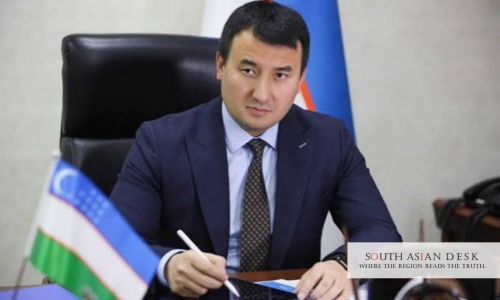
Afghanistan Uzbekistan trade relations have taken a significant step forward following the arrival of a high-level Uzbek economic delegation in Kabul. The delegation, led by Uzbekistan’s Deputy Prime Minister Jamshid Khodjayev, includes 170 Uzbek traders and investors and was welcomed upon arrival by Nooruddin Azizi, Afghanistan’s Minister of Industry and Commerce. The visit marks one of the largest economic delegations to travel from Tashkent to Kabul in recent years and reflects a growing push on both sides to formalize and expand cross-border commerce.
Uzbek Delegation Meets With Islamic Emirate Officials
According to the Afghanistan Chamber of Commerce and Investment (ACCI), the Uzbek delegation is scheduled to meet with several senior officials of the Islamic Emirate, including the Prime Minister. These meetings are expected to cover a wide range of economic issues affecting both countries.
Ehsanullah Ehsan, Head of Public Relations at the ACCI, said that beyond meetings with government officials, the Uzbek delegation will also hold direct talks with Afghanistan’s private sector. He added that a major economic forum between Afghan and Uzbek investors is planned for Sunday, giving business leaders from both countries a chance to discuss potential deals and partnerships face to face.
Kabul Tashkent Trade Cooperation in Focus
The main focus of the meetings is to expand cooperation in trade, transit, and investment, while strengthening economic ties between Kabul and Tashkent. Afghan-Uzbek economic ties have grown steadily over the past few years, with both governments signaling interest in deeper regional integration.
Economic analysts say that continued visits of this kind could help increase investment, create employment opportunities, and strengthen Afghanistan’s access to Central Asian markets. Given Afghanistan’s landlocked position, reliable transit and trade routes through neighboring countries such as Uzbekistan remain critical to the country’s economic outlook.
Azarakhsh Hafizi, an economic analyst, said that at a time when some border crossings are closed and the region is facing conflict, cooperation between the chambers of commerce and investment of Afghanistan and neighboring countries is extremely important. His comments point to the wider regional pressures that make stable trade partnerships, such as the one between Kabul and Tashkent, especially valuable right now.
Why Central Asian Markets Matter for Afghanistan
Afghanistan Uzbekistan trade relations are part of a broader effort by the Islamic Emirate to expand economic relations with regional countries, which it has identified as one of its economic policy priorities. Uzbekistan, for its part, has in recent years sought to deepen its economic and transit cooperation with Afghanistan, viewing the country as a gateway to South Asian markets as well as a trading partner in its own right.
Improved access to Central Asian markets could open new opportunities for Afghan exporters, particularly in agriculture, textiles, and minerals, while also giving Uzbek traders and investors a foothold in Afghanistan’s developing private sector. The Afghanistan Chamber of Commerce and Investment has been positioning itself as a key facilitator in this process, coordinating meetings between officials and private businesses from both countries.
What Comes Next
With the economic forum between Afghan and Uzbek investors set to take place on Sunday, both sides appear ready to move beyond diplomatic gestures and toward concrete trade and investment agreements. If the momentum from this visit continues, Afghanistan Uzbekistan trade relations could see tangible growth in the months ahead, particularly in transit infrastructure and cross-border investment.
For now, the arrival of Deputy Prime Minister Jamshid Khodjayev and his delegation stands as one of the clearest signals yet that Kabul and Tashkent are serious about deepening their economic partnership, even as regional instability continues to complicate trade across parts of Central and South Asia.
Published in SouthAsianDesk, July 27th, 2026
Follow SouthAsianDesk on X, Instagram and Facebook for insights on business and current affairs from across South Asia.