Asim Munir’s Turkiye visit began on Monday, as Pakistan’s Chief of Defense Forces, Field Marshal Asim Munir, arrived in Turkiye for a two-day official trip to hold talks with the country’s political and military leadership. Pakistani state media reported that the discussions would focus on matters of mutual interest, though officials did not disclose a detailed agenda in advance.
State broadcaster Radio Pakistan, citing security sources, said Field Marshal Munir received a warm welcome upon his arrival. “During the visit, he will hold important meetings with Turkiye’s military and political leadership to discuss matters of mutual interest,” the broadcaster reported, without providing further specifics.
Why Asim Munir’s Turkiye Visit Comes Now
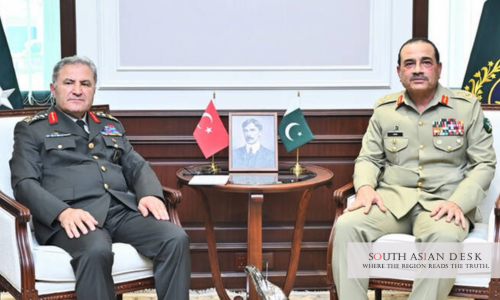
The trip follows closely on the heels of another high-level exchange between the two militaries. A month earlier, Pakistan hosted General Metin Tokel, commander of the Turkish Land Forces, who met Field Marshal Asim Munir in Rawalpindi to discuss regional security and ways of expanding defense cooperation. Taken together, the two visits suggest that Islamabad and Ankara are keen to sustain regular, high-level contact rather than rely on occasional gestures to maintain the relationship.
The timing is also notable given the wider regional backdrop. Asim Munir’s Turkiye visit comes amid renewed military activity between the United States and Iran in the Middle East, a period during which Pakistan, alongside Qatar, Saudi Arabia, Turkiye and other regional states, helped broker an interim peace arrangement between Washington and Tehran in mid-June. That context gives the current visit added weight beyond routine bilateral defense business.
Pakistan Turkiye Ties Extend Across Political, Economic and Military Lines
Pakistan and Turkiye maintain close political, economic and defense ties that go well beyond military-to-military contact. Both countries belong to the R-4 diplomatic framework, a grouping launched in March together with Egypt and Saudi Arabia to coordinate positions on regional crises, underscoring a shared interest in shaping outcomes in the wider Middle East and South Asia rather than simply responding to them.
Pakistan Turkiye defense cooperation has also grown in more specialised areas in recent months. In May, Pakistan Air Force Chief Air Chief Marshal Zaheer Ahmed Baber Sidhu met Turkiye’s air force commander, its defense minister, and senior executives from drone manufacturer Baykar Technologies. The engagement reflects a broader global trend, with militaries increasingly investing in drones, electronic warfare, cyber capabilities and integrated multi-domain operations, an area in which Turkish industry has built a strong international reputation.
Beyond Defense: A Broader Pakistan-Turkiye Partnership
The security relationship has been matched by economic outreach at the political level. Earlier this month, Pakistan Prime Minister Shehbaz Sharif visited Turkiye and invited Turkish firms to invest in Pakistan’s energy, mining, infrastructure, maritime, telecommunications and agriculture sectors, a sign that Islamabad views its ties with Ankara as extending well beyond security cooperation alone.
Taken as a whole, Asim Munir’s Turkiye visit fits a broader pattern of sustained engagement between the two countries across military, diplomatic and economic channels. With Field Marshal Asim Munir now holding direct talks with Turkiye’s leadership, officials on both sides appear intent on consolidating a partnership that has shifted from periodic exchanges toward a more structured, continuous relationship, one likely to produce further high-level visits in the months ahead.
Published in SouthAsianDesk, July 14, 2026
Follow SouthAsianDesk on X, Instagram and Facebook for insights on business and current affairs from across South Asia.