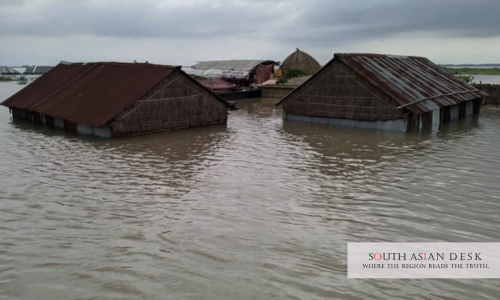
Bangladesh flood death toll figures rose to 59 on Saturday as authorities reported further fatalities from flooding and landslides across the country’s south-eastern and north-eastern districts.
Cox’s Bazar remained the worst-affected district, accounting for 32 deaths, more than half of the national toll. The fatalities included 19 local residents and 13 Rohingya refugees, according to an updated report from the Ministry of Disaster Management and Relief.
The revised government figures, based on information collected until 4pm on Saturday, also recorded 40 injuries. One person remained missing in Cox’s Bazar.
Bangladesh flood death toll highest in Cox’s Bazar
The Bangladesh flood death toll has been concentrated heavily in Cox’s Bazar, where prolonged rainfall caused flash floods, waterlogging and landslides in both local communities and Rohingya refugee settlements.
Alongside the 32 deaths, the district recorded 25 injuries. Those injured included 20 local residents and five Rohingya refugees.
The refugee camps are especially exposed to landslides because many shelters are built from bamboo and plastic on steep, densely populated hillsides. Earlier in the emergency, authorities relocated residents from high-risk areas after repeated landslides struck the camps.
More than one million Rohingya refugees live in Cox’s Bazar, where seasonal rain frequently damages shelters, roads and drainage systems. The combination of unstable slopes, heavy rainfall and limited space makes emergency evacuations particularly difficult.
Deaths reported across five districts
Chattogram recorded the second-highest number of fatalities, with 16 deaths and 12 injuries.
Seven people were killed and two injured in Bandarban, while Rangamati reported three deaths. One person died in Moulvibazar.
Khagrachhari recorded one injury but no fatalities. No deaths were reported in Habiganj in the latest government assessment.
The floods and landslides have affected seven districts: Khagrachhari, Rangamati, Bandarban, Cox’s Bazar, Chattogram, Moulvibazar and Habiganj.
The affected area covers 56 upazilas, 374 unions and four municipalities, demonstrating the wide geographical reach of the Bangladesh monsoon floods.
Chattogram and hill districts face widespread flooding
Partial waterlogging was reported across Chattogram city and 16 upazilas, affecting 176 unions and localities.
In Cox’s Bazar, flooding affected 75 unions across 10 upazilas. The district has experienced extensive damage to homes, roads and public infrastructure after repeated spells of torrential rain.
Rangamati reported flooding in 43 unions and two municipalities across nine upazilas. In Bandarban, 34 unions and two municipalities across seven upazilas were affected.
Flooding also reached 36 unions in Khagrachhari, five unions in Moulvibazar Sadar and five unions across three upazilas in Habiganj.
Earlier assessments found that damaged roads and bridges had restricted access to some communities. Power outages and communications failures also complicated the delivery of food, drinking water and medicines.
Army and navy personnel were deployed during the emergency to transport essential supplies by boat to areas that could not be reached by road.
Emergency shelters opened for displaced residents
Authorities opened 73 emergency shelters across the affected districts.
Bandarban accounted for 67 of the shelters, while four were opened in Moulvibazar and two in Habiganj. As of Saturday afternoon, 298 people were staying in the shelters, all of them in Moulvibazar.
The relatively low number of shelter residents does not reflect the full scale of displacement. Many affected families have remained with relatives, stayed near damaged homes or returned as floodwater began to recede.
Earlier government figures showed that tens of thousands of people had entered relief centres during the worst period of flooding. More than one million people were reported affected across seven districts at an earlier stage of the emergency.
Flood relief operations continue
The disaster management ministry said flood relief operations were continuing across affected areas.
Assistance includes rice, dry food, cash payments, children’s food, animal feed, corrugated iron sheets and financial support for rebuilding damaged homes.
Chattogram was allocated Tk75 lakh and 1,200 tonnes of rice, while Cox’s Bazar received Tk40 lakh and 450 tonnes of rice.
Rangamati received Tk30 lakh and 500 tonnes of rice. Khagrachhari and Bandarban were each allocated Tk25 lakh and 400 tonnes of rice.
The government has also allocated Tk5.15 crore, 9,050 tonnes of rice, 4,200 bundles of corrugated iron sheets and Tk1.26 crore for house reconstruction across all 64 districts.
The ministry clarified that the nationwide allocations form part of the government’s broader disaster response and are not reserved exclusively for the seven districts affected by the current floods.
Receding floodwater leaves continuing risks
Although water levels have begun falling in some locations, the humanitarian emergency is not over.
Floodwater can contaminate wells, tube wells and other drinking-water sources, increasing the risk of diarrhoea and waterborne disease. Damaged roads and bridges can also delay the return of essential services and prevent isolated families from receiving assistance.
Mud deposited inside homes has left many residents unable to cook or safely store food. Agricultural land, fisheries, livestock and local businesses have also been exposed to extensive damage.
Further rain could trigger renewed waterlogging or landslides, particularly in the Chattogram Hill Tracts and the densely populated Rohingya camps.
The rising Bangladesh flood death toll highlights the danger posed by prolonged monsoon rainfall in low-lying and hilly areas. The immediate priority for authorities remains reaching isolated communities, securing clean water supplies and supporting families whose homes and livelihoods have been damaged.
Published in SouthAsianDesk, July 19, 2026
Follow SouthAsianDesk on X, Instagram and Facebook for insights on business and current affairs from across South Asia.