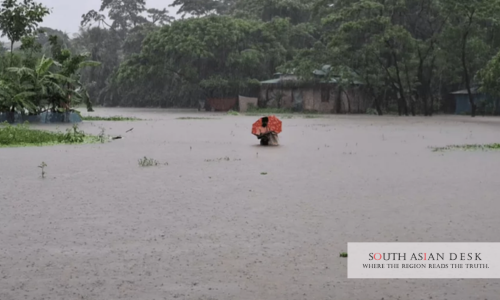
Bangladesh floods have spread beyond the southeastern hill districts after days of relentless monsoon rain left at least 30 people dead, disrupted transport, stranded thousands and raised fears of further landslides and flash flooding.
Disaster Management and Relief Minister Asadul Habib Dulu told parliament that the deaths occurred over the past few days in Chittagong, the Chittagong Hill Tracts and Cox’s Bazar due to landslides and other rain-related incidents.
The fatalities include 19 in Cox’s Bazar, five in Chittagong, five in Bandarban and one in Rangamati. The worst single incident occurred in the Kutupalong Rohingya refugee camp in Ukhiya, where a rain-soaked hillside collapsed onto a madrasa during Quran classes, killing children and teachers.
The Bangladesh Meteorological Department has forecast heavy to very heavy rainfall across all eight divisions over the next two days, warning that landslides may occur in Chittagong’s hill districts and that temporary waterlogging may affect Dhaka and Chittagong metropolitan areas.
Bangladesh floods widen beyond the southeast
Bangladesh floods are no longer limited to the hill districts. The Flood Forecasting and Warning Centre has warned that heavy rainfall in Bangladesh and upstream Indian states could push several rivers above danger level over the next three days.
Districts at risk include Bandarban, Cox’s Bazar, Feni, Khagrachhari, Sylhet, Sunamganj, Moulvibazar, Habiganj, Netrokona, Sherpur, Mymensingh, Nilphamari, Lalmonirhat and Rangpur. Low-lying areas of Lakshmipur and Noakhali are also facing flood risks.
Several rivers, including the Sangu, Matamuhuri, Teesta, Manu, Khowai, Someshwari and Jadukata, are forecast to rise rapidly if the rainfall continues. Some may cross danger levels, increasing the risk of flash floods in northern, northeastern and southeastern districts.
The spread of warnings beyond the hills shows how quickly a localised landslide emergency can develop into a broader flood crisis during an active monsoon spell. Upstream rainfall and swollen rivers can turn low-lying areas into danger zones even before local rainfall peaks.
Landslides keep death toll rising
The most severe impact so far has been in landslide-prone areas of the southeast. Hill slopes saturated by continuous rain have collapsed in several locations, killing residents and damaging homes, roads and community buildings.
In Cox’s Bazar, the Rohingya refugee camps remain particularly vulnerable. Many shelters and learning centres are built on or near unstable slopes, while dense settlement patterns make evacuation difficult. The madrasa collapse in Kutupalong has again exposed the danger facing children and families living in fragile camp conditions.
Landslide risks also remain high in Rangamati, Bandarban, Khagrachhari and Chittagong. Authorities have urged hill residents to evacuate immediately from dangerous slopes, but relocation can be difficult when families fear losing shelter, possessions or access to livelihoods.
Heavy rain makes the danger unpredictable. Even after rainfall slows, waterlogged slopes can remain unstable, meaning the threat of further landslides may continue for days.
Transport links cut as roads and railways flood
Transport disruption has worsened the emergency. Road communication with Bandarban has been cut off after landslides buried sections of highways. Flooding has also closed parts of the Bandarban-Thanchi road and affected travel routes linking Chittagong and Cox’s Bazar.
Rail services to Cox’s Bazar remain suspended after floodwater submerged sections of the railway line. The suspension has affected movement into one of the country’s major tourism and refugee-hosting regions at a time when emergency access is already under pressure.
In Rangamati, 561 tourists became stranded in Sajek Valley after roads went underwater. The Bangladesh Army rescued an initial group of 150 tourists by ferrying them across flooded stretches, while more than 400 others remained in the hill resort awaiting evacuation.
The transport disruptions are significant because they affect both rescue operations and civilian movement. When roads and rail lines are cut off, delivering relief, evacuating vulnerable residents and restoring normal supplies become much harder.
Coastal and northeastern areas face growing risk
The crisis has also spread to coastal and northeastern areas. In Noakhali’s Hatia, tidal surges submerged homes, roads, crop fields and fish ponds, leaving many families unable to cook for days.
In Moulvibazar’s Kamalganj, nearly 10,000 people were trapped after a breached embankment on the Dhalai River flooded at least 25 villages. The breach cut road links and inundated schools and farmland, increasing pressure on local authorities and residents.
These developments show that Bangladesh’s flood emergency now involves several overlapping hazards: landslides in hills, river flooding in low-lying districts, tidal impacts in coastal areas and waterlogging in urban centres.
The warnings from forecasters suggest that the situation could worsen if heavy rain continues for another 48 to 72 hours.
Authorities step up evacuations and relief
Authorities have intensified evacuation efforts across vulnerable hill districts. In Chittagong, executive magistrates, land officials and around 150 volunteers have been deployed to relocate residents from 26 identified high-risk hills.
Rangamati has opened 19 shelters covering 39 landslide-prone locations, while similar evacuation drives are underway in Khagrachhari and Bandarban. Officials have warned residents not to ignore relocation orders.
The government says hundreds of shelters have been opened across affected districts, with food, drinking water and emergency relief being distributed. Each district has also received emergency allocations from the Prime Minister’s Relief Fund, with further support promised if conditions deteriorate.
Maritime ports at Chittagong, Cox’s Bazar, Mongla and Payra have been advised to keep Local Cautionary Signal No 3 hoisted. Fishing boats have been asked to remain close to shore because of rough weather risks.
Monsoon threat remains active
Bangladesh floods are likely to remain a major concern while the monsoon stays active. Forecasters say heavy rainfall may continue for at least two more days, keeping the threat of fresh floods, landslides and urban waterlogging high.
The immediate priority is to move people away from vulnerable hillsides, support families already displaced, reopen transport links where possible and maintain river monitoring in districts at risk of flash floods.
The wider challenge is familiar but urgent. Bangladesh faces recurring monsoon disasters, and the combination of heavy rainfall, hill settlements, river swelling, coastal exposure and dense populations can quickly turn severe weather into a national emergency.
For now, the death toll of 30 underscores the seriousness of the crisis. With rivers still rising and more rain forecast, authorities are warning that the situation could worsen before it improves.
Published in SouthAsianDesk, July 10, 2026
Follow SouthAsianDesk on X, Instagram and Facebook for insights on business and current affairs from across South Asia.