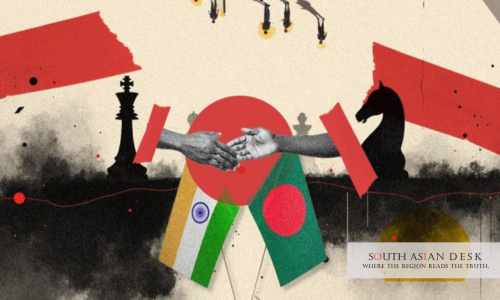
Bangladesh India trade gap remains a major concern for Dhaka as the government moves to pursue a Comprehensive Economic Partnership Agreement with New Delhi to reduce import dependence, expand exports and address the imbalance in bilateral trade.
Commerce Minister Khandakar Abdul Muktadir told parliament that the government has taken the initiative to launch a CEPA with India as part of a wider strategy to strengthen Bangladesh’s export capacity and make trade more balanced.
In a scripted reply to a question from Rangpur-3 MP Mahbubur Rahman Belal, the minister said bilateral trade between Bangladesh and India stood at $11.39 billion in fiscal year 2024-25. Bangladesh’s exports to India amounted to only $1.76 billion, showing the scale of the imbalance.
In the minister’s absence, State Minister for Commerce Shariful Alam answered questions in parliament, with Speaker Hafiz Uddin Ahmed presiding over the sitting.
Bangladesh India trade gap remains a policy challenge
Bangladesh India trade gap has persisted despite India being one of Bangladesh’s most important regional trade partners. The imbalance is largely driven by Bangladesh’s heavy import of food items, raw materials, capital machinery, intermediate goods and industrial inputs from India.
Earlier parliamentary data showed that Bangladesh’s imports from India stood at $9.62 billion in FY2024-25, against exports of $1.76 billion. That left a trade deficit of $7.86 billion, the largest trade gap Bangladesh has with any South Asian partner.
The latest parliamentary statement confirms that reducing the imbalance is now being framed as a trade policy priority. A CEPA could offer Bangladesh a wider platform to discuss tariffs, non-tariff barriers, standards, customs procedures, investment, services and trade facilitation.
However, a trade agreement alone will not automatically reduce the deficit. Bangladesh will need to expand the range and competitiveness of goods it can sell to India, while also developing domestic industries capable of replacing some imports.
CEPA seen as route to stronger bilateral trade
The proposed Bangladesh India CEPA is expected to focus on deeper economic cooperation rather than only tariff reductions. Such agreements usually cover goods, services, investment, customs procedures, standards, digital trade, trade facilitation and dispute settlement.
Bangladesh and India had made progress on CEPA discussions under the previous government, including a joint feasibility study. However, formal progress slowed after political changes in Dhaka and shifting trade policy priorities.
The government’s latest statement suggests that Dhaka wants to revive or relaunch the process as part of a broader effort to secure better market access and improve export performance.
India already provides duty-free and quota-free access to nearly all Bangladeshi goods under the South Asian Free Trade Area framework. Yet Bangladesh’s exports to India remain limited compared with imports. This indicates that market access alone is not enough unless exporters can meet price, quality, scale, logistics and standards requirements.
A CEPA could help address some of these barriers, but only if negotiations focus on practical obstacles faced by Bangladeshi exporters.
Export diversification central to reducing imbalance
Bangladesh’s export base remains heavily dependent on garments, even though the country sells hundreds of products to global markets.
The commerce minister told parliament that Bangladesh exported 812 products to 202 destinations in FY2024-25. Major export items included woven garments, knitwear, home textiles, fish, agricultural products, jute and jute goods, leather and leather products, footwear and engineering products.
These products generated $44.17 billion, accounting for 91.48 percent of Bangladesh’s total export earnings. The figures show that Bangladesh has a broad product list, but export earnings remain concentrated in a few major sectors.
To narrow the Bangladesh India trade gap, Dhaka will need to expand exports in sectors where Indian demand is strong and Bangladesh can compete. These may include garments, jute goods, processed foods, leather products, footwear, light engineering goods, ceramics, pharmaceuticals and selected agricultural products.
The challenge is that India itself has a large domestic manufacturing base. Bangladeshi exporters therefore need not only preferential access, but also competitive pricing, reliable supply, branding, standards compliance and faster logistics.
Import dependence remains a structural issue
The government has linked the CEPA initiative with a broader policy to reduce import dependence. The commerce minister said Bangladesh is pursuing measures to develop domestic industries, expand production of import-substitute goods and discourage imports of products that can be manufactured locally.
At the same time, the government wants to encourage imports of essential raw materials and capital machinery. This distinction is important. Bangladesh cannot simply cut imports if those imports are required for industrial production, exports or infrastructure.
The policy challenge is to reduce unnecessary dependence while protecting productive imports. Raw materials, machinery and intermediate goods can support domestic manufacturing, but consumer goods that can be made locally may widen the deficit without strengthening industry.
The proposed Import Policy Order 2026-2029 is expected to emphasise local industrial competitiveness, efficient foreign currency use and more transparent, modern and business-friendly import management.
If implemented carefully, such measures could help Bangladesh conserve foreign exchange while supporting industrial growth.
Trade policy must address non-tariff barriers
For Bangladesh, narrowing the trade gap with India will require attention to non-tariff barriers as much as tariffs.
Exporters often face challenges linked to testing, certification, customs procedures, logistics delays, standards recognition, border infrastructure and transport costs. These barriers can weaken the benefits of formal market access.
Improved land port facilities, faster customs clearance, mutual recognition of standards and smoother payment systems could help increase bilateral trade efficiency. The two countries have already made progress in connectivity, including integrated check posts, rail links, waterways and port arrangements, but traders continue to face operational difficulties.
India and Bangladesh also launched a mechanism in 2023 to settle bilateral trade in Indian rupees. The mechanism was intended to reduce dependence on the US dollar, lower transaction costs and improve trade efficiency. Its practical impact will depend on adoption by traders and banks.
A CEPA could give both countries a structured platform to address these long-running trade facilitation problems.
Bangladesh pursuing wider trade agreement strategy
The CEPA push with India comes as Bangladesh seeks to expand trade agreements before and after its graduation from least developed country status.
Dhaka currently has trade agreements with Bhutan and Japan, according to the commerce minister’s parliamentary reply. The Bhutan agreement was signed in December 2020, while the Japan agreement was signed in February 2026.
Bangladesh has also pursued discussions with other partners, including South Korea, Singapore and China. These efforts are part of a wider strategy to protect market access, attract investment and diversify export destinations as the country prepares for a more competitive trade environment.
However, progress on trade deals has often been slow. Economists have pointed to limited negotiating capacity and the complexity of modern trade agreements as reasons for delays.
The India CEPA will therefore test Bangladesh’s ability to negotiate a complex agreement with one of its most important neighbours.
Domestic industry support will determine outcome
The proposed Bangladesh India CEPA can only help narrow the trade gap if domestic industry becomes more competitive.
Bangladesh will need investment in productivity, quality control, standards compliance, logistics, energy reliability and technology. Exporters also need better market intelligence on Indian demand and stronger support in navigating regulatory requirements.
Local industries must also be protected from inefficient import substitution. If policy support only raises barriers without improving productivity, consumers may face higher prices and industries may remain weak. A successful strategy should encourage local production where Bangladesh can realistically compete.
The government’s emphasis on import-substitute goods must therefore be paired with export-oriented industrial policy. Reducing imports matters, but earning more from exports is the more sustainable way to narrow the bilateral imbalance.
CEPA could reset Bangladesh India economic ties
Bangladesh India trade gap remains wide, but the government’s renewed interest in a Comprehensive Economic Partnership Agreement signals that Dhaka wants to manage the imbalance through structured economic engagement rather than ad hoc restrictions.
The numbers show why the issue matters. Bilateral trade reached $11.39 billion in FY2024-25, but Bangladesh’s exports accounted for only $1.76 billion. That gap has turned trade with India into both an economic and political concern.
A CEPA could help if it improves market access, reduces non-tariff barriers, supports investment and strengthens supply chains. But the agreement will not be enough on its own. Bangladesh must also build domestic capacity, diversify exports and improve the competitiveness of local industries.
The government’s policy direction is clear: reduce import dependence where possible, preserve essential industrial imports, and push for stronger export growth. Whether that strategy succeeds will depend on how effectively Dhaka negotiates with New Delhi and how quickly it can support businesses at home.
For now, the Bangladesh India trade gap remains one of the central challenges in the country’s regional economic policy. The proposed CEPA may become an important tool, but its success will depend on practical implementation rather than diplomatic language alone.
Published in SouthAsianDesk, July 10, 2026
Follow SouthAsianDesk on X, Instagram and Facebook for insights on business and current affairs from across South Asia.