Bangladesh Kazakhstan Relations Move Toward Stronger Institutional Ties
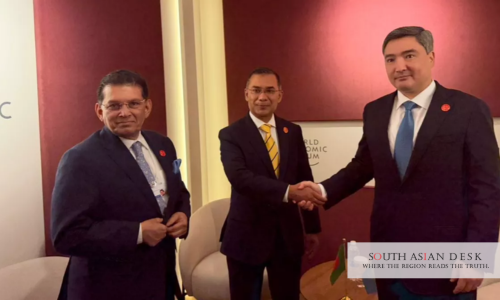
Bangladesh Kazakhstan relations are set for a new phase after Prime Minister Tarique Rahman and Kazakh Prime Minister Olzhas Bektenov agreed to work towards opening permanent diplomatic missions in each other’s capitals.
The two leaders met on Wednesday on the sidelines of the World Economic Forum’s Annual Meeting of the New Champions, also known as Summer Davos, in Dalian, China. Their meeting focused on strengthening political, economic and commercial links between Dhaka and Astana, with both sides identifying resident embassies as a key step in deepening cooperation.
The decision reflects Bangladesh’s growing effort to widen its foreign policy outreach beyond traditional partners and explore new opportunities in Central Asia. For Kazakhstan, the move offers a route to stronger engagement with one of South Asia’s fast-growing economies and a large labour-exporting country.
Permanent diplomatic missions would give both governments a stronger institutional platform to manage trade, investment, labour mobility, education links and official exchanges. They would also make it easier for businesses and citizens to pursue visas, documentation, commercial contacts and government-to-government coordination.
Trade, Investment and Workforce Mobility Discussed
Trade and investment featured prominently in the talks. Rahman and Bektenov discussed ways to expand cooperation between business communities and increase official-level engagement to identify practical areas of partnership.
The two sides explored possible collaboration in skilled workforce migration from Bangladesh to Kazakhstan. This could become an important area for Dhaka, which is seeking new labour markets for Bangladeshi workers while trying to improve the quality, transparency and safety of overseas employment.
Kazakhstan’s economy has demand in sectors linked to infrastructure, services, industry and technical work. Bangladesh, meanwhile, has a large workforce and is looking to diversify beyond its traditional labour destinations in the Gulf and Southeast Asia.
The leaders also discussed cooperation in renewable energy, digital infrastructure, technology, agribusiness and food processing. These sectors align with Bangladesh’s current economic priorities as the government seeks investment, export diversification and new growth partnerships.
For Bangladesh, Kazakhstan could offer a gateway into Central Asian markets. For Kazakhstan, Bangladesh presents opportunities in labour, textiles, pharmaceuticals, technology services and consumer goods.
Dhaka Looks Beyond Traditional Partners
The meeting came during Rahman’s first overseas tour since taking office, which has included Malaysia and China. The trip has been framed around investment, labour opportunities, trade expansion and broader diplomatic outreach.
Bangladesh’s engagement with Kazakhstan fits that wider strategy. Dhaka is trying to strengthen ties with countries that can offer new markets, infrastructure partnerships, workforce opportunities and diplomatic support in multilateral forums.
Central Asia has not traditionally been at the centre of Bangladesh’s foreign policy, but that may be changing. Countries such as Kazakhstan have growing importance because of their energy resources, connectivity ambitions and links with China, Russia, Turkey and Europe.
Opening permanent missions in Dhaka and Astana would therefore be more than a symbolic step. It would show that both countries want a regular diplomatic channel rather than occasional engagement through third countries or multilateral meetings.
Regular Exchanges Seen as Key
The two prime ministers also stressed the need for regular exchanges among politicians, officials, business leaders and people from both countries. Such exchanges are often necessary before trade and investment pledges can become concrete projects.
Bangladesh and Kazakhstan currently have room to expand economic ties from a relatively modest base. Without direct diplomatic presence, business engagement can remain slow and limited. Resident missions could help identify investment opportunities, promote trade fairs, support private-sector visits and resolve administrative barriers.
The proposed embassies could also support educational and cultural exchanges, which are important for building long-term ties between countries with limited public familiarity.
For Bangladesh, stronger engagement with Kazakhstan may also support its broader push for economic diplomacy under the Rahman government. The administration has repeatedly emphasised investment, employment and international partnerships as it seeks to revive confidence and broaden external relations.
A Step Toward Broader Central Asia Engagement
The agreement to open diplomatic missions points to a more active Bangladeshi approach toward Central Asia. Kazakhstan is the region’s largest economy and a key player in Eurasian connectivity, making it a natural starting point for deeper engagement.
If followed through, the move could help Bangladesh build links in trade, labour, food processing, technology and renewable energy. It may also create space for cooperation in logistics and connectivity, especially as China-backed regional routes continue to reshape trade patterns across Asia.
The challenge will be implementation. Announcing diplomatic missions is only the first step. Both sides will need to move quickly on administrative decisions, staffing, commercial priorities and sector-specific follow-up.
Still, the Dalian meeting gave Bangladesh and Kazakhstan a clear direction: build permanent diplomatic channels, expand economic engagement and use regular exchanges to turn political goodwill into practical cooperation.
For Dhaka, the agreement supports a foreign policy increasingly focused on jobs, investment and diversified partnerships. For Astana, it opens a more direct channel to South Asia. For both, the planned missions in Dhaka and Astana could become the foundation for a relationship that has long remained underdeveloped.
Published in SouthAsianDesk, June 25, 2026
Follow SouthAsianDesk on X, Instagram and Facebook for insights on business and current affairs from across South Asia.