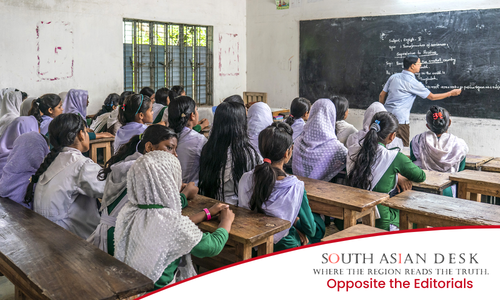
From Bangladesh to India and Pakistan, climate disruption is no longer a distant environmental threat. It is increasingly determining who can learn, who falls behind, and who is forced out of school.
For a child in South Asia, a school closure is rarely just a day without lessons.
A flood can turn a classroom into a shelter. A heatwave can make attendance unsafe. A cyclone can destroy roads, homes and school buildings at once. For families already living with financial insecurity, repeated interruptions can eventually transform a temporary absence from school into permanent educational loss.
The climate crisis is therefore becoming something much larger than an environmental crisis.
It is becoming an education crisis.
In 2024, at least 128 million students across South Asia experienced climate-related disruptions to their education, according to UNICEF. The disruptions included school closures caused by extreme heat, floods, tropical storms and other climate-related hazards.
Bangladesh illustrates the scale of the problem particularly clearly.
UNICEF estimated that 35 million children in Bangladesh experienced education disruptions caused by climate-related events in 2024. Heatwaves forced schools to close, while Cyclone Remal and subsequent flooding created further interruptions. In some parts of the country, children lost as much as eight weeks of learning.
Eight weeks may sound temporary.
For a child whose education is already vulnerable, it is not.
When a School Closure Becomes More Than a Closure
Education systems are built around continuity. Students attend classes, complete assignments, sit examinations and progress from one grade to another. When disasters repeatedly interrupt that cycle, the consequences accumulate.
A student who misses several weeks may struggle to catch up with the curriculum. A family that loses its income after a flood may no longer be able to afford transportation, uniforms, books or other educational expenses. A child may be expected to work, care for younger siblings or contribute to household recovery.
Eventually, returning to school can become harder than leaving it.
For adolescent girls, the risks can become even more complicated. Climate-related displacement can disrupt access to education while increasing vulnerability to child marriage, exploitation and other forms of harm. The climate crisis does not create every existing inequality, but it can intensify inequalities that were already there.
That distinction matters.
Climate change does not affect every child equally.
A child from a financially secure urban household may continue learning through private tutoring, digital resources or temporary relocation. A child from a low-income rural household may lose access to almost everything that makes continued education possible.
The same flood can therefore produce radically different educational consequences depending on where a child lives and what resources their family possesses.
South Asia’s Heat Problem
Floods and cyclones are not the only threats.
Extreme heat is increasingly disrupting education across the region.
South Asia is already one of the world’s most climate-vulnerable regions, and children are particularly exposed because their bodies are less able to regulate extreme temperatures. Excessive heat can make classrooms physically unsafe, reduce concentration and increase health risks.
UNICEF has warned that during the 2050s, four times as many children in South Asia could be exposed to extreme heatwaves compared with the 2000s.
This creates a difficult question for education policymakers:
How do we prepare children for a changing climate if the climate is simultaneously making it harder for them to attend school?
Closing schools during dangerous heat can protect children in the short term. But repeated closures without alternative learning systems create another problem.
Protection and continuity have to exist together.
Schools need climate-resilient infrastructure, adequate ventilation, access to safe drinking water, heat-action plans and emergency systems that allow learning to continue when physical attendance is impossible.
Digital learning can be part of the solution, but it cannot be treated as a universal answer.
A student without reliable electricity, internet access, a smartphone or a quiet place to study cannot benefit from an online classroom in the same way as a student who has all four.
Technology can reduce educational inequality only when access to technology is itself equitable.
The Children Behind the Statistics
Climate statistics can make the problem appear abstract.
But every disrupted school day belongs to a particular child.
It belongs to the student who walks through floodwater to reach a school that may not open. It belongs to the girl whose family has relocated after losing their home. It belongs to the child who returns to school after weeks away and discovers that everyone else has moved ahead.
This is why climate policy and education policy cannot continue operating in separate compartments.
A flood-management project is also an education intervention if it protects schools and roads.
A social-protection programme is also an education intervention if it prevents a family from withdrawing a child from school after losing its income.
A climate-resilient school is not simply an infrastructure project.
It is an investment in human capital.
Young People Are Not Just Victims
There is another part of the conversation that South Asia needs to reconsider.
Young people are frequently described as the generation that will inherit the climate crisis.
That is true, but incomplete.
Young people are already living through it.
UNICEF research in Bangladesh found that 94 percent of young people surveyed wanted to take action on climate change but needed support to do so. The same research found that 78 percent believed climate change had already hampered their education.
That should change the way institutions engage young people.
Students should not only be taught about climate change. They should have opportunities to participate in climate adaptation within their own schools and communities.
They can map local risks, conduct environmental research, develop awareness campaigns, monitor water and sanitation challenges, participate in biodiversity projects and contribute to disaster-preparedness planning.
Their knowledge is not merely symbolic.
A young person who lives through recurring floods may understand the practical consequences of those floods in ways that a distant policy document cannot.
Preparing for a More Mobile Generation
Climate disruption also has implications beyond the classroom.
The World Bank has projected that as many as 40 million people could become internal climate migrants in South Asia by 2050 without stronger climate and development action.
Migration can fracture educational continuity.
A child who moves because of flooding, coastal erosion, drought or extreme heat may leave behind a school, teachers, friends, educational records and an established curriculum. At the destination, another school may not have the capacity to accommodate them.
Education systems therefore need to prepare not only for climate disasters, but also for climate mobility.
That means making school enrollment more flexible, protecting educational records, strengthening public schools in high-migration areas and ensuring displaced children are not treated as outsiders within the education system.
Resilience Cannot Become an Excuse
South Asian governments increasingly use the language of resilience.
Children are encouraged to become resilient. Communities are encouraged to adapt. Young people are encouraged to innovate.
But resilience should never become a substitute for institutional responsibility.
A child should not need extraordinary determination to remain in school after a flood.
A girl should not have to choose between education and household survival after a climate disaster.
And a family should not have to decide whether education is a luxury every time extreme weather destroys its livelihood.
South Asia has spent decades expanding access to education. Climate change now threatens to reverse some of those gains.
The response must therefore go beyond reopening schools after disasters.
It must involve climate-resilient infrastructure, emergency learning systems, stronger social protection, climate-informed education planning and meaningful youth participation.
Most importantly, South Asian countries need to recognize that climate adaptation is not only about protecting the future.
It is about protecting the present.
Millions of children are already experiencing the consequences of a changing climate.
The future of South Asian education will not be determined solely by textbooks, examinations or technology.
Increasingly, it will also be determined by whether the school building survives the flood, whether the classroom remains safe during a heatwave, whether a displaced child can enroll somewhere new, and whether a family can afford to keep its children in school after a disaster.
South Asia does not have the luxury of waiting for the climate crisis to become worse before redesigning its education systems.
For millions of children, the question is no longer whether climate change will affect their education.
It already has.
Works Cited
UNICEF. Learning Interrupted: Global Snapshot of Climate-Related School Disruptions in 2024. UNICEF, 2025.
UNICEF Bangladesh. “35 Million Children in Bangladesh Had Schooling Disrupted by Climate Crises in 2024.” UNICEF Bangladesh, 24 Jan. 2025.
UNICEF. “Four Times as Many South Asian Children Could Be Exposed to Extreme Heatwaves in the 2050s.” UNICEF, 20 Nov. 2024.
UNICEF Bangladesh. Rising to the Challenge: Youth Perspectives on Climate Change and Education in Bangladesh. UNICEF, 2021.
World Bank. Groundswell: Acting on Internal Climate Migration. World Bank, 2021.