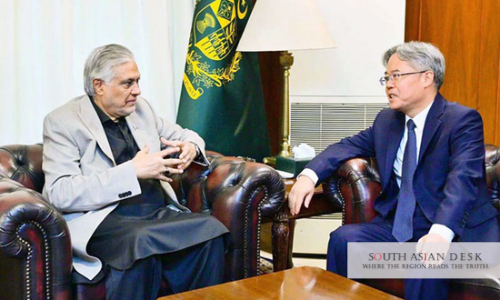
CPEC progress was the central subject of a meeting on Sunday between Deputy Prime Minister and Foreign Minister Ishaq Dar and Chinese Ambassador Jiang Zaidong in Islamabad, the Foreign Office said. The two officials also reaffirmed bilateral ties and discussed recent regional developments, as both countries work to speed up the next stage of the China-Pakistan Economic Corridor.
Dar Praises the Strategic Partnership
According to a statement released by the Foreign Office spokesperson, Ishaq Dar welcomed the continuing expansion of what the two governments call an all-weather strategic cooperative partnership. Discussions covered trade, investment, regional connectivity, agricultural modernisation and people-to-people exchanges.
Dar also stressed the need for sustained high-level engagements to build what officials describe as a “Pakistan-China Community of Shared Future in the New Era”. Beyond the economic agenda, he and Ambassador Jiang Zaidong discussed regional developments and agreed that dialogue and diplomacy remain essential for long-term peace and stability in the region.
Reviewing CPEC Progress in the Second Phase
The meeting comes as Islamabad and Beijing seek to accelerate the second phase of the China-Pakistan Economic Corridor, which shifts attention from the energy and transport projects of the early years toward industrialisation, technology and export-led growth. Since its launch in 2013, the corridor has attracted tens of billions of dollars in transport, energy and infrastructure investment, according to earlier reporting by Arab News.
Officials said in August that the first phase had drawn approximately $25 billion in Chinese investment, and that the next phase would give priority to private-sector partnerships and technology transfer. At a bilateral meeting reported earlier this year, both sides reaffirmed their commitment to what they call CPEC 2.0, with an emphasis on industrialisation, special economic zones, clean energy, agriculture and livelihood projects.
Special economic zones are a central part of that plan. Daily Times reported in January that the number of approved zones under the corridor had risen from seven to 44 during the second phase, with 37 new zones notified through efforts led by the Board of Investment. Those figures come from press reporting and have not been independently verified here.
Chinese Business Interest Grows
The review of CPEC progress follows other recent engagement. Earlier this month, a 22-member Chinese business delegation from Xinjiang visited Islamabad to explore opportunities in agriculture, mining, manufacturing and special economic zones. During that visit, Planning Minister Ahsan Iqbal urged Chinese investors to form joint ventures and help turn Pakistan into a regional production and export hub.
Mr Iqbal, who oversees the project on the government’s behalf, has previously said the corridor’s future should be built on quality rather than quantity, with only carefully chosen, high-impact projects advanced. The emphasis on joint ventures and private-sector participation reflects that approach.
Challenges the Corridor Still Faces
Progress on the second phase has not been straightforward. Pakistani press commentary has pointed to security concerns, bureaucratic hurdles and earlier delays as factors that slowed implementation. Security has also drawn attention this month, with officials in Islamabad focused on militant violence in Khyber Pakhtunkhwa and along the Afghan border. Neither side’s statement on Sunday addressed these issues in detail.
The Foreign Office statement said little about specific projects, timelines or new financing, so the meeting is best read as a reaffirmation of intent rather than an announcement of new commitments. Analysts will look for concrete steps in the coming months, such as the start of construction in the new industrial zones, new joint ventures and the arrival of Chinese manufacturing investment.
Outlook
For Pakistan, the corridor remains one of its most important economic and diplomatic partnerships, and for China it is a flagship of its overseas infrastructure programme. Regular meetings between Ishaq Dar and Ambassador Jiang Zaidong allow both governments to keep the project on track and to align their positions on wider regional questions. Whether the latest review of CPEC progress translates into new investment will depend on the delivery of projects already under discussion and on the security and business environment that investors encounter.
Follow SouthAsianDesk on X, Instagram and Facebook for insights on business and current affairs from across South Asia.