Dailekh gas exploration has completed its first phase, confirming an estimated 80.7 billion cubic metres of natural gas in the Jaljale area, although officials say commercial production remains uncertain. The Department of Mines and Geology says further technical tests are needed, and a follow-up agreement with China for the project’s second phase is still pending, according to The Himalayan Times.
What the Dailekh Gas Exploration Has Confirmed
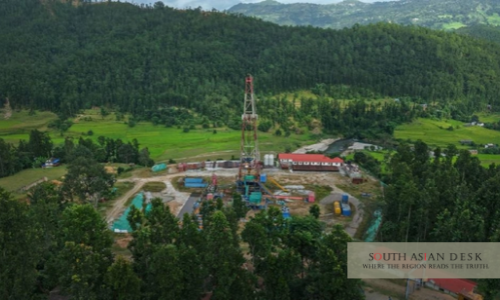
The project reached a drilling depth of 4,013 metres at Jaljale, in Bhairavi Rural Municipality of Dailekh district, after geological, seismic and geochemical studies identified the site as a potential gas reserve. Analysis of samples collected during drilling put the natural gas reserve in Jaljale at 80.7 billion cubic metres. That figure is lower than an earlier preliminary estimate of up to 112 billion cubic metres, which was announced in June 2025 before the final report was completed.
The department has described the site as the deepest exploration well in Nepal’s history. During drilling, around 50 gas samples were collected from nine geological intervals, and more than 3,000 rock cuttings were sent to China for laboratory analysis, according to earlier reporting. Officials have also said that more than 90 percent of the gas is methane.
How the Project Developed
The project grew out of a bilateral understanding between the prime ministers of Nepal and China in 2016, followed by a preliminary study by the Department of Mines and Geology and a Chinese technical team. In 2019, the department signed a formal agreement worth about Rs2.4 billion with the China Geological Survey for exploration and drilling. The exploration has been described as a pilot project supported by Chinese financial and technical assistance. The China Geological Survey carried out the geological surveys, while the Chinese state-owned company CNPC Xibu Engineering Company conducted drilling from May 2023.
Locals in Dailekh had long reported natural gas and oil-like substances seeping from the ground, but formal exploration began only in recent years. The China Geological Survey later submitted its final report to the Department of Mines and Geology, which gave the figure of 80.7 billion cubic metres.
Why Commercial Production of Natural Gas Remains Uncertain
A confirmed estimate of the reserve does not mean the gas can be produced at a profit. The Department of Mines and Geology said further testing is needed to determine the gas’s quality, pressure, flow capacity and overall economic viability. Those factors decide how much of the gas can actually be extracted and at what cost.
The second phase of the project has also yet to begin, because the follow-up agreement with the China Geological Survey has not been finalised. Officials have not said when it is expected to be signed, or who will fund the next stage. The funding question matters, since the first phase was supported by China and the later stages would likely require far larger investment.
Possible Benefits and Open Questions
If commercial production proves feasible, officials say the gas could be used for cooking fuel, industrial operations and electricity generation, and could reduce Nepal’s dependence on imported energy. The potential appeal is clear in a country that relies on imports for its cooking gas. The Himalayan Times has also reported localised LPG shortages in the Kailali and Rautahat districts in recent days.
The same officials caution that substantial investment in processing, storage and distribution infrastructure would be needed before households or industry could use the gas. Earlier reports based on the higher preliminary estimate suggested that the reserve could meet Nepal’s gas demand for decades. Those projections rested on a larger figure than the one now confirmed, so the lower estimate and the pending flow tests may change them.
What Comes Next
The immediate steps are the additional technical tests and a decision on the second-phase agreement with China. Until the tests show how much gas can flow and at what pressure, the economic case will remain unproven, and it is unclear how long that will take. The government will also need to decide how the project would be financed, how the gas would reach consumers and which uses should come first.
For now, the Dailekh gas exploration has established that natural gas exists in commercially interesting quantities in Jaljale, but whether it can become a dependable domestic energy source depends on results that have yet to be produced.
Follow SouthAsianDesk on X, Instagram and Facebook for insights on business and current affairs from across South Asia.