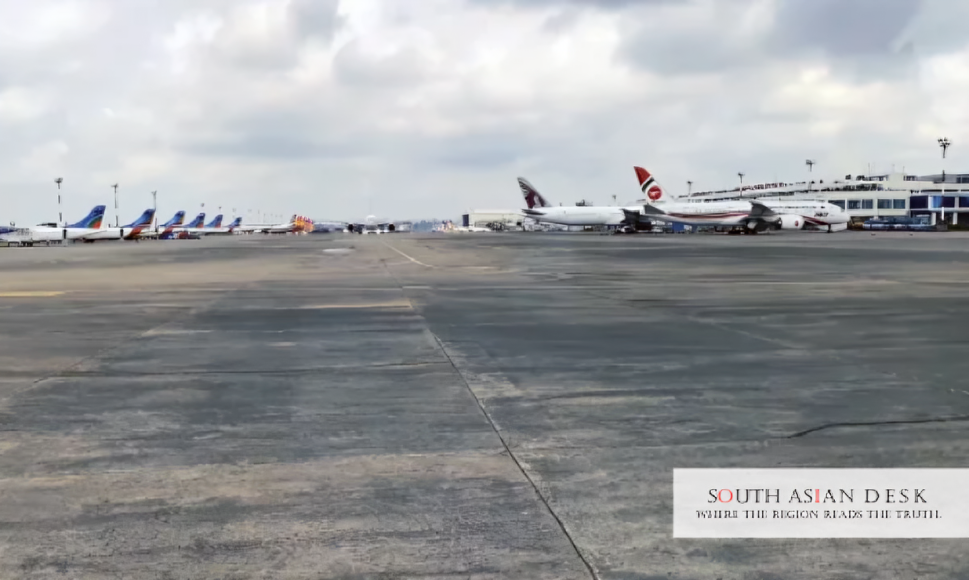
Dhaka airport satellite disruption exposes vulnerabilities in Bangladesh’s aviation infrastructure, with air traffic without satellite Bangladesh relying on backups amid ongoing VSAT interference Dhaka and heightened aviation safety Dhaka airport concerns during winter fog.
Dhaka’s Hazrat Shahjalal International Airport has operated its air traffic system without satellite connectivity for two months following unexplained interference, switching to fibre-optic links. Authorities from the Civil Aviation Authority of Bangladesh (CAAB) confirmed the shift on 5 January 2026, as investigations continue into the signal jamming that began in October 2025.
This Dhaka airport satellite disruption affects the nation’s busiest hub, which handles over 10 million passengers annually and serves as a key transit point for South Asian routes. In a region where aviation links economies like India, Nepal and Bhutan, such technical failures could delay cross-border trade and travel, amplifying costs during peak seasons.
Air Traffic Without Satellite Bangladesh: Operational Changes
CAAB shifted to fibre-optic internet cables after satellite signals faltered. Air Commodore Noor-e-Alam, CAAB’s air traffic management member, stated that operations proceed normally without immediate disruptions. The system, originally a backup, now handles all communications for take-offs, landings and ground movements.
The switch occurred after interference in the 4540-4546 MHz frequency band, allocated to the BS-1 satellite managed by Bangladesh Satellite Company Limited (BSCL). A joint team from the Bangladesh Telecommunication Regulatory Commission (BTRC) and BSCL detected brief signal peaks during a field analysis on 20 October 2025 but failed to pinpoint the source.
Without satellite redundancy, air traffic without satellite Bangladesh leaves the system prone to failures from cable cuts or power outages, common in the region. Aviation experts note that major airports maintain multiple layers, satellite, fibre, microwave for resilience. Dhaka’s current setup deviates from this standard, potentially straining controllers during high-traffic periods.
Data from CAAB shows the airport managed 250 daily flights in December 2025, with no reported incidents tied to the disruption. However, the reliance on a single system raises questions about long-term stability.
VSAT Interference Dhaka: Probing the Cause
The VSAT interference Dhaka stems from unexpected signals obstructing the Very Small Aperture Terminal (VSAT) system used by CAAB. BTRC’s memorandum detailed a temporary obstruction, prompting the recommendation to alter the frequency band.
On 10 December 2025, BTRC issued a formal letter to BSCL’s managing director, copied to CAAB’s chairman, urging the change to prevent future issues. The latest internal note, dated 14 December 2025, confirms ongoing monitoring.
Air Commodore Noor-e-Alam described the problem as “satellite jamming” and assured resolution once the source is identified. Investigations involve spectrum analysis, but the intermittent nature of the signals has complicated tracing.
Similar interferences have affected other sectors in Bangladesh, though aviation-specific cases remain rare. BTRC’s spectrum monitoring branch leads the probe, with no timeline announced for completion.
Aviation Safety Dhaka Airport: Fog and Vulnerability Risks
Aviation safety Dhaka airport faces scrutiny amid the Dhaka airport satellite disruption, particularly with winter fog reducing visibility. Pilots rely on ground systems like Instrument Landing Systems and continuous controller communication during low-visibility operations.
If fibre-optic links fail during dense fog, flights could divert or suspend, experts warn. In December 2025, fog already caused diversions at the airport, including nine flights on 2 January 2026, four to Chattogram, four to Kolkata and one to Bangkok.
CAAB maintains that current measures suffice, but analysts argue for swift satellite restoration. “Fibre-optic cables are supposed to be backup, not the primary system,” an aviation analyst noted. Any dual failure could lead to closures, impacting thousands.
Regional comparisons show airports like Delhi and Kathmandu employ redundant systems to mitigate fog risks. Dhaka’s situation highlights needs for infrastructure upgrades, including enhanced spectrum security.
The disruption underscores broader South Asian challenges, where ageing systems meet growing demand. Bangladesh’s aviation sector grew 8% in 2025, per CAAB data, amplifying the stakes.
Background
Bangladesh’s aviation relies on satellite for secure, wide-area coverage, especially in varied terrain. The BS-1 satellite, launched in 2018, supports multiple services, including air traffic. Past interferences, like solar events in September 2025, disrupted TV and internet but spared aviation until this incident.
CAAB oversees 8 airports, with Dhaka handling 70% of traffic. Investments in fibre backups followed global standards, but the prolonged Dhaka airport satellite disruption reveals gaps in preparedness.
What’s Next
Authorities aim to restore satellite connectivity by changing frequencies, as BTRC recommended. CAAB plans enhanced monitoring and potential international consultations for jamming detection. Until resolved, air traffic without satellite Bangladesh continues, with close watch on aviation safety Dhaka airport during fog-prone months.
The Dhaka airport satellite disruption resolution will shape future policies, ensuring robust systems for regional connectivity.
Published in SouthAsianDesk, January 5th, 2026
Follow SouthAsianDesk on X, Instagram and Facebook for insights on business and current affairs from across South Asia.