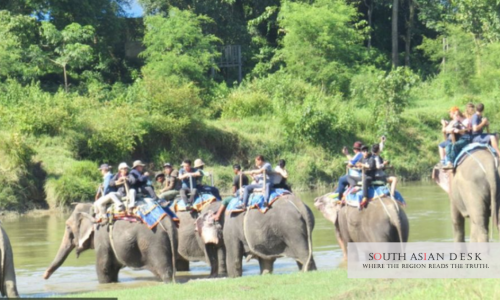
Elephant safaris in Chitwan are facing an uncertain future after Nepal’s Supreme Court directed authorities to explore alternatives to the decades-old activity, setting off a debate among tourism entrepreneurs, conservationists and elephant owners over how a transition to more ethical wildlife tourism in Nepal could reshape the local economy. The ruling, published on the court’s website last Thursday, has shifted attention in Sauraha, the country’s largest wildlife tourism hub bordering Chitwan National Park, from routine crowd management concerns to the very survival of one of its most recognisable attractions.
The Supreme Court elephant welfare ruling stems from a writ petition filed on September 14, 2021, by animal rights advocates including Sanjay Adhikari of the Forum for Protection of Public Interest, known as Pro Public. The petition sought stronger legal protection for elephants, calling for an end to practices considered cruel, proper documentation of ownership transfers, action against illegal trade, restrictions on prolonged chaining and a broader shift away from using elephants for rides. The court issued its verdict on December 17, 2025, with the full sixty-two-point order, passed by a joint bench of Justices Hari Prasad Phuyal and Tek Prasad Dhungana, made public only last week.
Supreme Court Elephant Welfare Ruling Targets Sauraha Elephant Rides
Point 48 of the order states that allowing tourists to ride elephants must be reconsidered from an animal welfare perspective and that alternative approaches should be adopted, noting that an elephant’s spine, legs and body structure were not naturally designed to carry human weight. Point 51 goes further, suggesting that Sauraha elephant rides be replaced with alternatives such as guided “elephant walks” and “elephant bushwalks” that allow visitors to observe elephants without riding them. At the same time, the court acknowledged the economic importance of elephant safaris in Chitwan, recognising their role in generating income, promoting tourism and creating local employment.
For decades, elephant safaris in Chitwan have ranked among the principal draws for visitors to Chitwan National Park and its surrounding buffer zones, with tourists riding elephants through grasslands and forest to spot rhinos, deer and wild boar. Elephant rides have not been permitted inside the national park itself for nearly fifteen years, meaning the activity is now confined to community forests along its edges, all operated using privately owned, domesticated elephants rather than government-owned animals.
Economic Stakes Behind Chitwan National Park Tourism
The financial stakes attached to Chitwan National Park tourism are considerable for the communities that rely on it. The Baghmara Buffer Zone Community Forest, which covers just 215 hectares on the outskirts of Sauraha, generated around thirty million rupees annually at its peak, according to former chairman Jitu Lama Tamang, with nearly a third of that revenue coming directly from elephant safaris. Seven or eight community forests surrounding the park depend heavily on similar income, and stakeholders warn that any abrupt end to elephant safaris in Chitwan without viable alternatives could hit hotels, guides, transport operators and the wider tourism economy.
Bhuwaneshwar Prasad Chaudhary, chairman of the Baghmara Buffer Zone Community Forest, said demand for Sauraha elephant rides has held up better among certain visitor groups even as overall interest declines. “Chinese tourists have a strong interest in elephant safaris,” he said, adding that European visitors now rarely take elephant rides and that Nepali tourists seldom repeat the experience.
A Cautious Path Toward Ethical Wildlife Tourism in Nepal
Conservationists broadly welcome the shift toward ethical wildlife tourism in Nepal, arguing that jeep safaris, guided jungle walks, canoe trips and birdwatching can offer rewarding experiences without relying on elephant rides. Dipendra Khatiwada, chairman of the United Elephant Operation Cooperative, which manages most of the elephants used in Sauraha, said operators would respect the court’s directive but cautioned against a sudden transition, noting that his cooperative’s elephant numbers have already fallen sharply from around sixty-three before the pandemic to thirty today, with the remainder operating independently.
Tourism entrepreneur Hari Bhakta Ghimire, who has run elephant safaris in Chitwan since the early 1980s, said the tradition predates the national park itself and should not be assessed solely through the lens of animal welfare. Others, including resort owner and conservationist Basu Dhungana, argue the move away from elephant rides is becoming inevitable as global tourism increasingly favours ethical wildlife experiences over direct animal contact.
Bed Kumar Dhakal, spokesperson for the Department of National Parks and Wildlife Conservation, said the government would work to implement the court’s directives while balancing them against the practical concerns of elephant owners and mahouts, including questions over grazing land and the long-term care of domesticated elephants that may no longer be used for tourism.
Chitwan National Park attracts roughly 300,000 domestic and international visitors each year, and officials say the challenge now is designing a transition plan for elephant safaris in Chitwan that protects animal welfare without undermining a tourism economy that entire communities around Sauraha continue to depend on.
Published in SouthAsianDesk, July 21, 2026
Follow SouthAsianDesk on X, Instagram and Facebook for insights on business and current affairs from across South Asia.