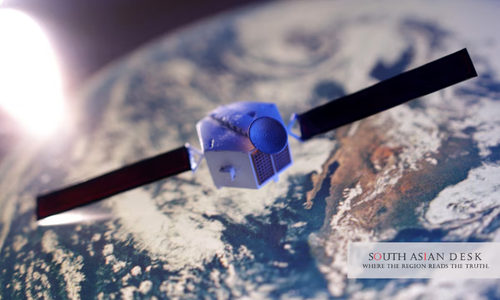
The GalaxEye satellite imaging patent granted this week in the United States has made the Bengaluru based company the first Indian space startup to hold a US patent specifically for satellite imaging technology. The company announced on Tuesday that the patent covers the core architecture behind its OptoSAR imaging system, which allows optical and radar sensors to work together on a single spacecraft.
According to GalaxEye, the patent protects the method used to align and synchronise optical and microwave sensors so that both can capture data at the same time, from the same location and in a matched frame of reference. This synchronisation is the technical foundation of OptoSAR, which merges the strengths of two very different observation methods into one platform. The same underlying technology has already been patented in India, and the US award extends that protection into one of the world’s largest markets for space technology and defence procurement.
What the GalaxEye Satellite Imaging Patent Covers
Optical sensors capture visual and spectral detail but are limited by cloud cover and darkness, while Synthetic Aperture Radar can observe the Earth’s surface through clouds and at night using radar signals rather than visible light. Combining the two on a single satellite has long been considered technically difficult because the sensors typically operate on different timings and viewing geometries. The GalaxEye satellite imaging patent addresses that problem directly, covering the system that keeps both sensors spatially and temporally aligned during a single pass.
This capability was first demonstrated in orbit through Mission Drishti, GalaxEye’s debut satellite, which launched on 3 May 2026 and was described by the company as the world’s first OptoSAR imaging satellite. At roughly 190 kilograms, Drishti was also India’s largest privately built Earth observation satellite at the time of its launch, combining multispectral imaging with SAR on a single spacecraft.
Building Toward a Larger Constellation
GalaxEye has said the newly granted patent strengthens its intellectual property position as it works toward a planned constellation of 30 satellites over the next five years. The company has described a growing commercial pipeline spanning domestic and international customers, with the eventual network intended to serve defence, government and commercial applications including national security, agriculture, infrastructure, insurance, maritime intelligence and disaster management.
To support that expansion, GalaxEye acquired Bengaluru based spacecraft engineering firm StarOps in August, a move the company said would strengthen its in-house capacity for building and operating satellites as it scales beyond a single spacecraft. Its stated roadmap includes next generation satellites, additional imaging payloads, and data processing capabilities that incorporate artificial intelligence.
It is worth noting that GalaxEye’s claim to being the first Indian startup to receive a US patent for satellite imaging technology is based on the company’s own statement and has not been independently verified against every space startup operating in the country. Even so, the patent fits a broader pattern of growth in India’s private space sector, which was opened to wider commercial participation under the 2023 Indian Space Policy, with IN-SPACe acting as the principal authority for licensing and promoting private space activity. Competition in the Earth observation segment has grown alongside this policy shift, with several Indian companies now developing their own imaging satellites and constellations.
For GalaxEye, the patent represents both a legal safeguard and a marketing milestone, giving the company a defensible position in a field where synchronised optical and radar imaging is likely to become increasingly valuable for governments and businesses seeking reliable, all weather Earth observation data.
Published in SouthAsianDesk, September 9th, 2026
Follow SouthAsianDesk on X, Instagram and Facebook for insights on business and current affairs from across South Asia.