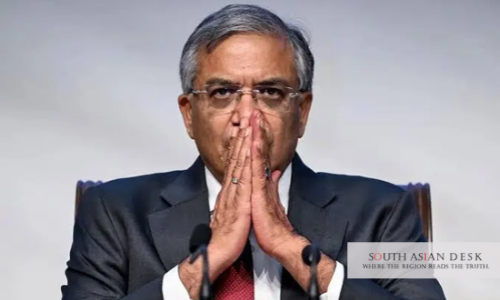
The Gyanesh Kumar suspension plea reached the Supreme Court of India on Monday, 5 October 2026, where a bench declined to pass an interim order against the Chief Election Commissioner and instead sought responses from the Centre and the Election Commission of India (ECI). The petitions allege that key decisions on the Special Intensive Revision (SIR) of electoral rolls were taken unilaterally, a claim the poll body disputes.
What the Bench Decided
The matter was heard by a bench of Chief Justice of India Surya Kant and Justices Joymalya Bagchi and V. Mohana. The court issued notice to the Union of India, the ECI, Chief Election Commissioner Gyanesh Kumar, Election Commissioners Sukhbir Singh Sandhu and Vivek Joshi, Deputy Election Commissioner Maneesh Garg and Director General (IT) Seema Khanna. It did not, however, restrain Mr Kumar from performing his functions.
Senior Advocate Vikas Singh, appearing for petitioner Rakesh Kumar Singh, urged the bench to suspend the Chief Election Commissioner immediately, arguing that the allegations went to the heart of the electoral process and could jeopardise citizens’ voting rights. The bench responded by asking who would conduct the elections in his absence. Mr Singh replied that the other two Election Commissioners could discharge those functions.
Why the Court Declined to Act on the Gyanesh Kumar Suspension Plea Without a Hearing
The bench’s reasoning rested largely on evidence and procedure. Mr Singh argued that an ECI press release effectively amounted to an admission of the allegations carried in news reports. The Chief Justice responded that the court could not pass an order solely on the strength of newspaper reports, and the bench indicated that authenticated information should first be placed before it. Justice Bagchi observed that the court could hardly grant such relief without hearing the Commission, adding that if the records ultimately showed the decisions were not unanimous, they could be declared ultra vires.
The Chief Justice also stressed that the statutory framework governing the Commission is mandatory and that any violation would be undone. In a related clarification, he stated that the Supreme Court had not approved the modified Form 6.
The Allegations Behind the Petitions
The principal petition contends that Article 324 of the Constitution vests the superintendence, direction and control of elections in the Commission as a body, and not in the Chief Election Commissioner alone. It also relies on Section 18 of the 2023 law governing the appointment and conditions of service of Election Commissioners, which provides for decisions to be taken unanimously or, where there is disagreement, by majority.
The plea draws on written communications and file notings attributed to Mr Sandhu and Mr Joshi, which allegedly record at least 14 objections between October 2025 and August 2026 to steps taken in the name of the ECI without their approval. It seeks a writ of quo warranto, preservation and production of the Commission’s records, and an independent inquiry led by a retired Supreme Court judge. A connected petition by advocate Shailendra Mani Tripathi seeks the quashing of the 14 decisions and also received notice.
The Election Commission’s Position
The ECI has maintained that its decisions, including those relating to the SIR exercise, were unanimous and taken with the approval of all three Commissioners. It has described differences raised during internal deliberations as part of the normal functioning of a multi-member constitutional body, and has said that communications sent by Mr Sandhu and Mr Joshi to the Cabinet Secretary concerned an officer on deputation, not policy or IT matters.
What Happens Next
Notice has been issued, and the respondents are now expected to file their replies. The outcome of the Gyanesh Kumar suspension plea will depend largely on what the Commission’s records reveal about how the disputed decisions were made. Notably, the Constitution provides that the Chief Election Commissioner may be removed only in the manner and on the grounds applicable to a Supreme Court judge, which sets a demanding standard for any petitioner seeking drastic relief. Hence, the coming hearings are likely to focus less on public controversy and more on the internal record of a constitutional body whose credibility is central to the electoral process.
Follow SouthAsianDesk on X, Instagram and Facebook for insights on business and current affairs from across South Asia.