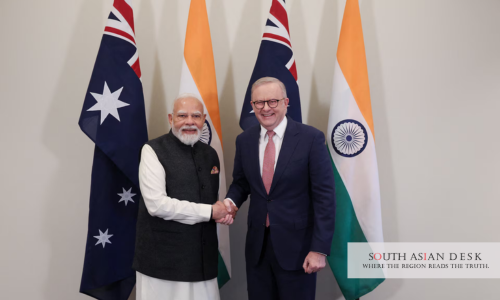
Indian Prime Minister Narendra Modi met his Australian counterpart Anthony Albanese in Melbourne on Thursday, with the long-anticipated India Australia uranium deal expected to headline a wide-ranging agenda that also covered trade, defence and regional security. The visit marks Modi’s first trip to Australia since 2023 and comes as both nations look to deepen ties amid shifting global supply chains and growing energy demands.
Modi arrived in Melbourne on Wednesday night to a red-carpet reception, having travelled from Indonesia, where he had earlier signed a series of agriculture and defence agreements. He was received by senior Australian officials and honoured with a ceremonial guard of honour before addressing local business leaders and members of the Indian diaspora.
Uranium Exports Expected to Be Finalised
According to a report in the Australian Financial Review, an agreement on uranium exports to India could be finalised during Modi’s visit, a development that would mark a significant breakthrough in a process that has moved slowly for more than a decade. India and Australia signed a Civil Nuclear Cooperation Agreement in 2014, but the actual export of uranium has remained limited, largely due to concerns over ensuring that nuclear fuel supplied to India is used solely for peaceful purposes such as power generation.
Speaking to reporters ahead of the summit, Albanese declined to confirm the details of any pending agreement but indicated that announcements were imminent. He said discussions with India had been constructive and that a range of joint announcements would follow his meeting with Modi.
For New Delhi, securing a reliable uranium supply has taken on renewed urgency. India is targeting 100 gigawatts of nuclear energy capacity by 2047, a goal tied closely to its ambitions of becoming a major hub for artificial intelligence data centres, which require substantial and consistent power capacity. Government sources in New Delhi have indicated that while no final agreement has yet been signed, recent negotiations have been described as forward-looking, with officials expressing confidence that a resolution is close.
Modi Albanese Meeting Extends Beyond Energy
While uranium supply has attracted the most attention, the Modi Albanese meeting is expected to touch on a considerably broader set of priorities. The two leaders were scheduled to co-chair the third Annual Summit between the countries, a forum established to review progress on the Australia-India Comprehensive Strategic Partnership and identify new areas of cooperation.
Officials from both governments have signalled that India Australia defence cooperation will also feature prominently. According to reporting from New Delhi, the two sides are preparing to renew and upgrade the 2009 Joint Declaration on Defence and Security Cooperation. A Maritime Security Collaboration Roadmap is also expected to be finalised, covering the exchange of white shipping information, meaning advanced data on the identity and movement of commercial, non-military vessels operating in the region.
Trade and investment featured heavily in Modi’s public remarks. Speaking at an Australia-India economic roadmap event in Melbourne, Modi described the relationship between the two countries as offering “historic opportunities” for cooperation in nuclear and renewable energy, as well as in green hydrogen. He suggested that Australian technology, capital and natural resources could help accelerate India’s energy transition, and pointed to potential cooperation on low-carbon aluminium projects. Modi also urged Australian business leaders to consider long-term investment in India’s road, port, rail and urban infrastructure.
Critical Minerals Partnership Gains Momentum
Alongside uranium and defence, a critical minerals partnership between the two countries is expected to be a key outcome of the visit. Australia holds substantial reserves of lithium, rare earths and other minerals essential to clean energy technology and advanced manufacturing, resources that India is eager to secure as it looks to reduce its dependence on a small number of overseas suppliers.
Albanese, addressing the same business event, praised Modi’s role in strengthening bilateral ties, describing him as a “living bridge” between Australia and India. He said Modi’s vision had helped reshape the roadmap for Australia’s economic engagement with India, a relationship that has grown steadily since the two countries elevated it to a Comprehensive Strategic Partnership.
India is currently Australia’s fifth-largest trading partner, behind China, Japan, the United States and South Korea. The relationship is also underpinned by a substantial diaspora connection, with close to one million people in Australia identifying as being of Indian ancestry. For Canberra, deepening trade ties with India forms part of a broader strategy to diversify its export markets and reduce reliance on China, which remains its largest trading partner.
Diaspora Event and Security Measures
Modi’s itinerary in Melbourne included a planned address to thousands of members of the Indian community at one of the city’s largest sports stadiums on Thursday evening. Australian authorities tightened security around the venue following reports of planned protests, according to local media, though officials did not disclose further details on the nature of the threat.
The formal bilateral talks between Modi and Albanese, along with any accompanying joint statement on the India Australia uranium deal, were scheduled to take place later on Thursday, following the leaders’ respective public engagements earlier in the day.
What Comes Next
Should the uranium agreement be confirmed, it would represent one of the most consequential developments in the Australia-India Comprehensive Strategic Partnership since the two countries first agreed to civil nuclear cooperation in 2014. Combined with progress on defence cooperation, maritime security and critical minerals, the outcomes of Modi’s Melbourne visit are likely to shape the trajectory of the bilateral relationship for years to come, particularly as both nations navigate an increasingly complex Indo-Pacific security environment and seek to reduce economic dependence on China.
Neither government had issued a formal joint statement at the time of writing, though both sides indicated that further announcements were expected once the leaders concluded their formal talks.
Published in SouthAsianDesk, July 9, 2026
Follow SouthAsianDesk on X, Instagram and Facebook for insights on business and current affairs from across South Asia.