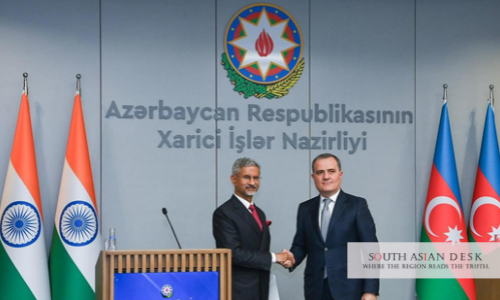
India-Azerbaijan ties received fresh political attention on Friday, October 23, when External Affairs Minister S. Jaishankar met Azerbaijani President Ilham Aliyev and Foreign Minister Jeyhun Bayramov in Baku. The visit was widely described as an attempt to rebuild a relationship that has been strained by differences over regional and security issues.
A Visit Following Up on the Bishkek Meeting
The trip follows a meeting between Prime Minister Narendra Modi and Mr. Aliyev on the sidelines of the Shanghai Cooperation Organisation summit in Bishkek last month. MEA spokesperson Randhir Jaiswal said Mr. Jaishankar’s visit was a follow-up to that encounter and was aimed at discussing how to take the bilateral relationship forward. Mr. Jaishankar also conveyed the greetings of President Droupadi Murmu and Mr. Modi to the Azerbaijani leader.
According to The Tribune, it was the first bilateral visit to Azerbaijan by an Indian external affairs minister in eight years. Mr. Jaishankar had last been in Baku in October 2019, as reported by The Morning Voice. Mr. Aliyev, in an official readout, expressed appreciation for the visit, which was made on the instructions of Mr. Modi.
Talks Cover Trade, Energy and Connectivity
In his discussions with Mr. Bayramov, the External Affairs Minister reviewed a broad agenda. Azerbaijan’s foreign ministry said the talks covered political dialogue, trade, investment, energy, transport, tourism, education, science and cultural cooperation. Mr. Jaishankar said the two countries should deepen their existing energy partnership while exploring new areas of investment and economic cooperation.
Energy and connectivity featured prominently. The ministers examined opportunities linked to the East-West and North-South transport corridors, the Baku-Tbilisi-Kars railway, the Port of Baku and the Alat Free Economic Zone. For India, the International North-South Transport Corridor is a strategic route that links the Indian Ocean to Russia and Europe through Iran and the Caucasus, which gives Baku a natural role in India’s connectivity planning.
Indian energy interests in Azerbaijan are already considerable. ONGC Videsh Ltd holds stakes in the Azeri-Chirag-Gunashli oil and gas fields and in the Baku-Tbilisi-Ceyhan pipeline, with investments reported to exceed 1.2 billion dollars.
Security and Regional Issues on the Table
Mr. Jaiswal said terrorism, security and common threats were among the subjects discussed. He described the talks with Mr. Bayramov as productive and said both sides agreed that they must cooperate to enhance peace, prosperity and security for their people. The two ministers also exchanged views on regional and global developments.
The MEA welcomed the peace agreement signed between Azerbaijan and Armenia, a point Mr. Jaishankar also highlighted at his press conference, according to OC Media. Neither government has publicly detailed the specific differences that had weighed on the relationship, though reports have referred to them in general terms as disagreements over regional and security matters.
Gratitude for Help During the Iran Evacuations
The External Affairs Minister also thanked Azerbaijan for assisting in the evacuation of Indian nationals, particularly students, from Iran earlier this year. Azerbaijan’s land border with Iran made it a useful transit route during the regional conflict, and the gesture was cited as a sign of goodwill that both sides could build on. Mr. Jaishankar invited Mr. Bayramov to visit India, though no dates have been announced.
India-Azerbaijan Ties: Why the Reset Matters
The visit comes as India seeks to expand its links across the Caucasus and Central Asia, where transport and energy projects are reshaping trade routes. Cultural understanding between the two countries, which Mr. Jaiswal described as a strong base, could help sustain momentum if political contacts continue.
Observers will now watch whether the high-level engagement produces concrete outcomes, such as new investment commitments or progress on transport links. A return visit by Mr. Bayramov to New Delhi would be an early indicator of whether the revived dialogue is taking firm shape.
Follow SouthAsianDesk on X, Instagram and Facebook for insights on business and current affairs from across South Asia.
Read More: