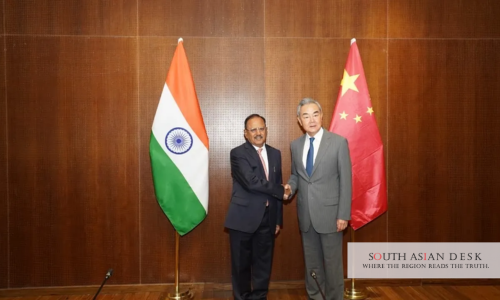
India China ties showed further signs of cautious stabilisation after National Security Adviser Ajit Doval met Chinese Foreign Minister Wang Yi in New Delhi on Monday, June 22, 2026, on the sidelines of the BRICS National Security Advisers’ meeting.
India’s Ministry of External Affairs said the two sides reviewed recent developments in bilateral relations and noted progress toward “gradual normalisation”. The talks were described by New Delhi as “constructive and forward-looking”, signalling continued efforts by both countries to manage tensions after years of strain along the Line of Actual Control.
India China Ties Reviewed During BRICS Meeting
Doval met Wang, who is also a member of the Political Bureau of the Communist Party of China, during the two-day BRICS security meeting hosted by India in New Delhi from Monday, June 22, 2026, to Tuesday, June 23, 2026.
According to India’s official account, Doval said stable, predictable and constructive bilateral relations would help build trust and better understanding between the two sides.
The meeting was not presented as a breakthrough. Instead, it appeared to reflect a step-by-step diplomatic effort to stabilise relations while unresolved issues, especially the boundary question, remain on the table.
LAC Situation Remains Central To Talks
Indian reports said Doval and Wang also reviewed the situation along the Line of Actual Control, where the 2020 Galwan Valley clash had pushed relations to their lowest point in decades.
The relationship began improving after India and China reached arrangements in 2024 to reduce friction in eastern Ladakh. Since then, both sides have gradually resumed political, diplomatic and people-to-people contacts.
However, normalisation remains limited. India has repeatedly linked wider bilateral recovery to peace and stability along the border, while China has generally urged that the boundary issue should not define the entire relationship.
Wang Yi Visit Comes Under BRICS Framework
China’s Foreign Ministry had earlier confirmed that Wang would attend the 16th BRICS National Security Advisers and High Representatives meeting at Doval’s invitation.
At a briefing on Thursday, June 18, 2026, Chinese Foreign Ministry spokesperson Lin Jian said Beijing expected to exchange views with BRICS members on international security, regional issues and conventional and non-conventional security challenges.
The BRICS security meeting has also provided India with a platform for bilateral engagement with several countries, including China, Iran and Brazil, at a time of wider global instability.
Gradual Thaw But No Full Reset
The latest Doval-Wang meeting adds to a series of high-level contacts between India and China since the border disengagement process gained momentum.
The thaw has included revived diplomatic mechanisms, discussions on direct air links, the resumption of some religious travel and efforts to expand limited people-centric exchanges. Still, the relationship remains cautious and heavily conditioned by security concerns.
A detailed Chinese readout of the Doval-Wang bilateral meeting had not been publicly located at the time of writing.
Background
India-China relations deteriorated sharply after the June 2020 Galwan Valley clash in eastern Ladakh, where soldiers from both sides were killed. The confrontation led to a prolonged military standoff, restrictions on Chinese apps and investments in India, and a wider freeze in political trust.
The two countries have since pursued disengagement and de-escalation through military commander-level talks, diplomatic channels and the Special Representatives mechanism on the boundary question.
India and China remain major Asian powers with deep trade links, but their relationship is shaped by border disputes, strategic competition, technology restrictions, regional influence and their respective ties with the United States, Russia and other partners.
What’s Next
The immediate focus will be whether the BRICS meeting leads to further bilateral contact between Indian and Chinese officials.
The broader test is whether both sides can move from limited stabilisation to more durable confidence-building, especially along the Line of Actual Control. Trade, travel and multilateral cooperation may improve gradually, but the boundary issue remains the central constraint.
For now, India China ties appear to be moving toward managed normalisation, but not a full reset.
Published in SouthAsianDesk, June 23, 2026
Follow SouthAsianDesk on X, Instagram and Facebook for insights on business and current affairs from across South Asia.