India’s new exam leak penalties mark one of the most significant reforms to the country’s examination system in years. On Thursday, the upper house of India’s parliament, the Rajya Sabha, passed a bill that doubles the maximum prison sentence for those convicted of leaking examination papers to ten years and raises the maximum fine to more than one million dollars. The legislation had already cleared the lower house a day earlier and was approved by voice vote after hours of debate.
The bill now awaits the signature of President Droupadi Murmu before it becomes law. Prime Minister Narendra Modi’s cabinet approved the tougher punishments last week, responding to weeks of mass unrest that culminated in the resignation of Education Minister Dharmendra Pradhan.
Why India Introduced Tougher Exam Leak Penalties
Speaking in the Rajya Sabha, junior minister Jitendra Singh, who had negotiated directly with student protesters, said the issue touched every family in the country. He described young people preparing for competitive exams as the nation’s greatest investment, arguing that every parent and citizen has a stake in protecting the integrity of the examination system.
Exam paper leaks have long been a recurring problem across both national and state-level examinations in India, despite repeated government crackdowns over the years. The latest scandal centered on the National Eligibility cum Entrance Test, commonly known as NEET, the fiercely competitive exam that serves as the gateway to admission at India’s medical colleges. Indian media reported this week that the country’s federal investigative agency had charged 13 people with a range of crimes connected to the leak of the national medical college entrance test earlier this year, a controversy that helped ignite the broader youth protests.
The Cockroach Party Protests That Forced Reform
The push for stricter exam leak penalties in India cannot be separated from the youth-led movement that made it politically unavoidable. The protests were spearheaded by an online movement called the Cockroach Janta Party, or CJP, a satirical group founded by Abhijeet Dipke after India’s Chief Justice reportedly referred to unemployed young people as “parasites” and “insects” during a court hearing in May 2026. The remark, widely seen as derogatory, spread quickly online and gave the movement both its name and its momentum.
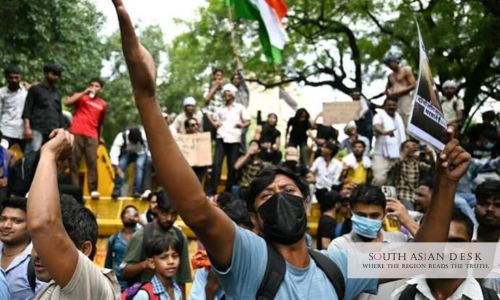
What began in early June as a small gathering of students at Jantar Mantar in New Delhi grew into a seven-week standoff that drew support from student unions across the country, including the Students Federation of India and the All-India Students Association. The protest gained national attention after climate activist Sonam Wangchuk joined in late June and began an indefinite hunger strike, a stand he maintained for 26 days before breaking his fast on assurances that the government would hold exam authorities accountable.
Demonstrations against the paper leaks turned violent in New Delhi on July 20, when large crowds attempted to march toward parliament. Police responded with tear gas and batons, triggering clashes and a wave of detentions that only intensified public anger and drew even larger crowds to protest sites across more than a dozen cities.
Minister’s Resignation and the Path to New Legislation
The pressure eventually proved too great for the government to withstand. Dharmendra Pradhan announced his resignation on social media on Saturday, July 25, after talks with CJP representatives, meeting the movement’s central demand. His departure triggered scenes of celebration among protesters who had occupied the Jantar Mantar site for weeks, with organizers calling on demonstrators to return home once the resignation was confirmed.
Within days, Modi’s cabinet moved to approve the stricter exam leak penalties that parliament has now passed into law, a rare example of sustained youth protest translating directly into concrete legislative change in India. Whether the doubled prison terms and steeper fines will be enough to deter future leaks remains an open question, but the new law represents the government’s clearest attempt yet to respond to years of frustration over a system that millions of students depend on every year.
Published in SouthAsianDesk, July 31st, 2026
Follow SouthAsianDesk on X, Instagram and Facebook for insights on business and current affairs from across South Asia.