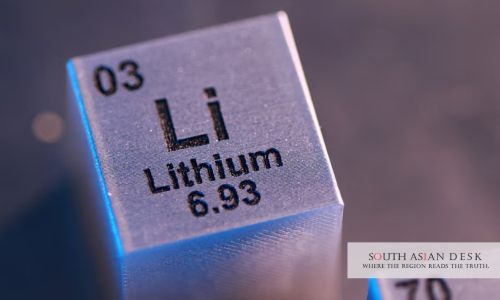
India lithium incentives are expected to be announced soon by the Ministry of Mines in New Delhi, with an outlay of around INR 30 billion to support domestic lithium and nickel processing for electric vehicle and clean energy supply chains, according to people familiar with the plan.
India lithium incentives linked to critical minerals policy
India is preparing to roll out a new incentive scheme for processing lithium and nickel, two minerals central to electric vehicle batteries and clean energy technologies, as part of a broader push to build domestic critical mineral capacity.
The proposed scheme is expected to carry an outlay of around INR 30 billion, equivalent to about USD 313 million at the exchange rate cited in market reporting.
The Ministry of Mines has not yet publicly released the final policy document. The reported proposal comes under India’s wider National Critical Mineral Mission, which was approved by the Union Cabinet on Wednesday, January 29, 2025, with government expenditure of INR 163 billion over seven years, from FY 2024-25 to FY 2030-31.
The mission aims to secure long-term supplies of critical minerals and strengthen India’s value chains across exploration, mining, beneficiation, processing and recovery from end-of-life products.
Lithium and nickel are especially important for battery manufacturing. India is trying to scale up electric vehicle adoption while reducing exposure to imported raw materials and overseas refining capacity, much of which is concentrated outside the country.
Proposed support for lithium and nickel processing
The planned incentive scheme is expected to support companies setting up domestic processing plants for lithium and nickel. Earlier policy discussions indicated that eligible lithium processing plants may need a minimum capacity of 30,000 metric tonnes, while nickel plants may need at least 50,000 metric tonnes.
The exact form of support has not been officially confirmed. Earlier discussions around the scheme included a possible capital subsidy for eligible investments in processing projects, but the final rate, caps and qualifying conditions remain to be verified.
Officials have previously said India is working on an incentive framework for processing critical minerals. The Ministry of Mines has also listed “fiscal incentives” and an “incentive scheme for processing of critical minerals to fill the gaps in value chain” among the way-forward items under the National Critical Mineral Mission.
The government’s official critical minerals documents also refer to possible measures such as tax holidays, concessional tax treatment, accelerated depreciation and deductions for scientific research expenditure. However, it is not yet clear which, if any, of these measures will form part of the lithium and nickel processing package.
India lithium incentives and EV supply chain security
The proposed India lithium incentives come as the country tries to strengthen the domestic electric vehicle ecosystem from raw materials to battery cells and finished vehicles.
India has set ambitious targets for electric mobility, including 30 percent electric car penetration and 80 percent electric two-wheeler penetration by 2030. Current adoption remains lower, making battery material security a major industrial and policy concern.
Lithium and nickel are used in several battery chemistries, including those designed for higher energy density. Without local processing capacity, battery manufacturers remain dependent on imported refined material, exposing them to price shocks, export controls, shipping disruptions and geopolitical risks.
The government has already taken steps to support battery and critical minerals supply chains. In Union Budget 2025-26, customs duties on waste and scrap of critical minerals and related materials were eliminated to provide more feedstock to India’s recycling sector and help domestic secondary producers compete globally.
The National Critical Mineral Mission also includes INR 15 billion for incentives for setting up recycling facilities. Separately, INR 1 billion has been approved during the mission period for pilot projects to recover critical minerals from overburden, mine tailings, fly ash and red mud through new methods.
Processing gap remains a strategic concern
India has limited domestic reserves and processing capacity for many battery minerals. While it has intensified exploration and overseas acquisition efforts, the processing stage remains one of the weakest links in the supply chain.
The Ministry of Mines’ mission material describes critical mineral value chains as covering exploration, mining, beneficiation, processing, recycling, research and development, trade and markets, and skills. It also notes the need to involve the private sector and use institutional financing to support processing parks and critical mineral projects.
For Indian manufacturers, local processing could reduce dependence on imported refined material and make it easier to integrate with battery cell, electric vehicle and renewable energy supply chains.
For investors, the proposed support may create opportunities in refining, precursor material production, recycling, industrial parks and technology partnerships. However, the economics will depend on the final incentive design, raw material access, environmental approvals, power costs and long-term offtake contracts.
Background
India approved the National Critical Mineral Mission in January 2025 to build a more secure and resilient supply chain for minerals needed in clean energy, defence, electronics and advanced manufacturing.
The mission is intended to support domestic exploration, overseas mineral asset acquisition, recycling, research and development, skills and processing. The government has also moved to remove or reduce customs duties on several critical minerals and related inputs.
Critical minerals have become a central issue for industrial policy because global supply chains are concentrated in a small number of countries. Lithium, nickel, cobalt, graphite and rare earth elements are all exposed to trade, investment and geopolitical risks.
India’s planned lithium and nickel processing support appears designed to address the midstream gap between mineral supply and battery manufacturing, where local capacity remains limited.
What’s next
The Ministry of Mines is expected to issue the final policy framework after inter-ministerial approval and budgetary clearance. Companies will then need clarity on eligibility, subsidy structure, timelines, environmental requirements, technology standards and whether imported raw material can qualify for processing incentives.
The India lithium incentives plan will be closely watched by battery makers, electric vehicle companies and global mineral suppliers as New Delhi tries to convert its critical minerals mission into domestic processing capacity.
Published in SouthAsianDesk, June 4, 2026
Follow SouthAsianDesk on X, Instagram and Facebook for insights on business and current affairs from across South Asia.