India Nepal relations are entering a new phase as New Delhi moves swiftly with aid and reconstruction grants after the devastating floods that struck Nepal earlier this year. The effort comes as Prime Minister Balendra Shah’s Gen Z-backed government faces its biggest test since taking power, and as India seeks to regain influence it has gradually lost to China over the past decade.
A Record Package for Nepal Flood Reconstruction
India was the first foreign government to respond to one of the worst disasters recorded in Nepal, which struck in August. It sent relief supplies and helped restore communications in the affected areas. On Monday, New Delhi followed with a package of grants and credit worth $1.62 billion, intended for reconstruction, infrastructure and energy projects.
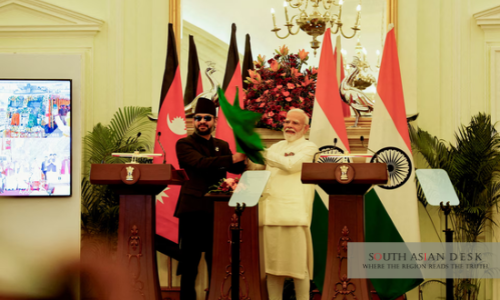
The package was announced when Prime Minister Balendra Shah visited New Delhi and met Prime Minister Narendra Modi at Hyderabad House. The 36-year-old leader took office in March, and the trip was his first bilateral visit abroad since then. Nepal’s Minister for Foreign Affairs, Shisir Khanal, said in a statement that the package was the largest financial assistance the country had ever received.
The scale of the need explains the weight of the offer. Nepal requires about $5 billion to rebuild damaged infrastructure, a sum equal to nearly a tenth of its economy. According to Nepali government data, Indian aid disbursement to Nepal was more than four times higher than that of China in the 2024-25 fiscal year, which ended in mid-July.
Why India Nepal Relations Became Strained
The relationship had frayed considerably over the past decade. Border disputes soured the mood, as did resentment over a blockade in 2015 that crippled fuel and other supplies. Many Nepalis blamed New Delhi for the blockade, although India has denied it was responsible.
Landlocked Nepal sits in the Himalayas between China and India, and the two Asian powers have competed for influence there for decades. Beijing’s economic rise has given Kathmandu greater room to manoeuvre between its neighbours, which challenges India’s long-held assumption that geography, economic integration and cultural ties would preserve its primacy.
The India-China Rivalry in Nepal
China has expanded its footprint steadily in the meantime. Its trade with Nepal has more than tripled over the past decade, driven overwhelmingly by Chinese exports, with electronics and electric vehicles flooding Nepali markets. Beijing has also extended its reach through infrastructure, health and education. The Confucius Institute hosted by Kathmandu University, for example, has trained about 50,000 high school-level learners in Chinese language and culture since 2007.
Beijing also responded to the August floods. Chinese Foreign Ministry spokesperson Guo Jiakun said China provided cash and five batches of relief supplies, sent more than 20 rescue and forensic experts and shared weather, water and geological data with Nepal. China’s foreign ministry told Reuters that its cooperation with Nepal was not directed against any third party and that it did not view Nepal as an object of competition.
For New Delhi, the India-China rivalry is increasingly less about keeping Beijing out of Nepal than about preventing China’s growing economic presence from turning into greater political influence. India also holds an advantage in the type of support it offers. Chinese official institutions committed nearly $2.2 trillion in overseas loans and grants between 2000 and 2023, according to AidData, compared with about $46 billion in Indian grants and concessional credit. Yet India has combined its development aid with rapid emergency assistance, while Chinese overseas finance has leaned more towards state-backed lending and large infrastructure projects.
Prime Minister Shah’s Message in New Delhi
During his visit, Prime Minister Balendra Shah described India as a “dependable and trusted neighbour”. He invited Indian investment and signed agreements to deepen cooperation in education, satellite communications and sustainable urban development. He added that building trust would be the key pillar for both countries after years of a relationship that has swung between warmth and suspicion.
Analysts see the package as part of a broader regional pattern. Ashok Mehta, an expert on the relationship, said it resembled the approach India took with Sri Lanka during that country’s economic crisis in 2022, after which ties became stronger than before. Michael Kugelman of the Atlantic Council noted that the smaller states of South Asia continue to rely heavily on Indian development aid. He pointed to the Maldives, where President Mohamed Muizzu initially sought closer ties with China but later described India as the country’s most important ally.
Can Aid Rebuild Trust?
Not everyone is convinced that money alone will settle the question. Kunda Dixit, a former editor of the Nepali Times, said India was seeking goodwill with an enigmatic new prime minister whom it was still sizing up, and that it may be trying to ensure he does not lean too far towards China.
Years of mistrust could complicate any attempt at a reset. Even so, the scale of the pledge and the speed of India’s response to the disaster have given New Delhi a strong opening. How well Nepal flood reconstruction proceeds, and whether the promised funds translate into visible progress for those affected, may do much to determine whether India Nepal relations settle on firmer ground.
Follow SouthAsianDesk on X, Instagram and Facebook for insights on business and current affairs from across South Asia.