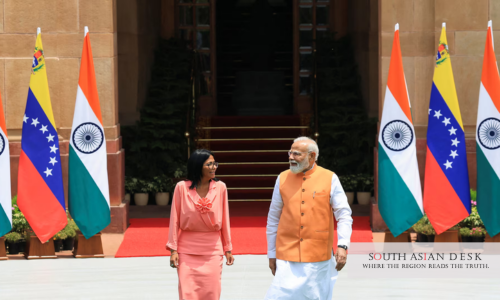
India-Venezuela energy trade moved into sharper focus on Thursday, June 4, 2026, as Venezuelan Acting President Delcy Rodríguez met Indian Prime Minister Narendra Modi in New Delhi to discuss hydrocarbons, investment and wider economic cooperation amid uncertainty in global crude supplies.
India-Venezuela energy trade at centre of talks
India and Venezuela reviewed their bilateral relationship with a strong emphasis on energy cooperation, as both sides seek to build on renewed crude oil flows and explore longer-term opportunities in upstream and downstream projects.
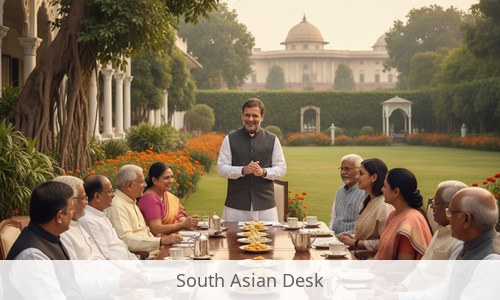
Rodríguez met Modi at Hyderabad House in New Delhi during her official visit to India from Wednesday, June 3, 2026, to Sunday, June 7, 2026. Venezuela’s foreign ministry said the talks focused on a comprehensive review of the cooperation map, with “special emphasis” on hydrocarbons, adding that India had become one of the main destinations for Venezuelan energy exports.
The meeting came at a time when India, one of the world’s largest crude oil consumers, is seeking to protect supply security amid disruption linked to the Gulf crisis.
Indian officials described the energy relationship as one marked by strong complementarity, with Venezuela holding large hydrocarbon resources and India offering a major, stable demand base. According to accounts of the official briefing, discussions covered cooperation in both upstream exploration and production, and downstream refining and related energy activities.
Venezuela sees India as a key energy destination
Venezuela’s foreign ministry said energy security had become a fundamental pillar of the bilateral relationship. It said Rodríguez was accompanied by a ministerial delegation covering economy, foreign affairs, science and technology, transport and communication, reflecting the wider economic scope of the visit.
The Venezuelan side said the meeting also sought to strengthen the role of both countries in the Global South and support macroeconomic agreements of mutual benefit. The ministry described the visit as one of the most relevant diplomatic engagements of the year for Venezuela’s economic development.
The latest talks build on earlier energy engagement between the two countries. In February 2025, Rodríguez visited India in her capacity as Venezuela’s hydrocarbons minister and took part in India Energy Week. During that visit, Venezuela’s foreign ministry said she met Indian officials and oil sector executives, including discussions with Petroleum and Natural Gas Minister Hardeep Singh Puri on the common energy outlook and the potential participation of Indian companies in exploration and production in Venezuela.
India seeks crude diversification
India has been increasing attention on alternative crude sources as global oil markets remain exposed to geopolitical risk. Venezuelan crude is seen as relevant to India’s diversification strategy because Indian refiners have experience processing heavier grades and because Venezuela has large proven oil reserves.
According to the competitor report, India was the second-largest importer of Venezuelan oil in May 2026, with purchases of 427,000 barrels per day. The report also said Venezuelan crude was on course to become one of India’s top oil sources for the month.
The same report said Reliance Industries had emerged among the major buyers of Venezuelan crude in recent months.
For New Delhi, the significance of the talks lies not only in immediate crude purchases but also in the possibility of structuring a longer-term energy partnership. Indian officials indicated that Venezuela viewed India as a preferred partner in the energy sector, while India saw opportunities for cooperation across both extraction and refining-linked activities.
Broader cooperation beyond oil
Although hydrocarbons dominated the agenda, both sides also discussed wider areas of economic cooperation. The official Indian visit announcement said the two countries would review the full spectrum of India-Venezuela relations and explore cooperation in energy, trade, investment, pharmaceuticals, healthcare, transportation and renewable energy.
Venezuela’s foreign ministry said Rodríguez and Modi discussed several windows of opportunity for expansion between the two countries. The Venezuelan delegation’s composition also suggested interest in technology, transport and communications, alongside energy and economic cooperation.
During Rodríguez’s previous India visit in February 2025, the two sides signed a memorandum of understanding on digital cooperation between Venezuela’s science and technology ministry and India’s electronics and information technology ministry. Venezuela said the agreement aimed to support digital transformation and cooperation in health, education and government management, including through software, technology applications and artificial intelligence.
India and Venezuela have also explored trade diversification beyond hydrocarbons. In 2025, India’s commerce ministry said both sides had discussed critical minerals and expanding Indian pharmaceutical exports to Venezuela, while Venezuela encouraged greater investment by Indian companies.
Background
India and Venezuela have maintained long-standing diplomatic and commercial ties, with energy often central to the relationship. Venezuela has historically been an important crude oil supplier for Indian refiners, although flows have fluctuated because of sanctions, payment constraints and changes in global oil trade.
Venezuela’s foreign ministry says the country holds the world’s largest oil reserves and significant gas reserves. India, meanwhile, remains heavily dependent on imported crude to meet domestic demand, making supply diversification a core part of its energy security strategy.
The latest engagement comes as oil-importing countries assess exposure to Gulf supply risks. For India, any prolonged disruption in West Asian supply routes could increase the strategic value of alternative suppliers, including Venezuela, the United States, Russia, Africa and Latin America.
However, the commercial expansion of Venezuela-India oil trade will depend on pricing, freight economics, sanctions compliance, refining suitability and payment mechanisms.
What’s next
Rodríguez’s visit is scheduled to continue until Sunday, June 7, 2026, with further engagements expected around energy and business cooperation. Indian and Venezuelan officials are likely to focus on whether the current rise in crude flows can be converted into a more structured partnership covering exploration, refining, trade and investment.
For New Delhi, the next step will be to balance energy security needs with commercial and geopolitical constraints. For Caracas, stronger access to Indian refiners could support export diversification and investment outreach.
India-Venezuela energy trade is therefore likely to remain a closely watched part of New Delhi’s crude diversification strategy as the Gulf crisis keeps pressure on global oil supply routes.
Published in SouthAsianDesk, June 5, 2026
Follow SouthAsianDesk on X, Instagram and Facebook for insights on business and current affairs from across South Asia.