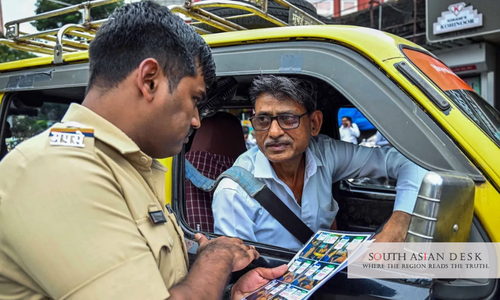
The Marathi language requirement for commercial drivers in Maharashtra has been extended by a year after a rule making it mandatory triggered widespread protests across the western Indian state. Transport officials had begun testing whether taxi and tuk-tuk drivers could hold basic conversations in Marathi, the state’s official language, and those who failed faced the prospect of having their licences suspended or cancelled within a month.
Marathi Language Requirement Sparks Protests Among Drivers
The testing drive began on 20 August, with officials assessing drivers on their ability to communicate in Marathi as part of a broader effort to improve interactions between drivers and passengers and to make journeys safer. The government maintained that the Marathi language requirement was intended purely as a practical measure rather than a punitive one.
However, drivers’ unions strongly objected to the compressed timeline, arguing that their members should not be placed at risk of losing their livelihoods while they were still in the process of learning the language. A significant proportion of the state’s taxi and tuk-tuk drivers are migrants who moved to Maharashtra from other parts of India in search of work, including large numbers from the Hindi-speaking states of Uttar Pradesh and Bihar.
Government Extends Deadline for Taxi and Tuk-Tuk Drivers
Amid mounting pressure, Maharashtra Chief Minister Devendra Fadnavis announced that taxi and tuk-tuk drivers would be given an additional year to meet the requirement, acknowledging that many drivers had been out of the formal education system for years and needed more time to learn. State Transport Minister Pratap Sarnaik confirmed that drivers would be expected to achieve proficiency within the extended period and said no further extensions would be granted.
Maharashtra currently has close to 979,000 valid taxi and tuk-tuk permits in circulation, with nearly half of them concentrated in the Mumbai metropolitan region, underscoring the scale of the workforce affected by the rule.
The reprieve has eased anxieties among many drivers. Lakhan Pandey, a taxi driver in Mumbai, said the extension had brought a measure of relief after weeks of uncertainty over his income.
How the Marathi Language Test Works
Under the revised motor vehicle rules, drivers are not required to read or write Marathi, nor are they expected to speak it fluently. Instead, they must demonstrate a working knowledge of the language sufficient for everyday interactions with passengers. To support this, the government has organized short training sessions focused on commonly used words and phrases, such as asking passengers where they wish to go, discussing fares and giving directions.
According to the state’s transport department, around 166,000 drivers have already completed the training and passed the accompanying oral assessment. At one training centre in Thane, near Mumbai, drivers spent four days learning a set of sixteen frequently used phrases before sitting the Marathi language test, with those who passed receiving a certificate they can present to officials during inspections.
A Deeper Political and Historical Debate
Beyond the immediate dispute over deadlines, the episode has reopened a long-running debate in Maharashtra over language, migration and employment. According to Prakash Akolkar, a journalist, author and political analyst, the issue extends well beyond communication between drivers and passengers and touches on questions of Marathi identity, migration and jobs.
The roots of this tension trace back to the formation of Maharashtra itself in 1960, following a sustained campaign for a Marathi-speaking state. As Mumbai subsequently grew into India’s financial hub, it attracted successive waves of migrants from across the country, and language increasingly became bound up with disputes over employment opportunities for Marathi speakers.
The Shiv Sena, founded in 1966 on a platform championing Marathi speakers, grew into one of the state’s most influential political forces on the strength of this identity politics. Maharashtra is now governed by a coalition led by Fadnavis’s Bharatiya Janata Party alongside a faction of the Shiv Sena, while rival factions, including the Maharashtra Navnirman Sena, have also positioned themselves as defenders of the Marathi cause.
Akolkar noted that ordinary citizens do not always approach language with the same intensity as political parties, which he said tend to raise the issue when it suits their circumstances. Deepak Pawar, a political scientist who heads the Marathi Abhyas Kendra, a body that promotes the language, took a firmer position, arguing that anyone who has lived and worked in the state for years should already possess at least a basic grasp of Marathi. He described continued refusal to learn the local language as “linguistic arrogance.”
Similar tensions have surfaced elsewhere in India, notably in Karnataka, where activists have voiced concern that migrants are relying on Hindi or English at the expense of Kannada, the local language.
Drivers Navigate Time and Money Pressures
For some drivers, the greater challenge lies not in the language itself but in finding time to learn it. Munawar Sheikh, a 58-year-old tuk-tuk driver who completed the training in Thane, said the course gave him enough Marathi to manage routine conversations with passengers.
Others have found the demands harder to balance. Ajay Singh, a taxi driver in Mumbai who earns between 1,500 and 2,000 rupees a day, said that taking time out for classes was financially difficult given how much of his day is already spent driving. He has instead tried to pick up the language informally, listening to Marathi radio broadcasts and practising with Marathi-speaking passengers during his shifts.
Pandey, for his part, said he had never objected to learning Marathi and simply wanted sufficient time to do so without endangering his ability to earn a living.
Conclusion
While the extended timeline has defused immediate tensions among taxi and tuk-tuk drivers, the underlying debate over the Marathi language requirement is unlikely to disappear. With political parties continuing to invoke the issue and the transport department signalling that this will be the final extension, the coming year is expected to test both the willingness of drivers to comply and the state’s resolve to enforce the rule once the deadline finally arrives.
Published in SouthAsianDesk, September 6th, 2026
Follow SouthAsianDesk on X, Instagram and Facebook for insights on business and current affairs from across South Asia.