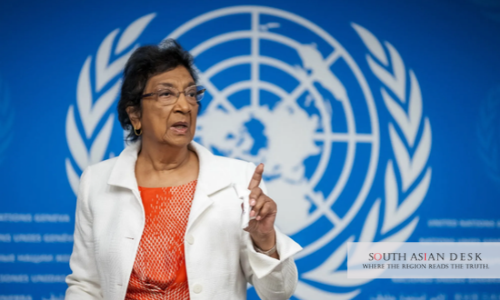
The Navi Pillay Nobel Peace Prize announcement on Friday, 9 October 2026, placed a South African jurist of Indian Tamil descent at the centre of global attention. The Norwegian Nobel Committee awarded the Nobel Peace Prize 2026 to Navanethem “Navi” Pillay, 85, “for her efforts to promote peace and international law.” The committee credited her with an instrumental role in ensuring that war crimes, crimes against humanity and genocide are prosecuted.
Committee chair Jørgen Watne Frydnes announced the decision in Oslo. Pillay was in Nuremberg, Germany, attending a gathering of legal professionals when the news broke, and she responded publicly the same day. She dedicated the award to the survivors of international crimes and to those who defend international criminal justice. She is the fifth South African national to receive the Peace Prize, and the formal presentation is scheduled for 10 December 2026.
From Clairwood to the Nobel Stage: A South Asian Diaspora Story
Pillay was born on 23 September 1941 in Clairwood, a Durban suburb set aside for people of Indian descent, into a poor family. Her grandparents had travelled from India as indentured labourers to work on the sugar plantations of Natal, and her father was a bus driver. The Navi Pillay Nobel Peace Prize win is therefore also a chapter in the history of the South Asian diaspora in southern Africa, a community whose presence on the continent traces back to the indenture system.
Her Tamil heritage has remained part of her public identity. On receiving a Nelson Mandela award from the Madras Development Society in Chennai, she dedicated it to the thousands of Indians who left South India, as her own grandparents did, to labour in South Africa under indenture. That heritage has also drawn scrutiny. According to an interview published by Lacuna, the Sri Lankan government once said she lacked objectivity because of her Tamil ancestry, while an Indian diplomat told her that her campaign against caste discrimination was unfair to India.
She studied at the University of Natal, earning a Bachelor of Arts in 1963 and a law degree in 1965, and later completed a master’s degree in law at Harvard Law School.
A Career Spanning Apartheid Courts, Rwanda and the United Nations
In 1967, Pillay became the first non-white woman to open her own law practice in Natal. Under apartheid she defended anti-apartheid activists, including her husband, Gaby Pillay, who was detained under the Terrorism Act, and she secured better conditions for political prisoners on Robben Island, among them Nelson Mandela.
In 1995, she became the first non-white woman to serve as a judge of the High Court of South Africa, and she was elected the same year to the International Criminal Tribunal for Rwanda, where she served as a judge and later as president. In 1998, the tribunal convicted Jean-Paul Akayesu of genocide and crimes against humanity, including rape. Pillay is credited with shaping the reasoning of that judgment, which is widely cited for establishing rape as an act of genocide and remains a landmark in international human rights law.
In 2003, she was elected to the first panel of judges of the International Criminal Court and assigned to its Appeals Division. From 1 September 2008 to 31 August 2014, she served as United Nations High Commissioner for Human Rights, the fifth person to hold the office. More recently, she chaired the UN Independent International Commission of Inquiry on the Occupied Palestinian Territory, including East Jerusalem, and Israel, which concluded in 2025 that Israel had committed genocide in Gaza. She announced that she would leave the commission in November 2025, citing her age and health, and she continues to serve as an ad hoc judge at the International Court of Justice.
What the Navi Pillay Nobel Peace Prize Says About International Law
Reaction to the Navi Pillay Nobel Peace Prize was swift. According to CBS News, the committee said that honouring someone with her body of work sent a message to those seeking to undermine international legal institutions. UN Secretary-General António Guterres welcomed the award and said Pillay had shown that “the force of law must prevail over the law of force.”
Israel’s Foreign Ministry sharply criticised the decision. The Nobel committee, for its part, denied that it was taking a position on whether Israel is committing genocide in Gaza, according to France 24.
For readers across South Asia, the Navi Pillay Nobel Peace Prize carries particular resonance. Pillay is a South African whose career unfolded in the courts of Durban, The Hague and Geneva, yet her Tamil heritage ties her to the Indian communities that crossed the Indian Ocean under indenture in the nineteenth century. The Nobel Peace Prize 2026 recognises a descendant of those labourers who rose from a segregated Durban suburb to the highest levels of international law, and it places the South Asian diaspora, and its contribution to the global struggle for justice, firmly in view.
Follow SouthAsianDesk on X, Instagram and Facebook for insights on business and current affairs from across South Asia.