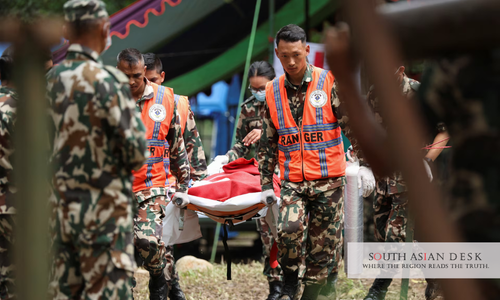
A Nepal hydropower tunnel rescue on Friday brought two workers out alive from a passage linked to a power station on the Trishuli River, nine days after an ice, rock and mud slide tore through the surrounding valley and killed more than 1,200 people. The two men, identified by Energy Minister Biraj Bhakta Shrestha’s office as mechanical foreman Sanjay Sah, 30, and mechanical supervisor Kabir Maharjan, 45, were recovered from the tunnel at the Upper Trishuli 3A Hydropower Station in the Rasuwa district.
Both survivors were flown by helicopter to a hospital in Kathmandu for treatment. An aide to the energy minister told Reuters that Maharjan, who was rescued second, cannot move his hands or legs and remains in a critical condition, while Sah’s injuries are not considered severe. According to the Nepali Army, one body was also recovered from the same tunnel during the operation, and rescuers reported hearing the voices of other workers still inside, raising hopes that additional survivors could be found.
Origins of the Trishuli River Flood Disaster
The Trishuli River flood disaster began on August 26, when officials and rescue workers believe a glacier collapsed on the upper reaches of the river, sending a mass of ice, rock and mud through the valley below. The event killed at least 1,252 people in Nepal, according to official figures, while more than 4,200 people remain missing and thousands more have been displaced from towns and villages near the border with China’s Tibet region. Homes, streets and schools in the affected communities were swept away by the force of the slide. Chinese authorities have separately reported 21 deaths and 541 people listed as missing on the Tibetan side of the border.
The scale of destruction has made the search for survivors exceptionally difficult. Roads and bridges leading into the region were destroyed, forcing rescue teams to rely on helicopters, zip lines and heavy machinery to reach isolated communities and industrial sites along the river.
Trapped Workers Nepal: Hundreds Still Unaccounted For
The number of trapped workers in Nepal linked to hydropower installations along the Trishuli River remains substantial. Officials and rescue teams believe at least 900 people were trapped in tunnels connected to six separate hydropower projects when the slide occurred. At the Trishuli 3A project alone, the Independent Power Producers Association of Nepal has said around 557 workers are still believed to be missing, with approximately 115 thought to be trapped within the main tunnel.
The rescue operation at Trishuli 3A has involved 75 army personnel and 18 police officers, supported by technical experts, according to the Nepali Army. Rescuers have also received assistance from specialists in India, South Korea and China, reflecting the scale and complexity of the effort. A tunnelling expert who has assisted with the operation told the BBC that the search relied on a combination of engineering analysis, old maps and satellite imagery to locate the tunnel’s entrance on the mountainside, before crews could begin advancing toward areas where survivors might still be sheltering.
Continuing Search Across Multiple Hydropower Sites
Search efforts have extended beyond the Trishuli 3A site to other hydropower installations along the river. At the Langtang hydropower plant, a rescue team that entered the tunnel recovered two additional bodies, the army said. At the Chilime plant, rescuers reported advancing roughly 100 metres further into the tunnel after clearing silt and debris that had accumulated since the slide. According to the Nepali Army, 58 people were rescued across the affected region on Friday alone, with the operation supported by seven military aircraft and six civilian aircraft.
The successful Nepal hydropower tunnel rescue at Trishuli 3A has been described by officials as a rare source of hope amid an otherwise grim recovery effort. Family members of the rescued workers expressed relief upon hearing the news, with one relative telling reporters that the family was travelling to the hospital to see the survivor in person.
What Comes Next
Authorities have indicated that search and rescue operations will continue at the Upper Trishuli 3A project and at the other affected hydropower sites, given indications that additional survivors may remain trapped within the tunnel network. Both rescued workers are being monitored in intensive care, with a source at the army hospital in Kathmandu describing their vital signs as stable.
With more than 4,200 people still missing across the region, the coming days are expected to remain focused on locating additional survivors while authorities continue assessing the broader toll of the disaster on communities along the Trishuli River and across the border in Tibet.
Published in SouthAsianDesk, September 5th, 2026
Follow SouthAsianDesk on X, Instagram and Facebook for insights on business and current affairs from across South Asia.