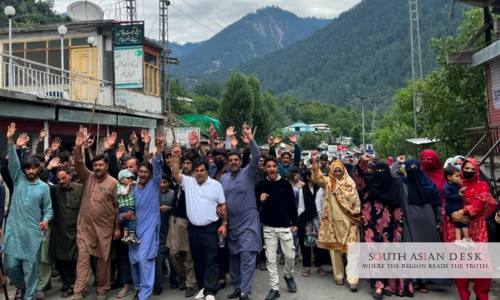
The Pakistan-administered Kashmir election is unfolding against the backdrop of one of the most turbulent summers the region has seen in years. Since early June, clashes between protesters and security forces have left nearly 40 people dead, banks closed for weeks, and mobile and internet services suspended across large parts of the territory. Now, as voters prepare to head to the polls, the contest has come to hinge on a single, deeply contested issue: the fate of 12 disputed seats reserved for Kashmiri refugees.
Formally known as Azad Jammu and Kashmir (AJK), Pakistan-administered Kashmir is choosing members of its 45-seat Legislative Assembly in an election that was originally scheduled for a single day but has since been split across three separate dates. Mirpur division votes first, followed by Muzaffarabad division and the refugee constituencies on August 2, while Poonch division, the epicentre of this year’s unrest, goes to the polls on August 10.
The Roots of the 12 Disputed Seats
Of the AJK Assembly’s 45 elected seats, 33 represent constituencies within the territory itself. The remaining 12 disputed seats are set aside for refugees from Indian-administered Kashmir who resettled across Pakistan after the 1947 partition of the subcontinent. These seats are not tied to a single geographic constituency inside AJK. Instead, their roughly 439,000 registered voters are spread across cities such as Lahore, Rawalpindi and Sialkot.
The arrangement dates back to electoral provisions introduced in 1960, strengthened through legislation in 1964 and 1970, and later formalised in AJK’s 1974 Interim Constitution. It was reaffirmed again through the constitution’s 13th Amendment in 2018. Chaudhry Muhammad Ibrahim Zia, a former chief justice of the AJK Supreme Court, traces the origins even further back, to the region’s founding declaration of October 24, 1947, which he says reflected the collective will of the people of the former state of Jammu and Kashmir. In his view, the seats rest on firm historical and constitutional ground and cannot fairly be labelled unconstitutional.
Critics see it differently. Kashif Abbasi, a committee member of the Jammu Kashmir Joint Awami Action Committee, argues that an election meant for residents of AJK should not include seats that sit outside the territory’s own jurisdiction, calling the arrangement without parallel elsewhere.
From Economic Grievances to a Constitutional Standoff
The Joint Awami Action Committee, widely known as JAAC, did not start out campaigning against the Kashmiri refugee seats. Its original demands centred on subsidised flour, cheaper electricity, and a fairer share of revenue from the Mangla and Neelum-Jhelum hydropower projects. The refugee seats only entered its charter in October 2025, and even then the group initially proposed alternatives rather than outright abolition, including replacing the 12 assembly seats with four seats on the AJK Council, the Islamabad-based body that oversees the territory’s federal-facing affairs.
Both proposals were rejected at an All-Parties Conference in Muzaffarabad in early June. Since then, JAAC’s demands have grown into a 38-point charter, with abolition of the refugee seats now front and centre. The group has since been banned by the local government, and much of its leadership has been arrested or gone underground, continuing to organise from protest camps in Rawalakot.
The AJK Supreme Court weighed in directly on the dispute, ruling that the seats are constitutionally protected and can only be removed through a formal constitutional amendment, not through executive action or street pressure. With the outgoing assembly’s term already over, no such amendment can move forward until a new legislature takes office, an outcome that depends entirely on the results of this election.
What the Government Says
Officials reject the idea that refugee-seat holders form an outsized or unaccountable political bloc. Abdul Majid Khan, AJK’s former finance minister, points to the scale of the territory’s roughly 310 billion rupee budget, arguing it dwarfs the resources tied to the 12 disputed seats. He describes the seat holders as people who migrated for a larger national cause, noting that refugee representation has existed since AJK’s first parliamentary election in 1975.
AJK Prime Minister Faisal Mumtaz Rathore has said any change to the seats must come from elected representatives, not from street protests, while Pakistan’s Defence Minister Khawaja Asif has urged JAAC to contest the issue at the ballot box rather than demand its resolution beforehand.
A Deeper Question of Power
Beyond the legal wrangling, the dispute has revived older questions about who actually governs Muzaffarabad. JAAC leaders have said they have written directly to Pakistan’s army chief, arguing that real authority over AJK affairs lies with the military establishment rather than the civilian government. Researchers who study Kashmiri displacement and politics have echoed that view, suggesting that AJK’s elected leadership has often been reduced to a largely symbolic role.
The debate also connects to a far older, unresolved commitment. Under a 1949 United Nations resolution, the future of Kashmir was meant to be settled through a free and impartial plebiscite. Nearly eight decades later, that vote has never taken place on either side of the Line of Control. Some analysts argue that the Kashmiri refugee seats help Pakistan maintain its position that AJK represents the whole of the former princely state, not just the territory it currently administers. Others point to a further contradiction: candidates seeking office in AJK must swear allegiance to the territory’s accession to Pakistan, a requirement critics say limits genuine self-determination.
What Comes Next
As voting proceeds in stages through August 10, the outcome will determine far more than who sits in the AJK Assembly. It will decide whether the next government has the mandate, and the votes, needed to open a constitutional process on the 12 disputed seats, or whether the standoff between JAAC and the state carries on into the next term. For a region already shaken by months of unrest, the result of this election may shape not just its assembly, but the terms on which its long-standing debate over representation and autonomy continues.
Published in SouthAsianDesk, July 27th, 2026
Follow SouthAsianDesk on X, Instagram and Facebook for insights on business and current affairs from across South Asia.