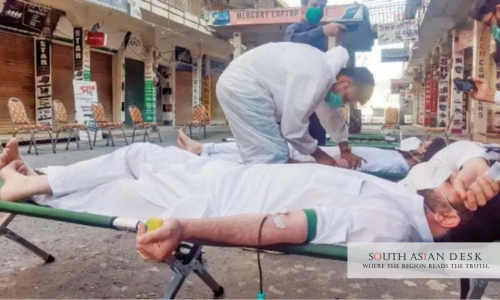
Pakistan’s blood donation deficit amounts to 2.3 million units annually, the World Health Organisation warned on Sunday on the occasion of World Blood Donor Day, as the country’s medical facilities receive only around 2.7 million donations per year against a clinical need estimated at more than 5 million, with the overwhelming majority of existing donations coming from family or replacement donors rather than the voluntary, unpaid donors regarded by health authorities as the safest and most sustainable source.
WHO Representative in Pakistan Dr Luo Dapeng said the scale of Pakistan’s blood donation deficit was directly costing lives that modern medicine would otherwise be capable of saving. “No patient, no mother, no sister, no son or daughter should die because of a lack of access to blood,” he said, adding that every donation counted and that without human solidarity hospitals and their health workers could not do their job. “Today, medical science can save lives more than ever before, but without human solidarity and blood donations, hospitals and their health workers cannot do their job of saving lives.”
This year’s global campaign, operating under the slogan “One Drop of Humanity. Give Blood. Save Lives”, seeks to reframe blood donation as an act of human solidarity rather than a purely medical transaction. WHO notes that thanks to advances in medical science, a single blood donation can now be processed to save up to three separate lives.
The Voluntary Donor Gap at the Heart of Pakistan’s Blood Donation Deficit
Of the approximately 2.7 million donations Pakistan currently receives each year, only 18 percent come from voluntary and non-remunerated donors. The remaining 82 percent come from family or replacement donors, individuals who donate specifically when a relative or known patient requires blood, rather than contributing to a shared national supply.
The dominance of family and replacement donations in Pakistan’s blood donation deficit picture carries implications beyond the raw volume shortfall. Voluntary donors are considered the gold standard by WHO because they are less likely to conceal medical histories or risk factors when donating, making blood collected from them statistically safer for transfusion. When a system relies predominantly on family donors recruited under the pressure of a medical emergency, the likelihood of inadequate screening and the pressured concealment of disqualifying conditions increases.
Pakistan’s thalassaemia burden makes the blood donation deficit particularly acute. Pakistan has one of the highest rates of thalassaemia major in the world, with an estimated 100,000 or more children living with the condition, each requiring regular and frequent blood transfusions for survival. The country also carries a significant haemophilia burden and one of the highest hepatitis C prevalence rates globally, a disease transmissible through contaminated blood that underlines the importance of safe screening. Every unit of blood in short supply affects patients with these chronic conditions first and most severely.
What Blood Transfusions Treat
WHO set out the breadth of clinical dependence on blood supply in its World Blood Donor Day statement, noting that transfusions are essential for managing pregnancy-related haemorrhage, treating severe childhood anaemia, addressing bleeding disorders, infectious diseases, and various chronic conditions including cancers. Transfusions also support complex medical and surgical procedures and provide lifelong care for conditions such as sickle cell disease, thalassaemia, haemophilia, and immune disorders. They are equally critical in emergencies, disasters, and conflict situations.
In Pakistan’s context, the reference to emergency and disaster scenarios carries specific weight. The country experiences recurring large-scale floods that generate mass casualty events placing sudden acute demand on blood supplies. The 2022 floods, which affected one-third of the country’s landmass, exposed the fragility of blood bank systems under surge conditions. The 2.3 million unit annual Pakistan blood donation deficit represents a structural baseline shortfall that emergency events can only worsen.
WHO’s Call for Systemic Reform
WHO used World Blood Donor Day to call on the Pakistani government and all health authorities to invest in robust blood systems that support voluntary donation, equitable access, and safe transfusion practices, including standardised blood screening methods and protocols. Dr Dapeng said WHO stands with Pakistan and its health workforce to reinforce the country’s blood banks. “We will work to ensure safe and adequate blood supplies for all, regardless of social or economic status, no matter where they live or who they are,” he said.
Addressing Pakistan’s blood donation deficit in a structural rather than episodic way requires building a culture of voluntary donation across the population, supported by public health campaigns, accessible donation infrastructure, and community trust in the safety of the donation process. International experience suggests this transition takes years to achieve and depends heavily on consistent government investment and public education.
Pakistan’s population of approximately 240 million means the country would need to achieve a donation rate of roughly 2 percent of the population annually to meet current clinical demand, a target that requires more than doubling the existing voluntary donor base while simultaneously converting the 82 percent family donor share into a self-sustaining voluntary system.
Published in SouthAsianDesk, June 16, 2026
Follow SouthAsianDesk on X, Instagram and Facebook for insights on business and current affairs from across South Asia.