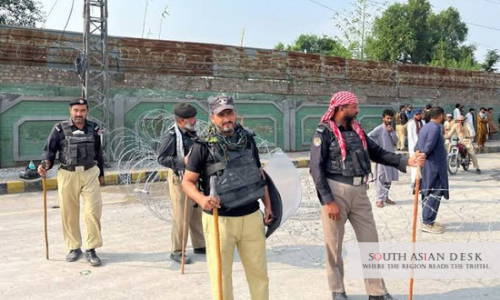
Pakistan forces kill 29 militants in a border operation following a series of recent attacks, including a deadly assault on a paramilitary facility in Karachi, according to reports citing Pakistani officials.
The operation, carried out along the Pakistan-Afghanistan border, comes at a time of renewed tension between Islamabad and Kabul over militant safe havens, cross-border attacks and the presence of Pakistani Taliban-linked fighters in Afghanistan. Pakistani officials said the action targeted militant hideouts after security forces came under repeated attack in recent days.
The report, carried by Reuters citing the Associated Press, said Pakistani forces conducted ground operations and strikes against militant positions. Information Minister Attaullah Tarar said the operation killed 29 militants, describing the action as a response to attacks on Pakistani security personnel. Afghan Taliban officials, however, disputed Pakistan’s account and said the strikes caused civilian casualties.
The competing claims could not be independently verified immediately.
Pakistan Forces Kill 29 Militants as Border Tensions Rise
The latest Pakistan-Afghanistan border operation follows a spike in militant violence that has placed renewed pressure on Pakistan’s security establishment. Islamabad has repeatedly accused militants affiliated with the Tehreek-e-Taliban Pakistan, or TTP, of using Afghan territory to plan and launch attacks inside Pakistan.
Kabul denies allowing foreign militants to operate from Afghan soil and has frequently rejected Pakistani allegations. The Taliban government says it does not permit any group to use Afghanistan against another country, but Pakistan insists attacks have continued despite repeated diplomatic warnings.
The latest operation therefore fits into a wider pattern: Pakistan says it is responding to armed groups based near or across the border, while Afghan authorities accuse Pakistan of violating Afghan territory and endangering civilians.
This dispute has become one of the most serious sources of friction between the two neighbours since the Taliban returned to power in Afghanistan in 2021.
Karachi Rangers Attack Adds Urgency to Security Response
The border operation came shortly after an attack on a Rangers facility in Karachi, where Pakistani authorities said several security personnel were killed. The attack was claimed by Jamaat-ul-Ahrar, a militant faction linked to the Pakistani Taliban movement.
Pakistani officials said the Karachi assault involved armed militants and suicide attackers. Security forces later said they had killed the attackers and captured one injured militant, reportedly an Afghan national. That detail has been used by Islamabad to reinforce its argument that militancy inside Pakistan is increasingly connected to networks operating from Afghan territory.
Karachi is far from the western border, but attacks in the city carry major national significance. It is Pakistan’s largest commercial centre, a key port city and a frequent target in earlier waves of militancy. A successful assault on a paramilitary installation there is likely to be viewed by the state as a serious escalation.
TTP and Cross-Border Militancy Remain Central Issues
The TTP is separate from the Afghan Taliban but shares ideological roots and has historically maintained ties with militant networks in Afghanistan. Since the Taliban takeover in Kabul, Pakistan has seen a rise in attacks, particularly in Khyber Pakhtunkhwa and Balochistan.
Pakistan says the TTP has become emboldened by sanctuaries across the border. The Afghan Taliban deny this, but relations between Islamabad and Kabul have steadily worsened as attacks have increased.
The problem for Pakistan is both military and diplomatic. Border operations may disrupt militant networks in the short term, but they also risk deepening hostility with Afghanistan. At the same time, doing nothing after attacks on soldiers, police and paramilitary forces carries domestic political costs and weakens the perception of state control.
This is why Pakistan’s security policy has increasingly combined intelligence-based operations inside the country with warnings, diplomatic pressure and, at times, reported cross-border action.
Afghanistan Rejects Pakistan’s Claims
Afghan Taliban officials have criticised Pakistani strikes in the past and have warned against violations of Afghan sovereignty. In the latest episode, Afghan officials said civilians were among those killed or wounded, while Pakistan said the targets were militant hideouts.
These competing narratives are now familiar. Pakistan frames such operations as counterterrorism actions against armed groups responsible for attacks inside its territory. Afghanistan frames them as unlawful military actions that harm civilians and increase instability.
The absence of independent verification makes such incidents difficult to assess. Border areas are often remote, access is restricted, and both sides have strong political incentives to shape the public narrative.
Still, the diplomatic effect is clear: every such operation widens the trust deficit between Islamabad and Kabul.
A Difficult Moment for Pakistan’s Security Policy
Pakistan’s security forces have been conducting frequent operations against militants in recent months, especially in Khyber Pakhtunkhwa and Balochistan. These operations have resulted in the killing or arrest of militants, but attacks on security personnel have also continued.
The state faces a difficult strategic environment. Militants operate across mountainous terrain, use cross-border networks, and often exploit gaps in local governance. At the same time, Pakistan’s western border remains politically sensitive because military escalation with Afghanistan could create broader instability.
There is also a domestic dimension. Rising attacks increase pressure on the government and military to show visible results. Operations that kill militants may reassure the public in the short term, but long-term security depends on intelligence coordination, border management, local policing, political engagement and sustained pressure on militant financing and recruitment.
Islamabad and Kabul Need More Than Tactical Responses
The latest operation shows that Pakistan is willing to use force when it believes militant attacks are being planned or supported from across the border. But it also shows the limits of force alone.
Pakistan and Afghanistan have held talks repeatedly over border security, refugees, trade and militant activity. Yet the underlying problem remains unresolved: Pakistan wants Kabul to act decisively against TTP-linked groups, while the Afghan Taliban either deny the scale of the problem or resist action that could create internal militant backlash.
Without a workable security understanding, both countries risk being trapped in a cycle of attack, retaliation and denial.
For Pakistan, the immediate claim is that 29 militants were killed. For the region, the bigger issue is that the Pakistan-Afghanistan border remains unstable, militant groups remain active, and diplomatic mechanisms have not yet produced lasting results.
The latest border operation may disrupt one set of militant hideouts, but unless Islamabad and Kabul find a way to address cross-border militancy through credible enforcement and communication, further escalation remains likely.
Published in SouthAsianDesk, June 29, 2026
Follow SouthAsianDesk on X, Instagram and Facebook for insights on business and current affairs from across South Asia.