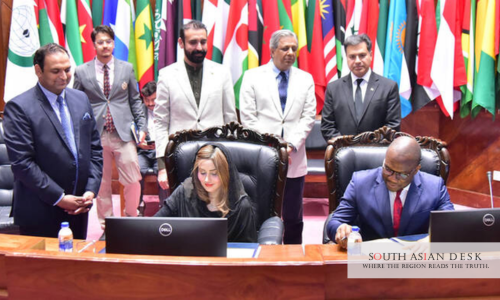
The Pakistan OIC Arbitration Centre agreement, signed this week in Islamabad, marks a significant step in the country’s efforts to modernize how commercial and other disputes are resolved outside conventional courts. The agreement was concluded between Pakistan’s International Mediation and Arbitration Centre, known as IMAC, and the Organization of Islamic Cooperation’s Arbitration Centre, or OIC-AC, with both institutions committing to long-term cooperation in mediation, arbitration and dispute prevention.
The partnership reflects Islamabad’s broader push toward internationally aligned alternatives to lengthy litigation, part of a wider strategy to create a more predictable environment for cross-border business. Alternative dispute resolution, commonly referred to as ADR, allows businesses and individuals to settle disagreements through arbitration, mediation and conciliation rather than through conventional court proceedings. Such mechanisms have become increasingly important in international commerce, where investors and companies often prefer faster and more predictable routes to resolving contractual disputes across jurisdictions.
What the Pakistan OIC Arbitration Centre Agreement Covers
Under the memorandum of understanding, IMAC and the OIC Arbitration Centre will exchange professional expertise, information and publications, while jointly organizing capacity-building programs, conferences, seminars and other training activities. The two institutions have also agreed to cooperate in identifying and recommending qualified mediators and arbitrators and in developing professional networks across the wider Organization of Islamic Cooperation region.
Law Minister Azam Nazeer Tarar, speaking at the signing ceremony, said the agreement would deepen Pakistan’s international linkages in mediation and alternative dispute resolution. He added that the government intended to expand the scope of mediation and conciliation domestically while strengthening cooperation with international institutions working in the field.
The agreement was signed at the conclusion of a five-day training program in Islamabad on civil, commercial and Shariah-integrated mediation, which brought together participants from across Pakistan’s legal and religious institutions. OIC Arbitration Centre Secretary General Umar A. Oseni said the training model, which combines civil, financial and Shariah-aligned mediation principles, had attracted international interest, and that both organizations intended to explore introducing similar programs in other countries.
Alternative Dispute Resolution Gains Ground in Pakistan
Pakistan has been steadily expanding its use of alternative dispute resolution as part of broader legal reforms intended to ease pressure on its court system. Officials say mediation can resolve cases within weeks that might otherwise take years to conclude through conventional litigation. Tarar noted last week that the government was pursuing legal measures to encourage parties to settle disputes before they reach the courts, including efforts to strengthen pre-litigation mediation in specific categories of cases.
Some tax disputes, he said, are already being resolved outside the courts, an approach the ministry hopes to extend further as part of its wider mediation strategy. Pakistan has also signed the Singapore Convention on Mediation, a move officials describe as aligning the country’s dispute resolution framework with recognized global standards.
A Wider Push to Attract Investment
The government has increasingly linked improvements in commercial dispute resolution to its broader efforts to attract foreign investment. The speed and predictability with which contractual disagreements can be resolved often influences investor confidence, particularly for companies weighing cross-border transactions. By aligning its mediation and arbitration practices with internationally recognized institutions, Pakistan aims to present itself as a more reliable jurisdiction for resolving commercial disputes.
The law ministry said the partnership with the OIC Arbitration Centre was ultimately intended to strengthen institutional capacity and professional networks in Pakistan, while offering more effective and less costly mechanisms for resolving disputes both domestically and across other member states of the Organization of Islamic Cooperation.
Published in SouthAsianDesk, August 27th, 2026
Follow SouthAsianDesk on X, Instagram and Facebook for insights on business and current affairs from across South Asia.