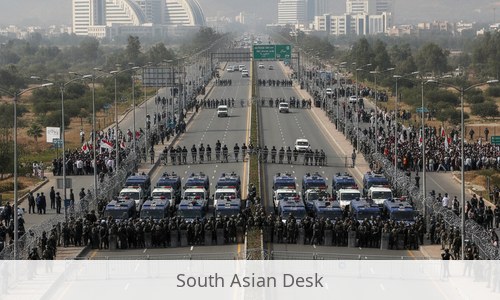
Pakistan protests for Imran Khan: Authorities have sealed major highways into Islamabad as supporters of jailed former Prime Minister Imran Khan plan to march into the capital. The closures are a response to rising tensions following the detention of Khan’s sisters under a public order law, which has sparked outrage among his supporters and raised concerns about civil liberties in Pakistan.
Pakistan protests for Imran Khan: Political Ramifications of Detaining Imran Khan’s Family
The detentions of Imran Khan’s three sisters occurred just days before the Pakistan Tehreek-e-Insaf (PTI) party’s planned nationwide protests demanding Khan’s release. According to Khaama Press, the sisters were detained for 30 days under a public order law, a move that has intensified political tensions. This crackdown may galvanize Khan’s supporters, potentially leading to increased civil unrest and further polarization in the country.
The government’s actions have drawn criticism from opposition groups and civil society organizations, who argue that such measures undermine democratic principles and the right to peaceful protest. Analysts note that the detention of Khan’s family members could be seen as an attempt to suppress dissent ahead of the planned protests, which are expected to involve large crowds in Islamabad and other cities.
Historical Context of Protests in Pakistan
The current situation reflects ongoing political unrest in Pakistan, particularly surrounding Imran Khan’s leadership and the actions of his supporters. Historical precedents show that government crackdowns on protests have often led to heightened tensions and, in some cases, violent confrontations with security forces.
In 2019, similar protests erupted after Khan’s ouster as prime minister, with supporters staging demonstrations across the country. The government’s response at that time included widespread arrests and the use of force to disperse crowds, which drew international condemnation. The current detentions of Khan’s sisters may follow a similar pattern, with the potential for further escalation.
The situation also raises questions about the broader implications for civil liberties in Pakistan. Critics argue that the government’s use of public order laws to detain individuals without clear legal justification is a violation of constitutional rights. This has sparked debates about the need for legal reforms to protect protesters and ensure that dissent is addressed through dialogue rather than repression.
Islamabad Road Closures and Security Measures
In anticipation of the planned Pakistan protests for Imran Khan, authorities have implemented strict security measures, including the closure of major roads leading to Islamabad. These road closures, part of Islamabad road closures, aim to prevent large gatherings and mitigate potential clashes between protesters and security forces. However, such measures have been criticized as disproportionate and counterproductive, as they may further inflame tensions rather than de-escalate them.
The government has justified these closures as necessary to maintain public order, but human rights advocates argue that they infringe on the right to peaceful assembly. The situation underscores the delicate balance between national security and the protection of civil liberties in Pakistan.
The road closures have also disrupted daily commutes and raised concerns about the government’s prioritization of security over public convenience. Local businesses near the closed routes have reported a decline in foot traffic, adding economic strain to an already tense political climate. Meanwhile, PTI supporters have expressed frustration, claiming that the closures are an attempt to suppress their movement and prevent the planned protests from gaining momentum.
Broader Implications for Civil Liberties
The detention of Imran Khan’s family members and the subsequent road closures have reignited debates about the erosion of civil liberties in Pakistan. Legal experts have pointed out that the use of public order laws, which allow for arbitrary detention, has been increasingly weaponized against political opponents. This has led to calls for greater transparency and accountability in the application of such laws.
Civil society organizations have urged the government to engage in dialogue with protest organizers rather than resorting to repression. They argue that addressing the grievances of Khan’s supporters through legal and political channels would be more effective in maintaining stability. However, the government has remained firm in its stance, emphasizing the need to uphold law and order in the face of what it describes as potential threats to national security.
Conclusion
As the planned protests approach, the situation in Pakistan remains volatile. The government’s actions against Imran Khan’s family and the imposition of road closures have only heightened tensions, with the potential for further unrest. The coming days will be critical in determining whether the situation can be managed through dialogue or if it will spiral into broader civil conflict.
Follow SouthAsianDesk on X, Instagram and Facebook for insights on business and current affairs from across South Asia.