Pakistan US trade talks have made progress in Washington as both sides work toward a reciprocal trade agreement aimed at replacing temporary tariff measures with a more stable bilateral trade framework.
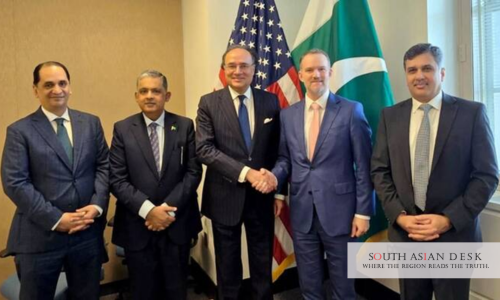
Pakistan’s foreign ministry said the latest round of negotiations was held in Washington this week and described the atmosphere as cordial. The Pakistani delegation was led by Commerce Secretary Jawad Paul, who characterised the discussions as positive and said significant progress had been made during the talks.
Foreign ministry spokesperson Tahir Andrabi said both sides had worked to iron out differences and build convergence, with a view to the early conclusion of an agreement. The talks come at a sensitive moment because a temporary 10 percent US tariff on Pakistan, imposed under Section 122 of the Trade Act of 1974, is due to expire later this month.
Pakistan US trade talks focus on reciprocal agreement
Pakistan US trade talks are focused on reaching a reciprocal trade agreement that can provide greater predictability for exporters, importers and policymakers after months of uncertainty over tariff measures.
For Islamabad, the negotiations are important because the United States is Pakistan’s largest single-country export market. Lower duties and a clearer trade framework could support Pakistani exporters, particularly in sectors such as textiles, apparel, leather goods, sports goods and other manufactured products.
For Washington, the talks are part of a broader effort to reshape trade relationships through reciprocal arrangements and tariff-linked negotiations. The US administration has used tariff policy as a bargaining tool with multiple trading partners, creating pressure for countries to negotiate bilateral frameworks that address market access, trade barriers and enforcement concerns.
Pakistan is seeking lower duties on its exports to the US, while also trying to avoid new or overlapping tariff measures that could reduce the competitiveness of its products in the American market.
Temporary US tariff deadline adds urgency
The timing of the talks is important because the temporary 10 percent tariff imposed under Section 122 is due to expire on July 24.
That temporary measure followed earlier tariff actions that affected Pakistani exports. In April last year, the US administration invoked the International Emergency Economic Powers Act to impose a 29 percent tariff on Pakistani exports as part of wider global trade measures. After engagement between Pakistani officials and the Office of the United States Trade Representative, the proposed tariff on Pakistani goods was reduced to 19 percent.
That arrangement was later disrupted after a US Supreme Court ruling that limited the White House’s authority to impose broad tariffs under the emergency powers law. The administration then turned to Section 122 of the Trade Act of 1974 to impose a temporary 10 percent global tariff for up to 150 days.
The result has been an unstable tariff environment for Pakistani exporters. Each change has affected planning, pricing, contracts and market access calculations. A reciprocal trade agreement would therefore be valuable if it creates a more durable structure for bilateral trade.
Section 301 forced labour tariff also part of backdrop
The negotiations are taking place against another tariff-related challenge: a proposed US Section 301 action linked to forced labour import restrictions.
The Office of the United States Trade Representative last month proposed additional duties on imports from 60 economies after investigations into whether those economies had failed to impose and effectively enforce prohibitions on goods produced with forced labour.
Pakistan was among the six economies that USTR said had failed to effectively enforce such a prohibition, rather than failing to impose one altogether. Under the proposed action, economies in that category could face a 10 percent additional duty, while other economies could face 12.5 percent.
Pakistan has submitted legal and regulatory documentation challenging the proposed measure. The issue matters because a Section 301 tariff could add another layer of cost for Pakistani exporters unless resolved through legal, regulatory or diplomatic engagement.
Exports to US remain economically important
The United States remains one of Pakistan’s most important trade partners. USTR data shows that total US goods and services trade with Pakistan was estimated at $10.1 billion in 2024, up 6.3 percent from the previous year. US goods trade with Pakistan reached an estimated $8.7 billion in 2025.
Pakistan’s export economy is heavily dependent on access to major developed markets. The US market is especially important because Pakistani exports to the country are concentrated in labour-intensive sectors that support large numbers of jobs.
Textiles and apparel remain central to Pakistan’s export profile. Any increase in duties can affect competitiveness, particularly when Pakistani products compete against exporters from countries with preferential access, lower duties or stronger supply chain advantages.
For manufacturers, uncertainty over tariffs can be almost as damaging as the tariffs themselves. Buyers may delay orders, renegotiate contracts or shift sourcing to countries where trade terms are clearer. That gives Pakistan a strong incentive to seek early clarity through a reciprocal trade framework.
Islamabad seeks tariff relief and predictability
Pakistan’s objective is not only to reduce immediate tariff exposure, but also to secure predictability for future trade.
A stable framework would help exporters plan pricing, production and delivery schedules. It would also support investment decisions by companies that depend on US orders. For an economy facing external financing pressures, export growth remains one of the most important paths toward improving foreign exchange earnings.
The government’s emphasis on “early conclusion” suggests that Islamabad wants the talks to move quickly before temporary measures expire and proposed new duties create further uncertainty.
However, an agreement will depend on whether both sides can settle outstanding differences. The issues may include tariff rates, forced labour enforcement, market access, customs rules, compliance mechanisms, supply chain standards and possible sector-specific arrangements.
Labour enforcement concerns could shape negotiations
The forced labour dimension may become a key part of the wider trade discussion.
USTR’s Section 301 findings were framed around the failure of trading partners to prevent goods made with forced labour from entering their markets. The agency said such failures burden US commerce by allowing unfair competition from goods produced with forced labour or forced labour inputs.
For Pakistan, the issue creates both a legal and policy challenge. Islamabad will need to show that it has sufficient laws, enforcement tools and import controls to address forced labour concerns. It may also need to provide evidence of regulatory action, monitoring systems and compliance capacity.
The matter is commercially important because labour standards are increasingly linked to market access. Buyers, customs authorities and governments in major economies are paying closer attention to supply chains, worker protections and traceability.
If Pakistan can address concerns credibly, it may strengthen its position in negotiations and reduce the risk of future trade restrictions.
Reciprocal agreement could broaden economic ties
A reciprocal trade agreement could potentially go beyond tariff relief.
Past discussions between Pakistan and the United States have included trade expansion, investment, energy, mining, critical minerals, information technology and digital infrastructure. These areas reflect a broader attempt to rebuild economic engagement between the two countries.
A stronger trade framework could support Pakistan’s efforts to attract US investment and diversify exports beyond traditional sectors. It could also help Washington deepen economic ties with Pakistan at a time when trade policy is increasingly linked to strategic relationships.
However, the immediate priority remains tariffs. Without clarity on duty rates and proposed additional measures, broader economic cooperation may remain limited.
Exporters await concrete outcome
Pakistani exporters will be watching for concrete details rather than general statements of progress.
So far, officials have said the talks were positive and that differences were being narrowed. They have not announced a final agreement, a new tariff rate, a signing date or the next round of negotiations.
That means uncertainty remains. Businesses will want to know whether the agreement will reduce existing duties, prevent new tariffs, create exemptions for key Pakistani sectors or provide any special treatment for textiles and apparel.
The outcome will also depend on the US side. Any reciprocal agreement must align with Washington’s trade policy priorities, including tariff reciprocity, forced labour enforcement and protection of American commercial interests.
Trade diplomacy enters decisive phase
Pakistan US trade talks have entered a decisive phase as the deadline for temporary tariff measures approaches and the proposed Section 301 duties remain unresolved.
The reported progress in Washington is a positive signal, but it does not yet amount to a concluded agreement. The key question is whether both governments can move from convergence to a signed framework that gives Pakistani exporters meaningful relief and gives US policymakers confidence on trade enforcement concerns.
For Pakistan, the stakes are high. The US market is central to export earnings, and even modest changes in tariff treatment can affect competitiveness in labour-intensive industries. For the United States, the talks are part of a broader effort to restructure trade relations through reciprocal agreements and enforcement-based measures.
If an agreement is concluded soon, it could provide Pakistan with greater tariff certainty and help stabilise an important trade relationship. If talks stall, exporters may face continued uncertainty as temporary duties expire and new proposed measures remain under consideration.
For now, Islamabad is presenting the Washington negotiations as a step forward. The next test will be whether that progress produces a formal reciprocal trade agreement before the current tariff window closes.
Published in SouthAsianDesk, July 12, 2026
Follow SouthAsianDesk on X, Instagram and Facebook for insights on business and current affairs from across South Asia.