ISLAMABAD — Pakistani sailors held by Somali pirates have completed 54 days in captivity aboard the Palau-flagged oil tanker MT Honour 25, with no resolution in sight as hostages report worsening conditions and a negotiation deadlock between the pirates and the shipping company deepens.
The tanker, carrying approximately 18,500 barrels of oil and en route to Mogadishu, was seized on Tuesday, April 21, 2026, approximately 30 nautical miles off the northeastern Somali coast near the semi-autonomous Puntland region. Six armed pirates initially boarded the vessel; the number of attackers later grew to at least 11. Of the 17-member crew, 10 are Pakistani nationals. The remaining crew members comprise four Indonesians, including the ship’s captain, as well as one crew member each from India, Sri Lanka and Myanmar.
Pakistani Sailors Held by Somali Pirates Describe Deteriorating Conditions
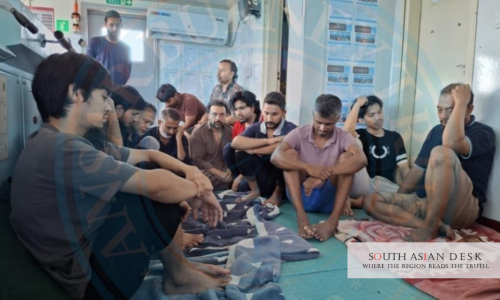
In a video circulated this week, the Pakistani hostages appeared on the deck of the vessel, with open sea visible in the background, describing increasingly severe circumstances aboard the tanker. The crew said they were surviving largely on plain boiled rice and had been forced to consume water from the ship’s storage tanks, which they reported was contaminated and causing illness. According to the hostages, they were required to repeatedly appeal to the pirates even for basic provisions. One hostage stated that their lives were in constant danger and that gunfire could be heard almost daily in the vicinity of the vessel.
The crew also reported that their supply of medicines had been completely exhausted. In statements shared with their families, the hostages said their hope of survival was fading amid mounting uncertainty over their future.
Stalled Talks: Pirates Reject Third-Party Interlocutor
The hostages described a critical impasse in efforts to secure their release. The shipping company, they said, had not entered into direct negotiations with the pirates and had instead designated a third party identified only as Usman as its representative. The pirates have refused to engage with Usman and are demanding direct talks with the firm’s authorised principals. The crew said this standoff had further delayed any prospect of an early resolution.
In May, the Somali pirates holding the MT Honour 25 formally communicated a ransom demand of USD 3 million for the release of all 17 hostages, the vessel and its cargo. The demand was transmitted via a WhatsApp message from the pirate group’s leader to Pakistan’s Ansar Burney Trust, a Karachi-based human rights organisation that has maintained contact with the pirates throughout the crisis. Qurrat-ul-Ain Advocate, director of the Trust, confirmed the demand and noted that the pirates had explicitly rejected any reduction in the figure or further negotiation over it. Earlier unverified reports had put the ransom demand as high as USD 10 million; the pirate group denied that figure and distanced itself from the individual named Usman. The pirates also called on the Pakistani government to engage with them directly rather than through any intermediary.
Pakistan’s Foreign Office confirmed that the ship’s owner — identified by the Ministry of Foreign Affairs as a Puntland-based businessman — has been designated as the principal negotiator with the pirates, while Islamabad has maintained contact with the Somali government to stay updated on developments.
Islamabad Intensifies Diplomatic Engagement
Pakistan’s Deputy Prime Minister and Foreign Minister Ishaq Dar spoke with Somali Foreign Minister Abdisalam Abdi Ali by telephone on Tuesday, June 9, seeking the early release of the Pakistani hostages. According to a Foreign Office statement posted on the Ministry’s official X account, Dar conveyed Pakistan’s “grave” concern over the situation and underscored the importance of ensuring the crew’s well-being, early release and safe repatriation. The Somali foreign minister assured Dar of his government’s “continued and sincere efforts” to secure the hostages’ release, and both sides agreed to maintain close coordination until the matter was resolved.
Foreign Office Spokesperson Tahir Hussain Andrabi separately confirmed at a weekly media briefing that Pakistan remained actively engaged in securing the crew’s release and acknowledged that the situation was serious and complex. He noted that the vessel’s location had been confirmed and that a delegation from Pakistan’s embassy in Djibouti had visited Somalia from Thursday, May 7, to Saturday, May 10, and been told by Somali authorities that the hostages were safe. Andrabi added that Somali officials had advised that a military operation to retake the tanker was not feasible given the flammable nature of its cargo.
Maritime Affairs Minister Junaid Anwar Chaudhry also engaged with Pakistan’s envoy in Somalia over the matter and separately discussed the case with the foreign minister. A government statement quoted Chaudhry as saying that the government was actively working for the crew’s safe return, that it remained in constant contact with the foreign ministry and the Somali embassy, and that humanitarian efforts had been initiated as soon as the incident was reported in April.
Families Protest; Rights Commission Raises Alarm
Relatives of the abducted Pakistani crew members staged a protest in Karachi on Wednesday, May 13, calling on the government to take immediate action for the safe return of their loved ones. Family members said the hostages had communicated that their condition was extremely critical, that food and water had run out, and that their hope of survival was fading. The families demanded the immediate appointment of a government-level focal person, the activation of full diplomatic channels and urgent steps to initiate recovery efforts. Children of the abducted sailors made emotional appeals for the return of their fathers and relatives.
The Human Rights Commission of Pakistan (HRCP) issued a statement on Thursday, May 14, expressing deep alarm over the continued captivity, describing reports of hostages surviving on contaminated water and minimal food as unacceptable. The HRCP declared solidarity with the families protesting in Karachi and called on the Pakistani government and relevant international authorities to treat the protection of Pakistani seafarers as an urgent national priority.
Piracy Resurgence Linked to Shifting Naval Priorities in the Indian Ocean
The seizure of the MT Honour 25 is part of a broader resurgence of Somali piracy in 2026 that security analysts have attributed to the redeployment of international anti-piracy naval forces from the western Indian Ocean to the Red Sea. Those assets have been diverted since 2023 to counter attacks by Houthi forces on commercial shipping in the Bab al-Mandeb Strait; the subsequent conflict between the United States and Iran, and the associated disruption around the Strait of Hormuz, has stretched those deployments further still.
The European Union Naval Force (EUNAVFOR) Operation Atalanta officially confirmed the hijacking on April 21 and noted that a Japanese Maritime Patrol aircraft from the Combined Maritime Forces flew over the area and confirmed the MT Honour 25’s location inside Somalia’s territorial waters. The United Kingdom Maritime Trade Operations (UKMTO) subsequently raised its maritime threat level for the Somali coast to “substantial.” Security analysts have described the April 2026 cluster of hijackings — which employed the dhow-as-mothership operational model that characterised the peak piracy years of 2008 to 2012 — as qualitatively different from sporadic post-suppression incidents and without modern precedent in the period following the earlier international crackdown.
Background
Somali piracy reached its height between 2008 and 2012, when pirate action groups operating primarily from the Puntland region seized dozens of commercial vessels across the Indian Ocean. A coordinated international naval response, including sustained patrols by EUNAVFOR Operation Atalanta and the Combined Maritime Forces, as well as the widespread deployment of private armed security teams on commercial vessels, led to a sharp reduction in successful attacks from 2012 onwards. The World Bank assessed the annual economic impact of Somali piracy on global trade at as much as USD 18 billion during that period.
The MT Honour 25 is operated by Wharf Chartering, a company registered in Indonesia. The tanker had departed Berbera in Somaliland in late February 2026, subsequently sailed near the United Arab Emirates and the Strait of Hormuz, before turning back on Thursday, April 2, heading to Mogadishu — where its fuel cargo was urgently needed to address a shortage exacerbated by the wider regional conflict — when pirates seized it on April 21. Within days of that seizure, a second commercial vessel, the cargo ship MV Sward, was seized on Sunday, April 26, approximately six nautical miles northeast of the Somali town of Garacad, with its 15-member crew of Syrian and Indian nationals also taken captive.
What’s Next
Pakistani authorities say they remain in contact with the Somali government, the vessel’s owner and relevant diplomatic channels. As of Saturday, June 14, 2026, no formal negotiation process between the shipping company’s authorised representatives and the pirate group had commenced. The pirates have continued to insist on direct engagement from company principals and from the Pakistani government, while the dispute over the designated intermediary continues to block progress. Security analysts have warned that the conditions enabling piracy attacks in the region are likely to persist for as long as international naval coverage remains stretched by competing priorities elsewhere. Whether the Pakistani sailors held by Somali pirates are able to secure their release will depend significantly on whether a credible, authorised interlocutor acceptable to all parties can be brought to the negotiating table.
Published in SouthAsianDesk, June 15, 2026
Follow SouthAsianDesk on X, Instagram and Facebook for insights on business and current affairs from across South Asia.