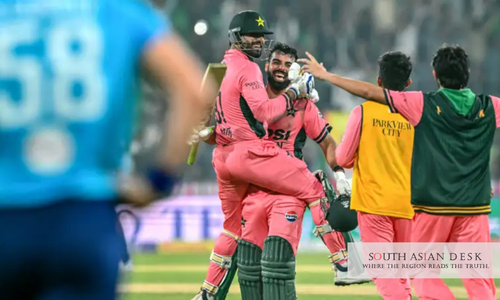
Pakistan’s dramatic cricket victories have long been defined by an extraordinary ability to recover from seemingly hopeless situations. From last-over finishes against traditional rivals to individual batting performances that overturned enormous deficits, Pakistan cricket has produced some of the most memorable comebacks in the history of One Day International (ODI) cricket. Recent performances, particularly Shadab Khan’s remarkable century against England, have once again brought this tradition into focus.
Pakistan’s cricketing identity has often been associated with unpredictability. While the team has experienced its share of disappointing collapses, it has also demonstrated an unusual capacity to turn matches around when defeat appears almost certain. These victories have frequently depended on individual players stepping forward at critical moments, producing innings that become part of the country’s sporting history.
Shadab Khan Revives Memories of Pakistan’s Historic Cricket Comebacks
Pakistan’s recent ODI tri-nation series provided another example of this familiar pattern. During the fourth match against England at Lahore’s Gaddafi Stadium on October 25, 2026, Shadab Khan produced a career-defining performance, scoring his maiden ODI century. His innings helped Pakistan secure a remarkable one-wicket victory after the team had been reduced to a precarious position.
The defining moment came through an unbeaten 89-run partnership between Shadab and Haris Rauf, which established a new record for the highest 10th-wicket partnership in a successful ODI run chase. Their performance demonstrated the importance of lower-order contributions in modern cricket, particularly when a team’s recognised batters have already been dismissed.
The innings also recalled an earlier era when Pakistan’s victories frequently depended on unexpected contributions from players lower down the batting order. Although contemporary cricket places considerable emphasis on aggressive batting and specialised roles, the ability to remain competitive under pressure remains a defining characteristic of the national team’s history.
Manzoor Elahi’s Match-Winning Performance Against India
One of the most memorable examples of Pakistan’s historic cricket comebacks came during a match against India in Sharjah in December 1986. The encounter followed Javed Miandad’s famous last-ball six against India earlier that year, adding further significance to an already intense rivalry.
India, batting first, were dismissed for 144 in a match scheduled for 45 overs. Pakistan appeared well-positioned during the early stages of the chase, but a dramatic collapse left the side struggling at 65 for six. Several established players, including Javed Miandad and Imran Khan, had departed without making a significant contribution.
With the match slipping away, Manzoor Elahi took responsibility for the chase. He scored a crucial 54-ball 50, guiding Pakistan towards the target and securing a memorable victory. His innings demonstrated how a single determined performance could transform the outcome of a match, particularly when the rest of the batting order had failed to deliver.
The victory remains an important reminder of the contributions made by players whose achievements are sometimes overshadowed by Pakistan’s more celebrated cricketing personalities.
Asif Mujtaba’s Extraordinary Rescue Against Australia
Another remarkable performance followed just weeks later, when Pakistan faced Australia in Perth during the 1986 America Cup. Chasing a target of 274, Pakistan found themselves in considerable difficulty after losing several wickets.
Qasim Umar had provided an important contribution with 67 runs, but his dismissal left Pakistan struggling at 96 for five. Subsequent wickets further increased the pressure, with the team requiring a substantial number of runs despite having limited batting resources remaining.
Asif Mujtaba played a crucial role in rebuilding the innings. He formed important partnerships with Manzoor Elahi, Saleem Yusuf and Wasim Akram, keeping Pakistan’s hopes alive. With seven runs required from the final over, the match came down to the contributions of the remaining batters.
The decisive moment arrived when last-man Saleem Jaffar struck Steve Waugh for a crucial two runs off the penultimate delivery. Pakistan secured an extraordinary victory, with Mujtaba remaining unbeaten on 59.
The match illustrated an important feature of Pakistan cricket: even when the recognised batters have failed, lower-order players have repeatedly found ways to keep the team in contention.
Salim Malik’s Explosive Innings in Kolkata
Pakistan’s memorable ODI victories against India also include Salim Malik’s extraordinary performance in Kolkata in 1987. Chasing 239 in a 40-over match, Pakistan were under pressure after Manzoor Elahi’s dismissal left the team at 160 for five.
Malik responded with an aggressive unbeaten 72 from just 36 deliveries. His innings completely changed the momentum of the contest, allowing Pakistan to overcome the remaining target with two wickets to spare and three deliveries remaining.
The performance was particularly significant because it demonstrated a different kind of match-winning contribution. Unlike innings built around carefully preserving wickets, Malik’s approach relied on taking calculated risks and putting the opposition bowlers under immediate pressure.
Such performances helped establish Pakistan’s reputation for producing unpredictable and highly entertaining cricket, particularly in matches against India.
Abdul Razzaq’s Unforgettable Century Against South Africa
Perhaps one of the most extraordinary examples of Pakistan’s batting resilience came in October 2010, when the team faced South Africa in Abu Dhabi. Chasing 287, Pakistan were struggling at 136 for five and still required another 153 runs with just over 20 overs remaining.
Abdul Razzaq produced an exceptional innings, scoring an unbeaten 109 from 72 deliveries. His innings included 10 sixes and seven fours, as he repeatedly attacked the South African bowling attack and kept Pakistan’s chances alive.
Razzaq received valuable support from Fawad Alam and Shoaib Akhtar, with the latter joining him for an unbeaten partnership that helped bring the target within reach. Pakistan eventually secured a one-wicket victory with one ball remaining.
The innings remains one of the most celebrated individual performances in Pakistan’s ODI history. It demonstrated that even a substantial deficit could be overcome through aggressive batting, composure and an ability to exploit opportunities under pressure.
Pakistan’s Dramatic Cricket Victories: Pakistan Cricket’s Tradition of Unexpected Heroes
Pakistan’s dramatic cricket victories are not simply remembered because of the results. They are remembered because of the circumstances in which they occurred and the unexpected individuals who made them possible.
From Manzoor Elahi and Asif Mujtaba to Salim Malik and Abdul Razzaq, Pakistan’s cricketing history contains numerous examples of players stepping forward when established batters have failed. These performances have contributed to a sporting culture in which matches are rarely considered over until the final delivery.
Shadab Khan’s recent century and his partnership with Haris Rauf represent a continuation of this tradition. While the players, formats and conditions have changed, the underlying qualities remain familiar: resilience, determination and the ability to perform when the pressure is greatest.
For younger supporters discovering these moments, such performances offer an introduction to a much broader history of Pakistan cricket. For older fans, they serve as reminders of an era in which extraordinary comebacks were among the most compelling features of following the national team.
Ultimately, Pakistan’s cricketing legacy is not defined exclusively by tournament victories or individual records. It is also shaped by matches that appeared lost but were transformed by remarkable performances. These encounters remain an essential part of the country’s sporting heritage and continue to reinforce the belief that, in Pakistan cricket, the result is never certain until the final ball has been bowled.
Follow SouthAsianDesk on X, Instagram and Facebook for insights on business and current affairs from across South Asia.
Read More: