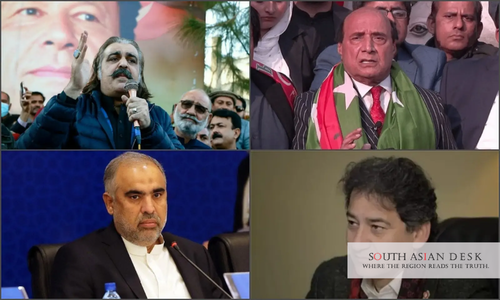
An Anti-Terrorism Court (ATC) in Islamabad granted pre-arrest bail to PTI leaders on Monday in cases linked to the October 26 protest and a demonstration held outside the Supreme Court. The relief went to former National Assembly speaker Asad Qaiser, along with Atif Khan, Latif Khosa and Faisal Amin Gandapur, all of whom belong to the Pakistan Tehreek-i-Insaf (PTI).
Details of the Anti-Terrorism Court Order
ATC Judge Abual Hasnat Muhammad Zulqarnain allowed the fresh applications after hearing arguments from counsel for the four politicians. The court directed each of them to furnish surety bonds of Rs5,000 as a condition of the relief.
According to the court order, Mr Qaiser was granted bail in nine cases, Mr Khan in four, Mr Khosa in three and Mr Gandapur in six. Taken together, the order amounts to 22 separate grants of protection against arrest across the proceedings in which the four leaders are named.
The cases stem from the aftermath of the PTI’s protest activity in the federal capital. The November 26, 2024 protest was aimed at building pressure on the government to release PTI founder Imran Khan, and the demonstration outside the Supreme Court is the subject of separate proceedings before the same court. Dawn reported the development in its edition of November 3. thenews
Why Pre-Arrest Bail to PTI Leaders Followed an Earlier Dismissal
The latest order is notable because it came only days after the same court had dismissed the earlier pre-arrest bail applications of the four leaders. The court had taken that step because they repeatedly failed to appear before it. The leaders then filed fresh applications, which the court accepted on Monday after hearing their lawyers.
The sequence illustrates a well-established feature of this remedy. Pre-arrest bail, which is sought under Section 498 of the Code of Criminal Procedure, 1898, is an interim protection that shields an accused person from arrest before it takes place. Courts ordinarily expect applicants to attend hearings, and repeated absence can lead to the dismissal of an application, as happened here. Hence the grant of pre-arrest bail to PTI leaders on this occasion turned on the leaders’ return to the court with fresh applications rather than on any decision about the underlying allegations.
It is equally important to understand what the order does not do. Bail of this nature does not conclude the cases or determine whether the accused are guilty. It simply restrains the authorities from arresting the four leaders in the specified cases, provided they furnish the required surety bonds and comply with the court’s directions. The proceedings themselves remain pending, and the leaders will be expected to appear when summoned.
The matter also reflects the volume of litigation that followed the PTI’s protests in Islamabad. Numerous cases have been registered against party leaders and workers, and they were filed under the Anti-Terrorism Act and other charges, with allegations that include damage to public and private property and the blocking of roads. As a result, the Anti-Terrorism Court in the federal capital has been hearing a steady stream of bail matters connected to these events. aaj
Islamabad High Court to Hear National Dialogue Committee Petition
In a related development concerning the party, the Islamabad High Court (IHC) has fixed November 5 for the hearing of a petition filed by members of the National Dialogue Committee (NDC). The petitioners are seeking permission to meet incarcerated PTI founder Imran Khan and his wife, Bushra Bibi, at Adiala jail.
Justice Umer Majid Malik will hear the petition on Thursday. It is currently pending alongside objections raised by the Registrar’s Office. The petition was filed through senior lawyer Faisal Fareed Chaudhry by former federal minister Fawad Chaudhry, former Sindh governor Imran Ismail, Mahmood Baqi Molvi and Barrister Muhammad Ali Khan Saif. The petitioners have named the interior secretary, the Punjab home secretary and the superintendent of Adiala jail as respondents.
What the Ruling Means for the Four Leaders
For Mr Qaiser, Mr Khan, Mr Khosa and Mr Gandapur, the ruling removes the immediate risk of arrest in the cases covered by the order, subject to the surety bonds of Rs5,000 each. Whether the protection endures will depend largely on their conduct before the court, given that an earlier set of applications failed for want of appearance.
For observers of the proceedings, the episode underlines how closely the Anti-Terrorism Court monitors attendance in politically sensitive cases. The four leaders now have a clear opportunity to participate in the proceedings, while the prosecution retains the ability to press its case on the merits as the hearings continue.
Follow SouthAsianDesk on X, Instagram, and Facebook for insights on business and current affairs from across South Asia.