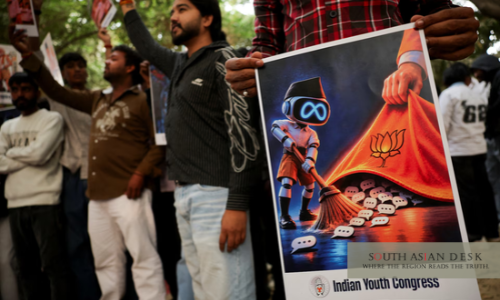
A protest outside Meta offices in the northern Indian state of Haryana ended with police using water cannon to disperse demonstrators on Saturday. The activists belong to the youth wing of the main opposition Congress party, which accuses the company of censoring opposition voices on its platforms. The confrontation marks a new phase in a campaign that has become one of the biggest challenges the parent company of Facebook and Instagram has faced in its largest market by users, according to Reuters.
Water Cannon Used in Gurugram
The latest demonstration took place near Meta’s office in Gurugram, where members of the Congress youth wing gathered with placards to object to the removal of some accounts and posts belonging to party members. Police used water cannon to break up the gathering. The youth wing said on X that its activists were drenched with dirty water, and it accused the government of using force against people demanding freedom of expression.
A Reuters witness reported that police detained a few party supporters, who were later released. The protest followed earlier demonstrations at Meta’s Indian offices. Business Standard reported that Youth Congress workers had protested in Hyderabad, Mumbai and Gurugram against the removal of Instagram accounts belonging to party members.
Allegations Against Meta and Its Response
The protesters accuse Meta of acting in the interests of Prime Minister Narendra Modi’s Bharatiya Janata Party, an allegation the company has not addressed in public. Meta says it restricts content in India in accordance with local laws. The company has not commented publicly on the protests, but people familiar with the matter told Reuters that Meta conveyed in a closed-door meeting with Congress that it remains neutral towards all political parties. According to Business Standard, which cited one of those people, Meta also told the party that some of the removals resulted from its policy on AI-generated content.
The Indian government has said that it orders content to be taken down only when it breaches local laws, according to Reuters reporting carried by The Express Tribune. Congress, however, argues that the practical effect of the restrictions is to put it at a disadvantage in the run-up to state elections next year, when Facebook and Instagram are expected to be key campaigning platforms.
The Automated Takedown Rule at the Centre of the Dispute
Beyond the street demonstrations, the Congress youth wing has taken the dispute to court. It has sued both Meta and the Indian government, seeking to strike down a rule that has sharply expanded content restrictions. Under the automated takedown rule, a single takedown order triggers an automated sweep that removes copies of the flagged post across the platform, rather than requiring each copy to be reviewed on its own.
The scale of the change is considerable. Reuters reported that Meta’s content restrictions in India rose by more than 130 times in the first half of this year after the rule came into force. Free speech activists have argued that the framework leaves social media companies with very little time to review and decide on takedown requests, and Reporters Without Borders has said the removal of journalistic content from social media has been increasing in India this year.
For Congress, the legal challenge is intended to address what it describes as the loss of its social media presence. The party’s youth wing alleges that the automated system is wiping out its online footprint by blocking political posts. The complaint also raises a wider question about whether a level playing field exists for parties that depend on social media to reach voters.
What the Protest Outside Meta Offices Signals
The protest outside Meta offices in Gurugram illustrates how a dispute over technical moderation systems has turned into a political contest with a street dimension. For Meta, the situation is delicate. The company must comply with Indian law in a market where it has an enormous user base, while also maintaining its position that it treats all political parties equally. For the government, the rule is a regulatory tool that it says is applied only to content that violates the law. For Congress, it is evidence of an uneven political environment as campaigning for state elections approaches.
How the courts respond to the youth wing’s petition is likely to shape the next stage of the dispute. Until then, further demonstrations at Meta’s offices appear probable, and the company will continue to face pressure from both the opposition and the authorities over how it enforces content restrictions in India.
Follow SouthAsianDesk on X, Instagram and Facebook for insights on business and current affairs from across South Asia.