Words carry meaning. In the past four months, we understood the heavy burden of the word “accountability.”
The National Eligibility cum Entrance Test (NEET) 2026 paper leak and the protests that followed highlighted that lapses in accountability don’t just damage a system. They erode public trust in the very institutions meant to protect them.
In this article, I examine the fallout of the NEET 2026 paper leak across four fronts: the Government, the Police, the Media, and the Cockroach Janta Party (CJP).
Ministry of Education, National Testing Agency (NTA), and National Medical Commission (NMC)’s constant negligence:
NEET isn’t just any examination. For the 22 lakh medical aspirants that give this examination yearly, it is the gateway to their future. One would expect such examinations to be carried out under strict security measures and robust protocols. However, the data tells another story. According to the Tribune India, over the past two decades, more than 90 instances of paper leaks have been recorded, including 15 conducted by central agencies.
When the 2024 NEET paper leaked, the then Union Education Minister, Dharmendra Pradhan denied all allegations. However, public outrage and political pressure caused him to retract the statement, noting that irregularities had occurred. His answer was a complete overhaul: a zero error mandate for leaks, a committee to ensure transparency and improvement in NTA’s structure and functioning. Furthermore, the case was also handed over to the Central Bureau of Investigation (CBI), whose probe resulted in charge sheets against 45 individuals.
After the 2026 leak, similar actions were taken. A fast-track court to expedite proceedings related to paper leaks, a task force headed by the chairman of Infosys, Nandan Nilekani, making amendments to the Public Examination (Prevention of Unfair Means) bill, and accepting the resignation of Union Minister Dharmendra Pradhan after public uproar across the country.
Are these steps enough to prevent paper leaks?
According to the Scroll, of the 45 charge sheets filed in 2024, 44 individuals are out on bail. The key accused, Sanjeev Mukhiya, has been cleared, citing no evidence against him. Authorities had 22 months to address inefficiencies in the systems, but the proposed computer-based system was not implemented, the restructuring of the NTA was not completed, and the Radhakrishnan Committee reforms were not actioned.
The gap between assurance and action is stark.
The Police Force and their actions during the “Chalo Sansad” march on 20th July, 2026:
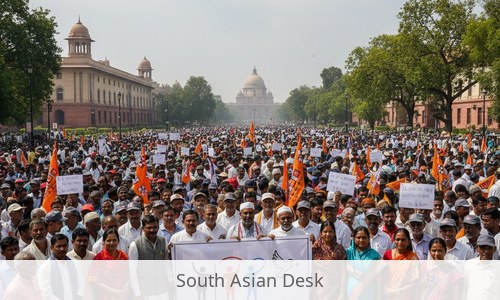
Article 19(1) (A) and 19 (1) (B) of the Indian Constitution give citizens the right to peacefully gather for a protest. Following the NEET paper leak, the CJP began a sit-in at Jantar Mantar in June 2026, joined by thousands of students demanding the resignation of Dharmendra Pradhan and reforms in the education system. When the government failed to respond, CJP and the students planned a march to parliament on 20th July, 2026.
What no one could have expected was the police action at Jantar Mantar and protest sites across the country.
According to a report by the Indian Express, after the first day of the march itself, Ram Manohar Lohia Hospital in Delhi treated more than 100 protesters. The Times of India reported a 21-year-old woman who was placed on ventilator support for two days after a stampede broke out when police fired tear gas into the crowd. The Hindu wrote of a case where a 19-year-old man could permanently lose his vision in one eye after being hit by a pellet gun.
The brutality was not just physical but mental as well. Across the country, students were intimidated not to join the protests, had their locations tracked by GPS, and wrongfully detained.
Who should be held accountable?
The Rapid Action Force has admitted to the use of excessive force. RAF Inspector General Seema Dhundhia has criticised the behavior of on-ground personnel, saying that the use of force should be in a graded manner. Yet, in a striking contradiction, the Central Reserve Police Force‘s own post-event assessment concluded that all standard operating procedures were followed by RAF personnel on July 20, directly at odds with its own force’s public admission of excessive force.
Accountability also rests on the protesters who resorted to violence and vandalism. The Delhi Police reported that at least 118 police personnel, including several senior officers, were injured, government vehicles were damaged, and public property was vandalized. Such actions take away the ethos of a movement demanding change.
At the time of writing this article, several questions remain unanswered. Why were water cannons not used? Who ordered the firing of pellet guns? Why were officers not wearing name tags? Why were male cops hitting females?
The protest was peaceful. The demand was for reforms.
Yet, students were met with lathis, tear gas, assault, and wrongful detentions.
The media and their repeated failure to report the nuances of the protest:
The media is an independent pillar of democracy, meant to keep executive powers in check. What happens when their sense of responsibility towards the nation diminishes?
Reporting of the protests by mainstream media has been biased and has not reflected the nuances of the situation.
An analysis by Alt News of the 404 posts shared by Asian News International (ANI) on X reveals no mentions of the brutal attacks by the police on student protesters. Newslaundry reports how channels such as Republic TV and ABP News twisted narratives around the protest. On Republic TV, the entire conversation by editor-in-chief Arnab Goswami repeatedly returned to allegations of foreign funding and claims that the protest was an attempt to destabilize the country. Vice President of News and Programming at ABP News, Chitra Tripathi, devoted much of her conversation to political opportunism on the part of the opposition and the CJP. Rarely were the primary demands of the protesters mentioned.
At the protest sites as well, a similar manner of questioning continued. Rather than addressing education reforms or student distress, reporters asked questions like the “full form of NEET” or the spelling of “cockroach”. Mainstream media picked isolated events of vandalism and anger on the part of the students, from a largely peaceful protest, and framed their entire narrative around it.
An institution responsible for reporting facts and not biases, news and not ideologies, cannot hope to function in this manner.
The Cockroach Janta Party and mismanagement of the protest:
Before any criticism, I want to commend their efforts. Awakening a spirit of political consciousness in a country as wide as India is not easy. Keeping a hunger strike for close to a month and managing crowds at Jantar Mantar is not easy.
However, that does not let them off accountability.
The injuries inflicted on students, wrongful detentions, and trauma they had to endure could have been largely averted if the protest had been organized in a centralized manner with crowd control and clear communication channels. This lack of communication resulted in stampedes, crowd control failures, and clashes between students and the police.
It also left the protest vulnerable to being hijacked by bad elements. According to the Frontline Magazine, the police identified 2873 people at Jantar Mantar with prior criminal records. This included more than 980 individuals who had been booked for cases like murder, robbery, and rape.
Calling off the protest without written assurance from the government and legal support for protesters sets a bad precedent. Students have borne immense risks and now bear the brunt of FIRs and intimidation by the police, with little support. Just days after the agreement, CJP itself had to threaten renewed protests, alleging that FIRs were still being filed and students detained across states despite government assurances to the contrary. While many political parties have offered legal assistance, with CJP itself launching the “Saakshi” platform for registering cases against police brutality, it feels too little too late.
Victory may have been claimed, but if students are still fighting for their rights, can it be called so?
Conclusion:
Wherever you look, the story remains the same. Be it the students protests in Jharkhand, questions around the Common Entrance Test (CET) or the UGC-NET being reconducted. It is institutions forgetting what accountability demands. Not a statement, not a resignation, not a platform launched after the damage was done, but the harder, slower work of actually changing what comes next.
The burden of the word “accountability” is immense. When institutions forgo this responsibility, the impact is not just within, but ripples throughout the country.