Rohingya camp landslide deaths rose again in Cox’s Bazar after four students and a teacher were killed when a hillside collapsed onto a madrasa in Ukhiya on Wednesday afternoon.
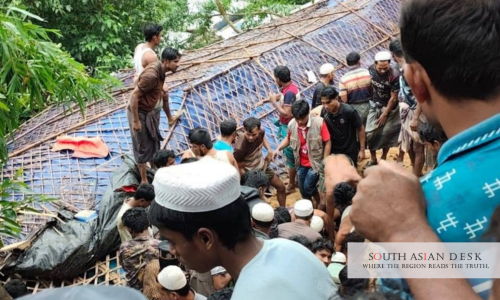
The incident took place at Khatijatul Mahila Hefazkhana Madrasa in Block A-3 of Rohingya Camp-5, where children were attending classes during heavy rain. Officials said a section of a hill collapsed onto a retaining wall, which then crashed into the bamboo-and-tarpaulin structure.
The Refugee Relief and Repatriation Commissioner revised the death toll to five after an earlier figure of eight was found to have resulted from double-counting during the rescue operation. The confirmed victims included four female students and a teacher.
Rohingya camp landslide hits madrasa during classes
The Rohingya camp landslide struck at around 2:00pm while more than 30 children were believed to be inside the learning centre. One student died at the scene, while injured students were taken to nearby hospitals. Officials later confirmed that three more students and a woman had died from their injuries.
Eight students were reported to be receiving treatment at different hospitals, with some in critical condition. Rescue operations were called off in the evening after community members and emergency responders searched through the debris.
Officials said the learning centre was privately operated by members of the Rohingya community. The Refugee Relief and Repatriation Commissioner also ordered the closure of all learning centres in the refugee camps until further notice.
A senior official from the Armed Police Battalion said the collapse involved the wall of a mosque and a maktab built on top of a hill about 12 feet high. The structure came down during heavy rainfall and fell onto part of the madrasa.
Heavy monsoon rain raises landslide danger
The latest Cox’s Bazar landslide came after days of intense monsoon rain in the district. The local meteorological office recorded 92 millimetres of rainfall during the 12 hours ending at 6:00pm on Tuesday, while total rainfall between Sunday morning and Tuesday evening reached 530 millimetres.
Heavy to very heavy rainfall was forecast to continue for another two to three days, increasing the risk of further landslides and flooding across the refugee settlements.
The danger is especially severe in the Rohingya camps because many shelters and learning centres are located on or near unstable hillsides. The settlements are densely populated, and many structures are built with bamboo, tarpaulin and light materials that offer little protection during slope failure.
The disaster also followed earlier landslides in the same week. From early Monday until dawn on Tuesday, eight Rohingya refugees were killed in separate landslides after heavy rainfall hit the camps.
Refugee camp safety under renewed scrutiny
The Rohingya camp landslide has renewed concern over safety conditions in one of the world’s largest refugee settlements. More than one million Rohingya refugees live in camps in Cox’s Bazar after fleeing violence and persecution in Myanmar, with many residing in areas exposed to flooding, fire and landslide risks.
The camp environment makes disaster prevention extremely difficult. Space is limited, slopes are heavily used, drainage systems are under pressure, and families often resist relocation from high-risk areas because of uncertainty over shelter, services and community ties.
Authorities and humanitarian agencies have repeatedly warned that monsoon rains can quickly turn steep camp terrain into a lethal hazard. Even small slope failures can be deadly when shelters, classrooms and community buildings are located beneath unstable hillsides.
The latest incident is particularly painful because it involved children attending lessons. It highlights the need for stricter site safety checks for learning centres, mosques, maktabs and other community structures built near slopes or retaining walls.
Bangladesh faces recurring monsoon disasters
Bangladesh landslides are a recurring danger during the monsoon season, especially in the hilly districts of the southeast. Cox’s Bazar is particularly vulnerable because it combines heavy rainfall, fragile slopes and the added pressure of large refugee settlements.
The Rohingya camps have experienced repeated disasters, including landslides, floods and fires. Humanitarian organisations have worked to improve drainage, relocate families from the most dangerous areas and strengthen emergency preparedness, but the scale of risk remains high.
The latest deaths show that risk reduction measures are still not enough to protect all residents. The combination of heavy rain, dense settlement patterns and fragile construction continues to place refugees at severe risk.
With further rain forecast, authorities are likely to intensify relocation efforts from dangerous slopes and restrict activities in vulnerable learning spaces. However, emergency steps will need to be matched with longer-term planning to prevent similar tragedies.
Calls grow for safer camp infrastructure
The Rohingya camp landslide has added urgency to calls for safer infrastructure in the camps. Temporary shelters and community buildings may be unavoidable in a refugee setting, but their location and construction standards can determine whether they withstand extreme weather.
Priority areas include slope stabilisation, drainage improvement, safer siting of schools and religious learning centres, and early warning systems that reach families quickly. Authorities may also need to review whether private community-operated learning centres are being built in locations that expose children to avoidable danger.
The disaster also underlines the wider humanitarian strain in Cox’s Bazar. Refugees remain dependent on aid, while international funding pressures have made it harder to improve shelters and camp facilities at the scale required.
For now, the immediate focus is on treating the injured, supporting bereaved families and preventing further deaths as rain continues. The confirmed loss of four students and a teacher shows how quickly monsoon conditions can turn dangerous in the camps.
The latest tragedy is not only a natural disaster. It is also a warning about the vulnerability of refugee communities living in fragile, overcrowded and hazard-prone conditions with limited long-term options for safety.
Published in SouthAsianDesk, July 9, 2026
Follow SouthAsianDesk on X, Instagram and Facebook for insights on business and current affairs from across South Asia.