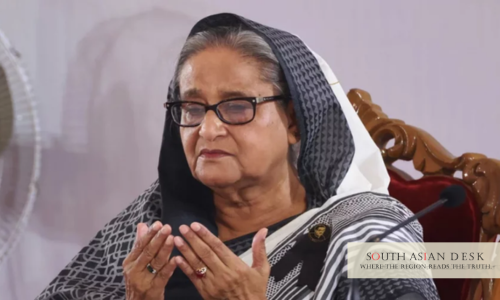
Sheikh Hasina return claims have reopened one of Bangladesh’s most sensitive political questions, after the country’s fugitive former prime minister said she intends to go back to Dhaka this year despite facing a death sentence over the deadly crackdown that preceded her fall from power.
Hasina, who has been living in exile in India since fleeing Bangladesh in August 2024, made the remarks in an interview with Indian broadcaster NDTV, according to reports. The former leader said she was prepared to return even though Bangladeshi courts have convicted her in absentia and sentenced her to death for crimes against humanity linked to the state response to the 2024 student-led uprising.
Her comments come at a volatile moment for Bangladesh. The country has spent nearly two years trying to move beyond the collapse of Hasina’s 15-year rule, while still dealing with the legal, political and social consequences of the violence that brought it down. For her supporters, the statement signals defiance and a possible attempt to revive the Awami League’s political relevance. For her opponents and victims’ families, it raises the prospect of a deeply polarising return by a leader they accuse of presiding over one of the bloodiest crackdowns in Bangladesh’s recent history.
Sheikh Hasina Return Statement Revives Political Tensions
The Sheikh Hasina return statement matters because it is not simply a personal declaration. Hasina remains the most recognisable figure in the Awami League and one of the most consequential politicians in Bangladesh’s history. She served as prime minister for a combined period longer than any other leader in the country’s history and governed continuously from 2009 until her ouster in 2024.
Her long tenure brought major infrastructure projects, economic growth and close ties with India, but it was also marked by growing allegations of authoritarianism, enforced disappearances, pressure on the opposition, restrictions on dissent and heavily disputed elections. By the time protests erupted in 2024, resentment had built across students, opposition groups, civil society and sections of the public who viewed her government as increasingly intolerant of challenge.
The protests initially began over a quota system for government jobs but quickly developed into a wider anti-government movement. The state’s response turned the crisis into a national uprising. Hasina fled to India on August 5, 2024, after protesters marched on Dhaka and stormed her official residence.
Death Sentence and Legal Risks
Hasina’s proposed return would carry extraordinary legal risks. In November 2025, Bangladesh’s International Crimes Tribunal sentenced her to death in absentia after finding her guilty of crimes against humanity over the 2024 crackdown. The tribunal convicted her of offences including incitement, ordering killings and failing to prevent atrocities during the suppression of protesters.
Hasina has rejected the case as politically motivated and has argued that the proceedings were unfair. Her party and supporters have similarly dismissed the charges as part of a campaign to erase the Awami League from Bangladeshi politics.
However, the allegations against her are not limited to domestic political rivals. A United Nations human rights investigation into the 2024 violence found evidence of widespread abuses during the crackdown and estimated that as many as 1,400 people may have been killed. The UN report accused the former government and security forces of serious violations, including the use of live ammunition against protesters, arbitrary detentions and attacks on journalists and medical personnel.
At the same time, international rights groups and UN officials have also raised concerns about the death penalty and fair trial standards, particularly because Hasina was tried in absentia. That has created a complicated legal picture: there is a strong demand for accountability for the killings, but also concern that justice must meet international standards if it is to be credible.
A Return Could Test Bangladesh’s Stability
If Hasina actually returns to Dhaka, the impact could be immediate and destabilising. She could face arrest on arrival, renewed court proceedings, or enforcement of existing convictions unless legal or political arrangements intervene. Any attempt by her supporters to mobilise around her return could trigger counter-protests from student groups, victims’ families and parties that helped bring down her government.
Bangladesh’s political environment remains deeply fractured. The Awami League, once the country’s dominant political machine, has been weakened by exile, legal cases and public anger over the 2024 violence. Many of its senior figures fled, went underground or faced prosecution after Hasina’s fall. The party’s opponents argue it should not be allowed to return to power without accountability for the crackdown.
Yet excluding a historically major party from politics also carries risks. Bangladesh has long struggled with cycles of winner-takes-all politics, revenge prosecutions and institutional mistrust. If the Awami League remains outside the formal political process, its support base may become more radicalised or operate through informal networks. If it is brought back without justice for the victims, public anger could deepen.
Hasina’s return threat therefore sits at the centre of Bangladesh’s hardest dilemma: how to pursue accountability without turning the post-Hasina transition into another chapter of political vengeance.
India’s Role Remains Crucial
Hasina’s continued presence in India has also strained India-Bangladesh relations. New Delhi was one of her closest international partners during her time in power. Her government cooperated with India on security, connectivity and regional policy, while India viewed her as a reliable partner in a strategically important neighbour.
After her ouster, Bangladesh sought her return to face legal proceedings. India, however, has not publicly moved to hand her over. The issue is diplomatically sensitive. Extraditing Hasina could damage India’s relationship with the Awami League and its support base; refusing to do so could fuel resentment in Dhaka and strengthen the perception that India is sheltering a fallen leader accused of grave abuses.
If Hasina says she intends to return voluntarily, that could shift the diplomatic pressure. But it remains unclear whether her statement reflects a concrete plan, a political signal to supporters, or an attempt to challenge the legitimacy of the current Bangladeshi order from exile.
Minority Rights and Competing Narratives
In her latest remarks, Hasina also criticised Bangladesh’s current leadership and accused it of failing to protect minorities. This is a politically powerful claim because Bangladesh has seen repeated concern over attacks on Hindu and other minority communities during periods of unrest.
However, the minority rights issue is also contested. Hasina and the Awami League have often presented themselves as defenders of secularism and minority protection, while opponents accuse her of using that image to justify authoritarian control. Since her fall, reports of attacks and intimidation against minorities have remained a serious concern, but the issue is frequently caught between genuine human rights fears and competing political narratives.
A credible response requires more than partisan claims. Bangladesh’s authorities need to investigate attacks on minorities transparently, protect vulnerable communities and prevent political actors from using communal insecurity as a weapon.
What Comes Next for Bangladesh Politics
The prospect of a Sheikh Hasina return will keep Bangladesh’s politics unsettled. If she stays in India, she remains a symbolic leader in exile, able to influence supporters but unable to directly control events on the ground. If she returns, Bangladesh may face a dramatic confrontation between the demand for justice and the risk of renewed unrest.
For now, the statement appears designed to show that Hasina does not consider her political career over. Whether that becomes a real journey back to Dhaka is another matter.
Bangladesh’s next test is not only what happens to Sheikh Hasina. It is whether the country can build a political system where accountability, due process, minority protection and democratic competition can exist together. Without that, Hasina’s shadow will continue to hang over Dhaka, whether she returns this year or not.
Published in SouthAsianDesk, June 29, 2026
Follow SouthAsianDesk on X, Instagram and Facebook for insights on business and current affairs from across South Asia.