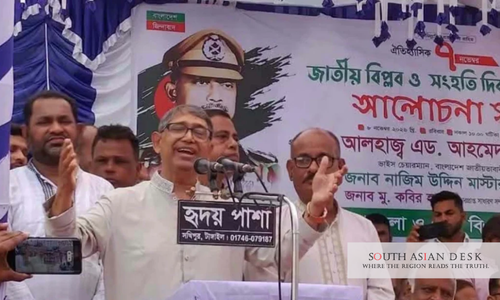
The Sheikh Hasina return to Bangladesh debate has intensified after Liberation War Affairs Minister Ahmed Azam Khan declared that the former prime minister would never return to the country. Speaking at a political gathering in Sakhipur on Sunday, November 8, the minister accused Hasina of attempting to destabilise Bangladesh from India and alleged that she could encourage Awami League leaders and activists to engage in sabotage.
His remarks come as Hasina continues to express her intention to return from India, where she has been living since leaving Bangladesh in August 2024 following a student-led uprising that brought an end to her government. In a significant development on November 9, Reuters reported that her lawyers had requested a new Bangladeshi passport and national identity card, describing the move as part of preparations for her planned return in December.
The contrasting statements highlight the uncertainty surrounding Hasina’s political future, the Bangladeshi government’s efforts to secure her return through legal channels, and the continuing tensions between the former ruling party and the current administration.
Ahmed Azam Khan Says Sheikh Hasina Will Never Return to Bangladesh
Ahmed Azam Khan made the remarks while addressing a discussion meeting organised by the Sakhipur upazila unit of the Bangladesh Nationalist Party (BNP) on Sunday afternoon. The gathering was held to mark National Revolution and Solidarity Day, an occasion observed by the party.
According to Dhaka Tribune, the minister said the government wanted Hasina to return to Bangladesh to face trial and imprisonment over allegations of genocide. However, he asserted that she would not come back and instead accused her of spreading rumours, attempting to destabilise the country and encouraging Awami League members to participate in sabotage.
The minister also warned that the government would not tolerate activities aimed at disrupting public order. He said Bangladesh had no room for sabotage and would continue moving towards democracy and development.
His comments reflected the government’s wider concerns about political instability and the activities of the former ruling party. The Awami League, which governed Bangladesh under Hasina for multiple terms, was banned following her removal from office. Many of its senior figures have faced arrest or remain outside the country.
Ahmed Azam Khan also criticised opposition parties for organising frequent demonstrations and issuing threats and ultimatums. He argued that political processions involving thousands of vehicles were wasteful at a time when the prime minister was attempting to address the country’s fuel crisis. He urged the government to be given five years to govern and said the next election should take place under a system that protects citizens’ voting rights.
Sheikh Hasina Return to Bangladesh Remains a Point of Political Tension
Despite the minister’s assertion, Hasina has repeatedly stated that she intends to return to Bangladesh. She left the country on August 5, 2024, after student-led protests forced her government from power. She subsequently travelled to India, where she has remained.
In an interview with the Associated Press published earlier in November, Hasina reaffirmed her intention to return in December, despite the possibility of arrest or imprisonment. She said she was prepared to face the consequences of returning and maintained that she did not intend to remain outside Bangladesh indefinitely.
Her position has also been reflected in a recent legal development. On November 9, Reuters reported that lawyers representing Hasina had written to Bangladesh’s embassy in New Delhi requesting the issuance of a new passport and national identity card. The request reportedly referred to the revocation of her existing documents and argued that she remained entitled to Bangladeshi nationality and the associated documentation.
Her aides have said that the specific date of her return would be announced after the necessary formalities were completed. The request does not, however, establish that her return has been approved or that arrangements for her arrival have been finalised.
The difference between Hasina’s stated intention and the minister’s prediction is significant. While Ahmed Azam Khan has presented her return as something that will not happen, Hasina has taken steps that she and her representatives describe as preparations for coming back.
Bangladesh Government Pursues Legal Routes for Hasina’s Return
The question of Hasina’s return is not solely a matter of political statements. It is also connected to the legal proceedings against her and the diplomatic relationship between Bangladesh and India.
Bangladesh has repeatedly sought her extradition from India. The Associated Press has reported that India has not agreed to hand her over, leaving the matter dependent in part on diplomatic and legal discussions between the two countries.
Bangladesh’s Law Minister, Md Asaduzzaman, said on November 8 that the government was pursuing the necessary legal procedures. Speaking to journalists in Dhaka, he stated that the government would act in accordance with the law and referred to a request made to India under the prisoner exchange agreement. He said that if India handed Hasina over, the authorities would follow due process.
The law minister’s comments provide an important distinction between the government’s position and Ahmed Azam Khan’s political remarks. While the latter said Hasina would never return, the law minister described an ongoing effort to secure her return through formal channels. Prothom Alo also reported that India describes Hasina as a state guest rather than a prisoner, a distinction relevant to the government’s reference to the prisoner exchange arrangement.
Hasina’s legal position further complicates the prospect of her return. In November 2025, a Bangladeshi tribunal sentenced her to death in absentia in connection with the crackdown on protesters during the 2024 uprising. She has denied wrongdoing and rejected the legitimacy of the proceedings. Her stated willingness to return despite the possibility of arrest therefore comes against the background of serious criminal proceedings and a highly contested political transition.
Political Uncertainty Surrounds Bangladesh’s Future
The dispute over Hasina’s possible return reflects the broader political divisions that have continued since the 2024 uprising. The BNP government, led by Prime Minister Tarique Rahman, faces the challenge of maintaining political stability while addressing the legal and political consequences of the previous administration’s removal.
The Awami League’s absence from the electoral process and the continued detention or exile of several of its leaders have also contributed to uncertainty about the party’s future. Hasina’s return could therefore have consequences extending beyond her individual legal proceedings, particularly given her continued association with the former ruling party.
For now, the statements made by Ahmed Azam Khan and Hasina’s recent actions point in opposing directions. The minister has ruled out her return, while her representatives have requested new identity documents and reiterated plans for a December homecoming. Neither development, by itself, settles the question.
The eventual outcome will depend on the legal proceedings, the Bangladeshi government’s efforts to secure her return, and the position taken by Indian authorities. Until those issues are resolved, Sheikh Hasina’s political future and the possibility of her return are likely to remain central subjects in Bangladesh’s political debate.
Follow SouthAsianDesk on X, Instagram and Facebook for insights on business and current affairs from across South Asia.