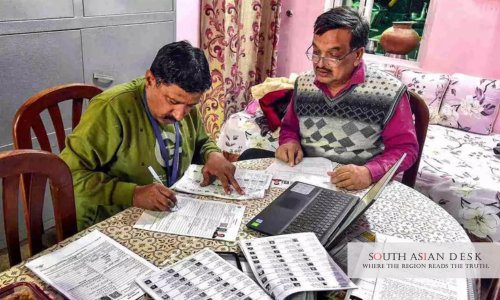
Special Intensive Revision of electoral rolls has completed one year, with nearly six crore names deleted from voter lists and the exercise continuing across 19 states and Union territories.
The large-scale revision, launched as a pilot in Bihar on June 24 last year, was presented as an effort to clean up electoral rolls by removing dead, duplicate, shifted or otherwise ineligible entries. But the scale of deletions has made it one of the most politically contested voter-list exercises in recent years, with opposition parties and activists warning that genuine voters may also have been excluded.
Special Intensive Revision Expands Beyond Bihar
The first major flashpoint came in Bihar, where the voter list was sharply reduced during the pilot exercise. The deletions triggered allegations that the process placed an excessive burden on ordinary voters, particularly poorer citizens, migrants and people without easy access to older documents.
After Bihar, the exercise was extended to several other states and Union territories. In the second phase, it covered Uttar Pradesh, West Bengal, Tamil Nadu, Rajasthan, Chhattisgarh, Kerala, Puducherry, Andaman and Nicobar Islands, Lakshadweep, Gujarat, Madhya Pradesh and Goa.
Across these 12 states and Union territories, the voter base reportedly fell from more than 50.99 crore to around 45.81 crore after the revision. That amounts to a reduction of more than 5.18 crore names, or about 10.2 percent of the earlier rolls.
Officials have said the deletions included deceased voters, duplicate entries and names removed after objections and adjudication. More than 66 lakh deceased electors were removed, while over 63 lakh names were deleted after objections and related proceedings.
Legal Battle Over SIR Voter Deletions
The Special Intensive Revision also became the subject of a major legal battle. Petitioners challenged the process, arguing that the exercise risked disenfranchising citizens and that the Election Commission’s verification requirements could unfairly exclude genuine voters.
The Supreme Court ultimately upheld the constitutional validity of the Election Commission’s power to conduct the exercise. The ruling recognised the Commission’s authority under Article 324 of the Constitution and the Representation of the People Act to maintain accurate electoral rolls.
However, the legal debate did not end the political controversy. Critics remain concerned about the practical effect of mass deletions, especially where affected voters claim they did not receive proper notice, did not understand the process, or were unable to submit documents in time.
Why the Election Commission Says SIR Is Needed
The Election Commission has defended the electoral roll revision as necessary for free and fair elections. Its stated objective is to ensure that no eligible citizen is left out and no ineligible person remains on the voter list.
That goal is not controversial in itself. Accurate electoral rolls are essential to any credible election. Names of deceased voters, duplicates and shifted residents can distort turnout figures and create opportunities for electoral malpractice.
The dispute is over method and scale. A clean voter list strengthens democracy only if the process is transparent, accessible and correctable. If genuine voters are removed without meaningful notice or an easy path back onto the roll, the same exercise can weaken public trust.
19 States and UTs Now Under the Exercise
The third phase of the Special Intensive Revision was rolled out in 16 states and three Union territories, covering Andhra Pradesh, Arunachal Pradesh, Haryana, Jharkhand, Karnataka, Maharashtra, Manipur, Meghalaya, Mizoram, Nagaland, Odisha, Punjab, Sikkim, Tripura, Telangana and Uttarakhand, along with Delhi, Chandigarh, and Dadra and Nagar Haveli and Daman and Diu.
This phase involves more than 36 crore voters and is expected to conclude later this year. Its progress will be watched closely, particularly in states where electoral competition is intense and where even small changes in voter rolls can become politically sensitive.
The central question now is not whether voter lists should be revised. They should. The question is whether the process can balance roll purity with voter protection.
For millions of Indians, the right to vote exists meaningfully only when their name appears on the electoral roll. As the Special Intensive Revision moves into more states, its credibility will depend on whether every eligible voter has a fair chance to remain on, or return to, the list.
Published in SouthAsianDesk, June 27, 2026
Follow SouthAsianDesk on X, Instagram and Facebook for insights on business and current affairs from across South Asia.