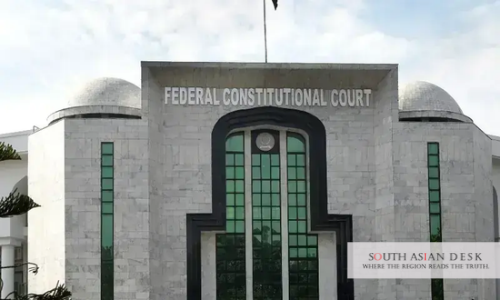
A state land ownership claim by the leaseholders of protected agricultural land in Pakpattan has been rejected by the Federal Constitutional Court (FCC), which held that public property cannot be alienated except in accordance with the law. The ruling was issued in Islamabad on Monday and sets aside a 2016 decision of the Lahore High Court (LHC).
The court observed that state property held by public functionaries in trust for the community is not open to transfer outside the framework of the law. Chief Justice Aminuddin Khan said that where the official record discloses a legal prohibition affecting the competence of an authority to transfer such property, courts cannot disregard it.
Background of the Dispute
The case was heard by a two-judge bench headed by Chief Justice Aminuddin Khan and also comprising Justice Ali Baqar Najafi. It arose from an appeal filed by the member (colonies) of the Punjab Board of Revenue against the LHC judgment, which had favoured the respondent, Rasheeda Bibi, who is now deceased.
The respondent had been allotted 49 acres, 5 kanals and 13 marlas of agricultural land in Chak No. 2/KB, Pakpattan, under the Temporary Cultivation Lease Scheme. The lease ran from Kharif 1968 to Rabi 1978, and extensions were granted periodically thereafter.
The respondent later applied for proprietary rights under a government notification dated September 3, 1979. That application was rejected on May 14, 2001, on the ground that the land fell within a prohibited zone.
After subsequent appeals and remands, the executive district officer (revenue) of Pakpattan accepted the claim in a 2008 order and directed the issuance of a challan for deposit of the land price. The order was later reviewed with the permission of the member (colonies) of the Board of Revenue, and the claim was rejected on August 24, 2011. The LHC subsequently set aside that rejection, which led to the appeal before the FCC.
Why the State Land Ownership Claim Failed
The FCC framed two questions for determination. The first was whether the disputed land could be considered for the conferment of proprietary rights under the policy notification of September 3, 1979. The second was whether the executive district officer (revenue) was competent to review the order of October 28, 2008.
On the first question, the court ruled that a temporary cultivation lease conferred no vested or indefeasible right to proprietary title. The entitlement of the respondents remained subject to the conditions of the 1979 notification, particularly its prohibition on land falling within the prohibited zone.
Chief Justice Aminuddin Khan further noted that the controversy had to be decided in accordance with the governing law and policy, and not on the basis of prolonged possession, extension of the lease or payment of government dues.
Distinction Between Lease and Title
The judgment drew a clear line between two kinds of transactions. According to the court, a temporary cultivation lease and the conferment of proprietary title are juridically distinct, and each operates upon different legal incidents. The former merely permits possession and cultivation without derogation from the title of the state. The latter results in the permanent divestiture of public property.
On this basis, the court found the reliance of the respondents on the original temporary lease to be misconceived, and it set aside the LHC order.
Procedural Rules and the Protection of Public Property
The court also addressed the role of pleadings. Chief Justice Aminuddin Khan noted that the rules of pleadings, though essential to procedural fairness, cannot be invoked to perpetuate an illegality that results in the unauthorised divestment of state property.
Courts, he added, are under a duty to take cognisance of any established legal impediment apparent from the record. They must also ensure that public property is not alienated through administrative error, omission, acquiescence or otherwise, contrary to law.
On the second question, the court held that the successor revenue officer was competent to review an order passed by his predecessor. This authority is subject to the statutory requirements and the prior sanction required under Section 163 of the Punjab Land Revenue Act, 1967.
Significance of the Ruling
The decision reinforces the principle that long possession, repeated lease extensions and payment of dues do not by themselves create a right to ownership of state land. It also confirms that errors or oversights by officials cannot be used to bypass legal restrictions on the transfer of public property.
For revenue authorities, the ruling affirms the power to correct earlier orders, provided the procedure and sanction prescribed by law are observed. For leaseholders on state-owned agricultural land, it makes clear that any claim to ownership must satisfy the conditions of the applicable policy and cannot rest on the duration of occupation alone.
Follow SouthAsianDesk on X, Instagram and Facebook for insights on business and current affairs from across South Asia.