Bürgenstock, Switzerland
The first round of US-Iran talks in Switzerland concluded on Sunday, June 21, 2026, with mediators Qatar and Pakistan saying discussions had been held in a “positive and constructive atmosphere” and produced “encouraging progress” toward a wider settlement of the conflict between Washington and Tehran.
In a joint statement issued Monday, June 22, 2026, the Ministry of Foreign Affairs of Qatar and the Ministry of Foreign Affairs of Pakistan said the talks, held under the framework of the Islamabad Memorandum of Understanding, would continue in a technical format for the rest of the week, with both sides aiming to reach a final agreement within 60 days.
What Happened at the US-Iran Talks in Switzerland
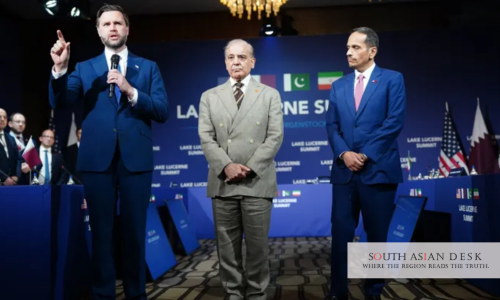
According to the joint statement, the session, referred to by mediators as the Lake Lucerne Summit, brought together delegations from Iran and the United States, along with representatives of the two mediating states, at the Bürgenstock resort overlooking Lake Lucerne.
The statement said the parties had agreed to establish a High Level Committee to provide political oversight of the mediation process. Under the new structure, chief negotiators, US Vice President JD Vance and Iranian Parliament Speaker Mohammad Bagher Ghalibaf, will report regularly to the committee, which will oversee working groups focused on nuclear issues, sanctions, and a monitoring and dispute resolution mechanism intended to support implementation of the memorandum.
The United States delegation included Vance, presidential special envoy Steve Witkoff, and presidential adviser Jared Kushner. Iran’s delegation was led by Ghalibaf and included Foreign Minister Abbas Araghchi, Supreme National Security Council Secretariat deputy Ali Bagheri, Central Bank Governor Abdolnaser Hemmati, National Iranian Oil Company chief executive Hamid Bovard, and foreign ministry officials Kazem Gharibabad and Esmaeil Baghaei, according to Iran’s state news agency.
A New Communication Line for the Strait of Hormuz
Mediators said the United States and Iran had agreed to establish a communication line between the two countries to avoid incidents and miscommunication in the Strait of Hormuz, a waterway that carries a significant share of global oil shipments. The mechanism is intended to ensure safe passage for commercial vessels through the strait during the 60-day period set out in the memorandum.
The strait has been a central point of leverage throughout the talks. Iran’s military command said on Saturday, June 20, 2026, that it would close the waterway, citing continued Israeli strikes in Lebanon and what it described as a failure by the United States to implement the memorandum. Shipping data cited in international reports suggested vessel traffic through the strait continued despite the announcement, though at reduced levels.
Trump’s Hormuz Remarks Briefly Stall the Talks
Negotiations were briefly disrupted on Sunday after President Donald Trump, in televised remarks, said the United States could resume military action against Iran and take control of the Strait of Hormuz if no agreement was reached. “If they don’t make a deal, we’ll collect tolls,” Trump said.
Iran’s foreign ministry spokesperson, Esmaeil Baghaei, said Iran’s delegation initially declined to continue in the four-way format involving the United States, Iran, Pakistan and Qatar after the remarks aired, according to Iranian state media. Mediators worked to keep the talks going, and discussions resumed and continued overnight before concluding with Monday’s joint statement. Oil prices rose following Trump’s remarks, with Brent crude increasing to about USD 81.66 a barrel and US crude, West Texas Intermediate, rising to about USD 77.66 a barrel on Sunday.
Lebanon Remains the First Real Test
Beyond the Strait of Hormuz, the conflict between Israel and the Iran-backed Hezbollah movement in Lebanon featured prominently in the Switzerland talks. Mediators said the United States and Iran had agreed to establish a de-confliction cell, involving Lebanon and facilitated by Qatar and Pakistan, to support compliance with the memorandum’s call for an end to military operations in the country. The joint statement did not name Hezbollah or Israel, neither of which was a party to the talks. Fighting in southern Lebanon has continued in recent days despite repeated truce declarations.
Araghchi wrote on the social media platform X that the de-confliction cell would be the “first real test” of the broader agreement. He also said that oil and petrochemical exports had been waived, a blockade had been lifted, some of Iran’s frozen assets abroad had been released, and a reconstruction and development plan for Iran had been launched, though he did not provide further detail on the scope of the plan.
Pakistan and Qatar’s Continuing Mediation Role
Pakistani Prime Minister Shehbaz Sharif and the country’s army chief, Field Marshal Asim Munir, travelled to Switzerland for the talks, underscoring Islamabad’s continuing role as a principal mediator between Washington and Tehran. Qatar’s prime minister and foreign minister, Sheikh Mohammed bin Abdulrahman Al Thani, also attended.
In their joint statement, Qatar and Pakistan said they would continue to do their utmost to ensure that negotiations are conducted in a constructive atmosphere, and thanked both the United States and Iran for their commitment to diplomacy and a peaceful resolution of the conflict. The two countries also acknowledged the support of other, unnamed friendly nations in the mediation process.
Background
The current round of talks builds on a 14-point Memorandum of Understanding signed by President Trump and Iranian President Masoud Pezeshkian on Wednesday, June 17, 2026, at the Palace of Versailles in France, following a Group of Seven summit in Évian-les-Bains. Pakistani Prime Minister Shehbaz Sharif signed the document as mediator. Known as the Islamabad Memorandum of Understanding, the agreement sought to end hostilities that began on Saturday, February 28, 2026, when the United States and Israel launched joint military operations against Iran.
Under the memorandum, Iran agreed not to procure or develop nuclear weapons, while the United States committed to lifting sanctions on Iranian oil exports and associated services, ending a naval blockade of Iranian ports, and supporting an eventual reconstruction fund for Iran, reported at USD 300 billion, once a final nuclear agreement is reached. The memorandum also reopened the Strait of Hormuz to commercial shipping without tolls for a 60-day period and called for an immediate and permanent end to military operations on all fronts, including in Lebanon.
Pakistan has played a central mediating role throughout the conflict, having hosted an earlier round of negotiations, known as the Islamabad Talks, in Islamabad in April 2026. The Sunday, June 21, 2026 session at the Bürgenstock resort was the first formal high-level meeting between US and Iranian delegations since the memorandum was signed.
What’s Next
According to the joint statement, technical-level talks will continue for the remainder of the week at the Bürgenstock resort, covering nuclear issues, sanctions and a monitoring and dispute resolution mechanism intended to ensure the memorandum is implemented. The High Level Committee has set a target of reaching a final deal within 60 days of the talks, a window that runs through roughly mid-August 2026.
The location and timing of any formal session beyond this week has not been officially confirmed. Mediators said they would continue working to keep the negotiations in a constructive atmosphere, while Araghchi’s description of the Lebanon de-confliction cell as the “first real test” suggests its early performance will be closely watched.
As the US-Iran talks in Switzerland move into their technical phase this week, attention is also expected to remain on developments in Lebanon, where a ceasefire between Israel and Hezbollah has continued to come under strain, and on whether the new Strait of Hormuz communication mechanism holds amid ongoing disputes over tolls and sovereignty.
Published in SouthAsianDesk, June 22, 2026
Follow SouthAsianDesk on X, Instagram and Facebook for insights on business and current affairs from across South Asia.