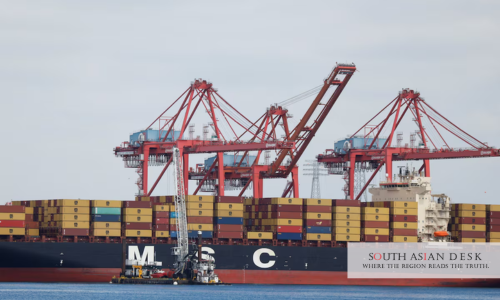
Vizhinjam port investment plans involving MSC Group and Adani Ports have triggered a political and regulatory dispute in Kerala after the state government said it was not consulted on the proposed $1.4 billion stake sale.
Adani Ports and Special Economic Zone Ltd announced that MSC Group’s terminal arm, Terminal Investment Limited, would invest $1.397 billion for a 49% stake in Adani Vizhinjam Port Private Limited, the concessionaire for the Vizhinjam port project. The deal values the port business at about $2.85 billion and has been described as the largest foreign private investment in India’s port infrastructure.
Kerala Chief Minister V.D. Satheesan said the state government had not been consulted before the announcement and had conveyed its “strong displeasure” to Adani Ports. He said any change in the concessionaire’s shareholding structure would require government approval and would be examined under the concession agreement and applicable regulations.
The dispute matters because Vizhinjam is not an ordinary port project. It is India’s first deep-water container transshipment port and is central to the country’s ambition to capture cargo that is often routed through foreign hubs such as Colombo.
Vizhinjam Port Investment Raises Approval Questions
Vizhinjam port investment has become controversial because the transaction involves a change in the shareholding of the port concessionaire. Kerala’s position is that such a change cannot proceed without the state government’s approval.
This does not appear to be a sale of the port itself. The issue concerns a 49% stake in Adani Vizhinjam Port Private Limited, the private concessionaire developing and operating the port. Adani Ports is expected to retain 51% and continue control, while MSC’s terminal arm would enter as a major strategic partner.
That distinction is important. Kerala remains the state authority behind the public-private project, while Adani is the concessionaire. But if the concession agreement requires prior approval for ownership changes, the state can argue that consultation is not a courtesy but a contractual requirement.
Adani Ports has said the transaction is subject to regulatory approvals. Kerala’s intervention suggests that state approval may now become a key step before the deal can move forward.
Why MSC Vizhinjam Deal Matters
The MSC Vizhinjam deal is commercially significant because MSC is the world’s largest container shipping company. Bringing MSC into Vizhinjam could give the port greater cargo visibility, faster ramp-up and stronger integration with global shipping networks.
Adani Ports said the partnership would support incremental cargo volumes and accelerate the port’s expansion. Vizhinjam currently has a capacity of about 1.6 million TEUs and is being expanded to around 5.7 million TEUs.
For India, this is strategically important. A strong transshipment port at Vizhinjam could reduce dependence on foreign ports for Indian cargo. The port’s deep draft, proximity to international shipping routes and location on India’s southern coast make it a natural candidate for large container vessels.
However, Kerala’s concern is that a deal of this size cannot bypass the state’s contractual and regulatory role. The state government is also likely to examine whether MSC’s entry could affect competition, revenue arrangements and long-term public interest.
Adani Ports MSC Partnership Could Boost Cargo Volumes
The Adani Ports MSC partnership is not new in broader terms. The companies already have joint ventures at Mundra and Ennore. The Vizhinjam transaction would deepen that relationship and give MSC a major stake in one of India’s most strategically located port assets.
For Adani Ports, the deal could help de-risk and accelerate the port’s growth. A global shipping giant with direct terminal investment can bring assured traffic, operational expertise and network effects. For MSC, Vizhinjam offers a foothold in a port designed for large-scale transshipment near major east-west shipping lanes.
That is the commercial upside. The public-policy concern is whether one major shipping line gaining a large stake in the concessionaire could create competition issues. Kerala officials and political leaders have raised concerns that the port should not become dependent on or dominated by one shipping group.
A port like Vizhinjam is meant to serve broader Indian and regional trade. If MSC’s investment helps bring more cargo, that is positive. But if it limits access or affects neutrality, regulators may want safeguards.
Kerala Government Approval Becomes Central Issue
Kerala government approval is now the central issue in the dispute. Satheesan has said any formal proposal will be examined strictly under the concession agreement and applicable rules.
The state’s objection is also political. Opposition leader Pinarayi Vijayan has questioned how Adani could proceed with such a stake-sale agreement without prior state approval. That has turned the deal into a state-level political flashpoint, not just a corporate transaction.
Kerala’s position is understandable from a governance perspective. Vizhinjam is a public-private infrastructure project involving state interests, land, regulatory support and long-term economic consequences. A major change in the concessionaire’s ownership structure naturally raises questions for the state.
At the same time, the investment itself could be valuable for Kerala if handled properly. A major global shipping partner could strengthen the port, create logistics activity, improve employment prospects and help the state position itself as a maritime hub.
The challenge is therefore not whether foreign investment is good or bad. It is whether the deal follows the required process and protects Kerala’s long-term interests.
Vizhinjam Transshipment Port Is Strategically Important
Vizhinjam transshipment port is strategically important because India has long lacked a major domestic hub capable of handling large transshipment volumes. Much Indian cargo has historically been routed through foreign ports, especially Colombo.
Vizhinjam’s deep-water profile gives it an advantage. Adani describes the port as a mega transshipment container terminal with a natural draft of 20-24 metres and proximity to international shipping routes. These features make it suitable for large container ships that require deep berths and quick turnaround.
If successful, Vizhinjam could reduce logistics costs, improve supply-chain efficiency and keep more port-related revenue within India. It could also strengthen Kerala’s role in regional trade.
This is why the MSC deal is attracting attention. A major shipping line’s investment could validate Vizhinjam’s commercial potential. But because the port is so strategically important, the state is likely to insist that approvals, competition safeguards and concession terms be respected.
Kerala Port Investment Needs Clear Process
Kerala port investment now needs clarity on three fronts.
First, Adani Ports and MSC need to clarify the approval pathway. If the concession agreement requires state approval for a 49% shareholding change, that process should be followed transparently.
Second, Kerala needs to explain what concerns it will examine. These may include competition, public revenue, port neutrality, national security, concession compliance and long-term control.
Third, the parties need to reassure the market that the dispute is procedural rather than a rejection of investment. A $1.4 billion foreign investment in port infrastructure is significant, especially at a time when India is trying to expand logistics capacity.
The best outcome would be a formal review that protects Kerala’s contractual rights while allowing commercially sound investment to proceed with safeguards.
Vizhinjam Port Investment Could Still Be a Major Win
Vizhinjam port investment could still be a major win for Kerala and India if the deal is handled properly. MSC’s participation could bring cargo, credibility and global shipping links. Adani’s continued control could preserve continuity in development and operations. Kerala’s approval process could ensure public-interest protections are built into the transaction.
The current dispute is therefore not only about a stake sale. It is about how India governs large infrastructure partnerships involving states, private concessionaires and foreign strategic investors.
For Kerala, the message is that the state cannot be treated as a bystander in a port project tied to its coastline and economy. For Adani and MSC, the lesson is that strategic infrastructure deals require political and contractual alignment, not just commercial agreement.
Vizhinjam’s promise remains substantial. But for that promise to translate into a durable maritime hub, the investment process must be as strong as the port’s commercial case.
Published in SouthAsianDesk, July 4, 2026
Follow SouthAsianDesk on X, Instagram and Facebook for insights on business and current affairs from across South Asia.