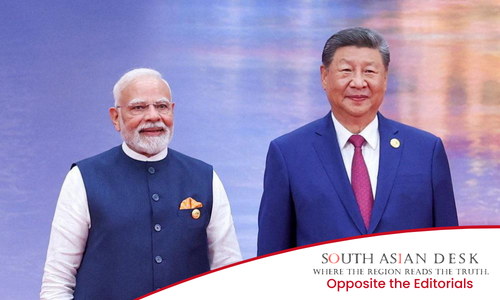
Chinese President Xi Jinping’s arrival in New Delhi for the BRICS Summit on 12th and 13th September 2026 marks his first visit to India in seven years. The visit marks a significant bilateral diplomatic engagement since the 2020 Galwan Valley clash. The meeting of Prime Minister Narendra Modi and Xi Jinping at the summit signals a cautious but deliberate effort to stabilize the relationship between the two countries that has long been strained by territorial disputes, strategic rivalry, and economic asymmetries.
The bilateral talks that happened at the summit marked a clear language of intent. India’s Ministry of External Affairs stated that the leaders “expressed commitment to a fair, reasonable and mutually acceptable resolution of the boundary question.” Prime Minister Modi emphasized the necessity of strengthening existing agreements and understandings on border-related issues.
Xi, on his part, defined the relationship in strategic and long-term terms, stating that although the two countries differ in many respects, they are fully capable of complementing each other’s strengths, supporting one another, achieving mutual success, and advancing together. He reiterated that Beijing views Sino-Indian relations from a strategic and long-term perspective, highlighting the importance of gradual restoration of institutional exchanges, expanding areas of cooperation, and record bilateral trade.
These statements, built on a gradual approach to strengthen bilateral ties, began after the leaders’ meeting on the sidelines of the 2024 BRICS Summit in Kazan and were reinforced at the 2025 Shanghai Cooperation Organization summit in Tianjin. This led to direct flights, visas, and high-level contacts being considerably restored. Special Representatives talks in Beijing in 2026 produced an eight-point outcome.
The talk included advancing discussions on an “early and substantial harvest” of boundary delimitation, additional military meeting points and hotlines, and expert-level mechanisms on trans-border rivers. This was further expanded by the first Corps Commander-level meeting in the Eastern Sector, and the architecture of the same was beyond Ladakh. Alongside, maintaining peace and tranquillity along the roughly 3,500-kilometer Line of Actual Control remained the essential foundation for progress in other domains, as without it, economic and people-to-people initiatives risk remaining fragile to military friction.
The second critical pillar of the dialogue was the normalization of the trade forms. The bilateral commerce between both countries has also reached new highs, with two-way trade in the first half of 2026 already at $91.72 billion, a 23.6 percent rise, and the same is on track to surpass the previous record. Yet the deficit remains severe, reaching $67.1 billion in the same period and projected to exceed the prior year’s $116 billion figure. India’s exports to China grew 37.2 percent to $12.31 billion, including rising shipments of printed circuit boards, but the overall thing remains skewed toward finished Chinese electronics and intermediate goods critical to Indian manufacturing.
Commerce ministers Wang Wentao and Piyush Goyal were expected to address structural imbalances, export controls, investment restrictions, and market access. As such, a more predictable and mutually beneficial commercial relationship would definitely reduce economic leverage as a source of friction and create stable economic ties.
Beyond the bilateral, the BRICS context multiplies the diplomatic value of the visit. The expanded 11-member grouping, now including Egypt, Ethiopia, Indonesia, Iran, Saudi Arabia, and the UAE, represents roughly half the world’s population and positions itself as a voice for the Global South. The New Delhi Declaration reaffirmed commitment to the peaceful resolution of international disputes through dialogue and consultation and called for maximum restraint in the Middle East.
The presence of Russian President Vladimir Putin and Iranian President Masoud Pezeshkian strengthened the summit’s relevance amid ongoing conflicts in Ukraine and the wider Middle East, as well as global trade turbulence and energy security concerns. India has navigated these pressures by deepening energy ties with Russia while carefully balancing relations with the West. In this regard, China’s participation reinforces the multidimensional importance of the forum without forcing New Delhi into an anti-Western posture.
For China, the highlight of the visit was to stabilize the relationship with India as a priority, although even as Beijing manages competition with the United States and projects influence across the Global South. For India, hosting Xi and the broader BRICS leadership advances its leadership for strategic autonomy and “non-Western but not anti-Western” multilateralism. Both sides appear to be pursuing a policy of strategic risk management rather than strategic realignment: maintaining a peaceful border, restoring practical cooperation, and expanding coordination through BRICS, while acknowledging that competition persists.
However, challenges still exist. The agony of Galwan still persists, where 20 Indian and four Chinese soldiers were killed. Heavy military deployments continue along the high-altitude frontier. Differences within BRICS itself were also evident, as in previous years, not much success was achieved in issuing joint statements. This limited the group’s ability to speak with one voice on every crisis. However, this time, the very act of sustained high-level dialogue, the expansion of military confidence-building measures, the focus on trade rebalancing, and the use of BRICS as a cooperative rather than confrontational platform constitute sustainable diplomatic progress.
Thus, Xi’s visit does not erase the boundary dispute or eliminate strategic rivalry. It does, however, create political space for both nations to pursue competitive coexistence: managing differences without allowing them to dominate the entire relationship, expanding economic and cultural links, and contributing to a more balanced international order. In an era of multipolar uncertainty, wars and trade disruptions, the ability of Asia’s two largest nations to stabilize their ties carries significance far beyond their bilateral frontier. Therefore, the diplomatic dialogue generated in New Delhi offers a pragmatic way ahead involving dialogue, enhanced confidence-building, and multilateral engagement, for navigating one of the twenty-first century’s most consequential bilateral relationships.