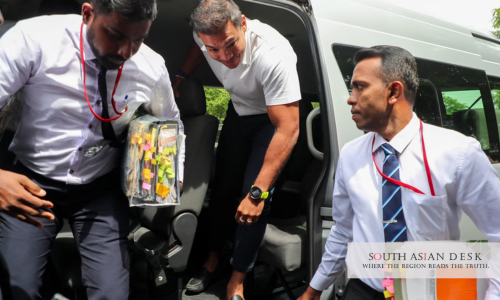
Yoshitha Rajapaksa Arrested by Sri Lanka Bribery Commission — Yoshitha Rajapaksa, the 38-year-old second son of former Sri Lankan President Mahinda Rajapaksa, was arrested on Wednesday by the country’s anti-graft body on charges linked to his irregular recruitment into the Sri Lanka Navy and subsequent use of state funds for overseas officer training in Britain. A Colombo court later granted him bail and imposed a travel ban while the investigation continues, in what is the latest legal action to ensnare a member of the family that once dominated Sri Lankan political life.
Police spokesman F.U. Wootler confirmed to reporters that Rajapaksa was arrested by the Commission to Investigate Allegations of Bribery and Corruption and subsequently presented before the Colombo Chief Magistrate’s Court, where he was granted bail.
Yoshitha Rajapaksa Arrested – The Charges: Navy Recruitment and Dartmouth Training
The Bribery Commission said Yoshitha Rajapaksa is being investigated for having risen through the naval ranks without the necessary academic qualifications and for attending government-funded officer training at Dartmouth, Britain’s naval college. In a formal statement, the commission said he was arrested “on a charge of aiding and abetting, in connection with his recruitment without the minimum qualifications, and subsequently using state funds for overseas training.”
According to local media, the inquiry centres on allegations that Rajapaksa was recruited as a naval cadet in 2006 despite not meeting required academic qualifications, particularly in science and mathematics.
His father Mahinda Rajapaksa was in office at the time. Critics argued that Yoshitha’s place at Dartmouth was taken at the expense of a naval cadet who had earned it on merit.
A former Rear Admiral stated that Rajapaksa had enjoyed unlimited, direct access to the office of then-Navy Commander Admiral Wasantha Karannagoda during his service.
Rajapaksa appeared before CIABOC after being summoned to provide a statement. He had originally been called to appear on Tuesday, June 16, but requested a postponement due to a conflicting Court of Appeal hearing. He presented himself before investigators the following morning and was subsequently taken into custody.
A Record Already Weighed Down by Pending Cases
Wednesday’s arrest was not Yoshitha Rajapaksa’s first encounter with Sri Lanka’s legal system. He was already an accused in two separate money-laundering cases and had been subject to a foreign travel ban, remaining on bail in both matters until his fresh detention.
He faces criminal prosecution for failing to explain the sources of income used to purchase a house while his father was in power between 2005 and 2015. He had told investigators that he raised the funds by selling gems given to him by his grandaunt, who cannot recall how she came to possess the stones. He also faces a case relating to his acquisition of a television network.
Dissanayake’s Corruption Mandate Drives Fresh Momentum
Cases against the Rajapaksa family have gained renewed impetus since President Anura Kumara Dissanayake won the 2024 presidential election on a platform of pledging to crush corruption. Several Rajapaksa family members and close associates have been charged with a range of offences over the years, including corruption and murder, all of which remain pending before the courts.
Mahinda Rajapaksa’s younger brother Gotabaya, who became president in 2019 and was forced from office in 2022 following an uprising triggered by a ruinous economic crisis, was handed a foreign travel ban earlier this month and has sought court protection against potential arrest over the Easter Sunday bombings of 2019, which killed 279 people.
Yoshitha’s arrest follows the questioning of eldest Rajapaksa son, legislator Namal Rajapaksa, over a separate property case and adds further weight to the picture of a family whose legal exposure has expanded significantly since the change of government. Sri Lanka’s once all-powerful political clan, whose members at one point controlled the presidency, key ministries, and a dominant share of state resources, is now navigating a cascade of judicial proceedings that reflect the changed political climate under Dissanayake’s administration.
Published in SouthAsianDesk, June 18, 2026
Follow SouthAsianDesk on X, Instagram and Facebook for insights on business and current affairs from across South Asia.