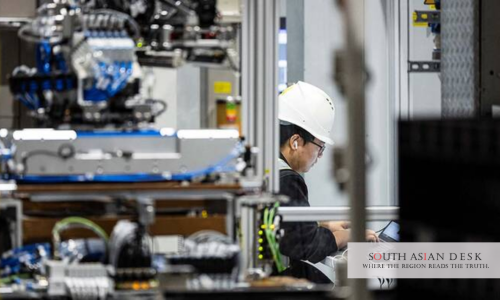
Lithium-ion batteries in Pakistan could soon move toward local manufacturing after Pakistani industrial conglomerate Saigol Group and China’s Juhang Energy Technology Group signed a memorandum of understanding to establish cooperation in advanced battery production, energy storage and clean energy technologies.
The agreement, reported by state media and Arab News Pakistan, is being presented as part of Islamabad’s broader push to reduce import dependence, strengthen domestic manufacturing and support Pakistan’s transition toward cleaner energy sources. The MoU is expected to pave the way for the local production of lithium-ion batteries, a technology increasingly central to solar power systems, electric vehicles, mobile devices and backup energy storage.
Speaking at the signing ceremony, Special Assistant to the Prime Minister on Industries and Production Haroon Akhtar Khan described the partnership as a major step in Pakistan-China industrial cooperation. He said the agreement reflected confidence in Pakistan’s industrial future and the strength of economic ties between Islamabad and Beijing.
Lithium-Ion Batteries in Pakistan and the Clean Energy Shift
The move to develop lithium-ion batteries in Pakistan comes at a time when demand for energy storage is rising sharply. Households, businesses and industries are increasingly turning to solar power, but solar generation requires reliable batteries to store electricity for use at night or during power outages.
Lithium-ion batteries are widely used because they are lighter, more efficient and longer-lasting than many conventional battery systems. They power mobile phones, laptops, wearable devices, electric vehicles and renewable energy storage units. In Pakistan, their importance has grown with the rapid expansion of solar panels and the gradual push toward electric mobility.
For years, Pakistan has relied heavily on imported batteries and components. Local battery manufacturing could help reduce the import bill, create jobs, support industrial self-sufficiency and give consumers access to more affordable storage solutions if production is scaled effectively.
Pakistani Chinese Firms Deepen Industrial Cooperation
The agreement between Saigol Group and Juhang Energy Technology Group is part of a wider trend of Pakistan seeking Chinese support for industrial relocation, technology transfer and advanced manufacturing.
China is one of the world’s leading producers of batteries, electric vehicles and renewable energy technologies. For Pakistan, partnerships with Chinese firms offer a route into sectors that require technical expertise, production scale and supply chain depth.
Juhang Energy Technology Group works in energy storage systems, electric vehicle charging infrastructure and related clean energy technologies. Under the MoU, cooperation is expected to cover advanced lithium-ion batteries, energy storage systems and electric vehicle charging solutions.
The agreement also fits Pakistan’s effort to move beyond basic assembly toward more meaningful local manufacturing. If implemented properly, it could help develop technical skills, create supplier networks and support the growth of a domestic clean technology industry.
Local Battery Manufacturing Could Reduce Import Dependence
A key benefit of local battery manufacturing is the possibility of reducing Pakistan’s dependence on imported energy storage products. With the country’s solar market expanding quickly, demand for batteries has increased among households, commercial users and industrial consumers seeking reliable backup power.
Imported lithium-ion battery systems remain expensive for many Pakistani consumers. Local production could make pricing more competitive, though that will depend on the scale of manufacturing, quality control, taxation, imported raw material costs and whether key components are actually produced locally or merely assembled in Pakistan.
Haroon Akhtar Khan said the local production of lithium-ion batteries would help create employment opportunities and support industrial self-sufficiency. He also said battery manufacturing represents an industry of the future as Pakistan looks to benefit from global technological shifts.
Why Battery Storage Matters for Pakistan
Pakistan’s energy system has long faced problems of circular debt, expensive imported fuel, transmission losses and power supply instability. Renewable energy offers one route to reduce dependence on imported fuels, but renewable power becomes more useful when paired with storage.
Solar panels can generate electricity during the day, but without storage, much of their potential is limited. Lithium-ion batteries allow consumers to store excess solar power and use it later, reducing pressure on the grid and improving energy reliability.
Battery storage is also essential for electric vehicles. If Pakistan wants to develop an EV market, it will need not only vehicles but also batteries, charging infrastructure, maintenance capacity and recycling systems. The Saigol-Juhang agreement could therefore support several sectors at once: renewable energy, transport, electronics and industrial manufacturing.
Pakistan’s Growing Interest in Battery Technology
The latest MoU is not Pakistan’s only recent move in the battery space. Earlier reports said Chinese company Dongjin Group planned to establish a dry battery manufacturing facility in Faisalabad to meet rising demand driven by solar systems and electric vehicles.
Pakistan has also been discussing localisation of lithium-ion battery technology, including lithium iron phosphate, or LFP, batteries, which are commonly used in energy storage and electric mobility because of their relative stability and longer cycle life.
However, the sector still faces major challenges. Pakistan will need technical standards, safety regulations, testing facilities, skilled labour, recycling systems and investor confidence. Poorly made or unsafe batteries can create fire and performance risks, so quality control will be essential if local manufacturing expands.
A Promising Step, But Implementation Will Matter
The agreement between Saigol Group and Juhang Energy Technology Group is an important signal, but it is still an MoU. The real test will be whether it leads to an operational manufacturing facility, technology transfer, local job creation and commercially viable battery products.
The report did not specify where the facility will be established or when production is expected to begin. Those details will matter for assessing the project’s actual impact.
If the agreement moves from signing ceremony to production line, it could support Pakistan’s clean energy transition and help the country capture value from a fast-growing global industry. For now, the MoU marks a promising step in Pakistan-China industrial cooperation and a potential opening for local battery manufacturing in Pakistan.
Published in SouthAsianDesk, June 29, 2026
Follow SouthAsianDesk on X, Instagram and Facebook for insights on business and current affairs from across South Asia.