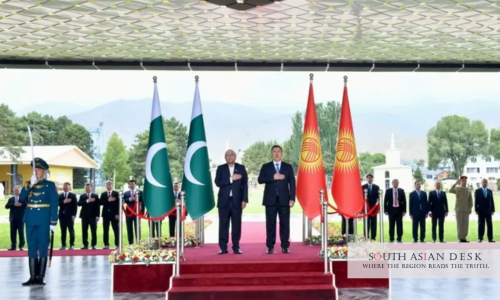
Pakistan Kyrgyzstan ties received a fresh diplomatic push as President Asif Ali Zardari and Kyrgyz President Sadyr Zhaparov reaffirmed their commitment to expanding bilateral cooperation, with trade, investment, transport connectivity and regional security at the centre of talks.
President Zardari arrived in Kyrgyzstan on July 6 for a four-day official visit. During talks held in Cholpon-Ata, the two leaders expressed satisfaction over the development of relations between the two countries and called for the implementation of agreements reached during President Zhaparov’s visit to Pakistan in December.
According to a joint statement, both sides agreed that the relationship should move towards a strategic partnership, particularly in the areas of trade, economic cooperation and investment.
Pakistan Kyrgyzstan Ties Focus on Trade and Investment
The two presidents stressed the need to deepen Pakistan Kyrgyzstan trade and strengthen direct links between business communities. They called for greater cooperation between chambers of commerce, investment promotion agencies, banking institutions and financial bodies.
Relevant ministries and agencies were directed to intensify efforts to implement earlier agreements and take practical steps to increase trade, investment activity and business-to-business engagement.
The statement also highlighted the need to improve the working of the Kyrgyz-Pakistani Intergovernmental Commission on Trade, Economic, Scientific and Technical Cooperation, along with relevant joint working groups.
For Pakistan, stronger links with Kyrgyzstan fit into a wider geo-economic strategy aimed at improving access to Central Asian markets. For Kyrgyzstan, Pakistan offers access to ports, a large consumer market and potential cooperation in education, health, pharmaceuticals and logistics.
Strategic Partnership and Regional Connectivity
Transport connectivity was one of the most important parts of the discussions. Both sides reaffirmed the importance of implementing agreements in transport, logistics and transit.
Pakistan and Kyrgyzstan also discussed the effective use of Pakistan’s seaports for regional trade. This is significant because Central Asian states are landlocked and need reliable routes to global markets. Pakistan, through its ports, can offer Kyrgyzstan and other Central Asian countries access to the Arabian Sea.
The two leaders also discussed using Kyrgyzstan’s transit and logistics potential to help Pakistan reach markets in Central Asia and the Eurasian Economic Union.
Improved cargo transportation was also discussed, suggesting that both sides want to move beyond diplomatic statements and focus on practical trade routes, logistics systems and customs facilitation.
CASA-1000 and Energy Cooperation
Energy cooperation was another major theme. The two sides noted the potential of the CASA-1000 project, which is designed to connect Central Asia and South Asia through electricity transmission.
The project aims to allow surplus hydropower from Kyrgyzstan and Tajikistan to be supplied to Afghanistan and Pakistan. If implemented effectively, CASA-1000 could help Pakistan diversify energy imports while giving Central Asian states a larger regional market for their electricity.
The project has often been discussed as a symbol of Central Asia South Asia connectivity. Its success would depend not only on infrastructure, but also on regional security and political stability.
Cooperation Beyond Trade
The joint statement also identified several sectors where Pakistan and Kyrgyzstan could expand cooperation. These included mining, agriculture, textiles, light industry, the halal sector, healthcare, pharmaceuticals, digital economy, information technology, tourism and financial services.
Medical education and regulatory cooperation were also discussed. Both sides referred to quality assurance in medical education, professional regulatory collaboration, vaccine production and biological product manufacturing.
The reference to pharmaceuticals is especially relevant because Pakistan has an established pharmaceutical manufacturing base, while Kyrgyzstan could offer market access in Central Asia. Joint ventures in pharmaceutical production and closer cooperation between drug regulatory authorities were also encouraged.
Security and Multilateral Cooperation
President Zardari and President Zhaparov also discussed cooperation against terrorism, extremism, narcotics trafficking, organised crime, irregular migration and cybercrime.
Both leaders condemned terrorist attacks in the region and beyond. They agreed that a secure environment is necessary to unlock the full potential of cooperation between Central Asia and South Asia.
The two sides also stressed coordination in international and regional forums, including the United Nations, Shanghai Cooperation Organisation, Organisation of Islamic Cooperation and Economic Cooperation Organisation.
Pakistan expressed support for Kyrgyzstan’s priorities during its SCO chairmanship, while Kyrgyzstan appreciated Pakistan’s role as a non-permanent member of the UN Security Council for 2025-2026.
Cultural and People-to-People Links
The leaders also discussed cooperation in education, science, culture, tourism, youth exchanges, healthcare and public health. Kyrgyzstan invited Pakistan to participate in the VI World Nomad Games, scheduled to be held in Kyrgyzstan from August 31 to September 7, and Pakistan accepted the invitation.
Pakistan also expressed support for Kyrgyzstan’s plan to host the Second Global Mountain Summit Bishkek+25 in 2027.
These cultural and people-to-people exchanges matter because Pakistan and Kyrgyzstan have historically friendly relations but limited public familiarity with each other. Tourism, student exchanges and cultural forums could help build a stronger social base for the relationship.
Why the Visit Matters
President Zardari’s visit comes at a time when Pakistan is trying to expand engagement with Central Asia through trade, transit and energy cooperation. For years, Pakistan’s Central Asia policy has been limited by geography, security challenges and weak connectivity. The renewed emphasis on ports, logistics and cargo transportation suggests Islamabad wants to make that policy more commercially meaningful.
For Kyrgyzstan, the relationship offers a chance to diversify partnerships beyond its traditional regional networks. Access to Pakistani ports and stronger trade routes could support Kyrgyzstan’s wider economic ambitions.
The challenge, however, will be implementation. Pakistan and Central Asian states have often issued ambitious statements on connectivity and trade, but actual volumes have remained below potential. Progress will depend on customs facilitation, banking channels, cargo routes, security coordination and private sector follow-through.
The latest joint statement shows that both governments understand the economic opportunity. Whether Pakistan Kyrgyzstan ties move from diplomatic goodwill to measurable trade growth will depend on how quickly the agreed mechanisms are activated.
Published in SouthAsianDesk, July 8, 2026
Follow SouthAsianDesk on X, Instagram and Facebook for insights on business and current affairs from across South Asia.