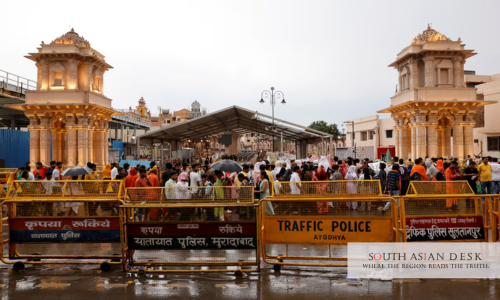
Ram temple trust reshuffle has placed one of India’s most politically and religiously significant institutions under intense scrutiny after people involved in counting donations at the Ayodhya temple were accused of stealing millions of rupees from offerings made by devotees.
The Shri Ram Janmabhoomi Teerth Kshetra Trust, which manages the Ram temple in Ayodhya, accepted the resignations of general secretary Champat Rai and trustee Anil Mishra after the alleged theft triggered public anger, opposition criticism and questions about financial oversight at the high-profile religious site. The trust also appointed an interim secretary and formed a committee to identify candidates for a newly created chief executive position.
The controversy is especially sensitive because the Ram temple is not merely a place of worship. It sits at the centre of decades of religious, legal and political conflict in India. Its consecration in January 2024, led by Prime Minister Narendra Modi, was treated by the ruling Bharatiya Janata Party as the fulfilment of one of its most important ideological promises.
Ram Temple Trust Reshuffle and What Changed
The leadership changes came after trustees of the Shri Ram Janmabhoomi Teerth Kshetra met and accepted the resignations of two senior figures. Champat Rai, who served as general secretary, and Anil Mishra, a trustee, stepped down amid the fallout from the donation theft allegations.
The trust has not publicly specified the total amount allegedly stolen. However, authorities said after the arrest of eight people last month that nearly Rs8 million had been recovered from seven of the accused. The figure is significant on its own, but it is even more striking when placed against the scale of the temple’s finances. By March 31, the temple had reportedly received Rs5.82 billion in offerings.
The administrative response suggests that the trust is trying to restore confidence by changing internal leadership and creating a more formal executive structure. The proposed chief executive position appears aimed at professionalising management at a site that now receives large numbers of pilgrims, large donations and continuous national attention.
Trust treasurer Govindadev Giri described the donation theft as a shameful incident and said the trustees were hurt by what had happened. That acknowledgement matters because the controversy is not limited to a routine police case. It has raised broader questions about how religious donations are counted, audited, secured and supervised.
Why the Donation Theft Scandal Matters
The alleged theft has struck a sensitive nerve because donations to the Ayodhya Ram temple carry deep religious meaning for many Hindus. Offerings are not seen merely as financial contributions. For devotees, they are acts of faith, sacrifice and participation in a temple movement that took decades to reach completion.
That is why accusations involving people connected to the donation-counting process are politically explosive. The issue is not only whether money was stolen. It is whether the systems around one of India’s most symbolic religious institutions were strong enough to protect public trust.
The scandal has also revived questions about accountability in religious trusts. Large temples in South Asia often receive substantial donations in cash, gold, silver and other valuables. Where donation flows are large and emotionally charged, the need for transparent counting, CCTV coverage, independent audit and clear responsibility becomes even more important.
The trust’s decision to create a CEO position may be read as an attempt to move from personality-led administration to more institutional management. However, critics argue that resignations and structural changes are not enough unless investigators establish how the alleged theft happened, who was responsible and whether supervision failed.
The Trust Behind the Ayodhya Ram Temple
The Shri Ram Janmabhoomi Teerth Kshetra was set up by the Indian government after the Supreme Court’s 2019 verdict in the Ayodhya land dispute. The court awarded the disputed land to Hindu parties for the construction of a temple and directed that a separate five-acre plot be given to Muslims for a mosque.
The trust was created to oversee the construction and management of the Ram temple. It became responsible for one of the most closely watched religious projects in modern India.
The temple was built at the site where the Babri Masjid once stood. The 16th-century mosque was demolished by a Hindu mob in December 1992, triggering nationwide riots that killed about 2,000 people, mostly Muslims, according to police accounts cited in reporting. Hindus who supported the temple movement have long argued that the site is the birthplace of Lord Ram and that a temple had previously stood there before the mosque was built.
The Supreme Court’s 2019 ruling brought the legal dispute to a formal close, but the site remains politically and historically charged. For supporters, the temple represents a long-awaited religious restoration. For critics, it remains tied to painful questions about majoritarian politics, communal violence and the place of minorities in India.
Modi, the BJP and the Political Weight of Ayodhya
The Ayodhya temple has long been central to the BJP’s political identity. The party and its wider ideological ecosystem built much of their mobilisation around the demand for a Ram temple at the disputed site. When the temple was consecrated in January 2024, the event was presented as a historic moment for Hindu devotees and a major political achievement for Modi’s government.
That is why the donation theft scandal has created political discomfort. The temple was promoted as a sacred national project, and any suggestion of financial mismanagement risks damaging the moral authority attached to it.
The controversy comes ahead of elections expected early next year in Uttar Pradesh, India’s most populous state. Uttar Pradesh is politically crucial because of its large number of parliamentary seats and its symbolic importance to Hindu nationalist politics. The BJP has governed the state since 2017, but its performance there in the 2024 national election was weaker than expected.
Opposition parties have seized on the scandal to question the trust’s management and demand stronger investigation. Congress spokesperson Pawan Khera said the country did not need “piecemeal resignations” and called for the complete dissolution and overhaul of the trust, along with an independent Supreme Court-supervised investigation.
The BJP has accused its opponents of exploiting the episode for political gain. The Rashtriya Swayamsevak Sangh, the ideological parent of the BJP, urged Hindus to remain patient and restrained, warning against forces it said were seeking to use the incident to malign Hindu society and dharma.
What Investigators Need to Establish
The immediate legal question is narrow: whether the arrested individuals stole donations and how much money was taken. But the governance questions are wider.
Investigators will need to determine who had access to donation boxes, cash-counting rooms and storage systems. They will also need to assess whether CCTV coverage, bank-handling procedures, supervision, audit trails and segregation of duties were adequate.
If donation counting was handled by contracted staff, security personnel or bank-linked workers, the inquiry may also need to examine how those people were appointed, supervised and rotated. In high-cash environments, best practice normally requires multiple layers of control: dual custody, continuous camera coverage, independent reconciliation, daily deposit records and periodic audits.
The recovery of nearly Rs8 million from seven accused people indicates that investigators have traced at least part of the alleged theft. However, that does not necessarily answer whether the recovered amount represents the full scale of the loss. The trust has not disclosed a final figure, and that gap is likely to fuel speculation unless a detailed audit is made public.
Why Transparency Is Now Central
The trust’s challenge is no longer only administrative. It is reputational.
Devotees who donate to temples expect that offerings will be used for religious, charitable or institutional purposes. When theft allegations arise, the damage is not limited to the amount stolen. It affects confidence in the entire donation system.
A credible response would require more than leadership resignations. It would require a transparent audit, clear public explanation of controls, disciplinary action where necessary and cooperation with law enforcement. If the trust can show that the problem was limited, identified and corrected, it may contain the damage. If the inquiry appears opaque, opposition parties and civil society critics are likely to keep the issue alive.
The creation of a chief executive role could improve accountability if the position comes with clearly defined powers, reporting obligations and professional standards. But if the new structure merely shifts titles without changing systems, it may not resolve the underlying concern.
Wider Implications for Religious Institutions
The Ayodhya case may also sharpen debate over financial governance in major religious institutions across India. Temples, shrines and trusts often operate with a mixture of religious authority, private trust structures, public emotion and political influence. That combination can make accountability complicated.
Some religious institutions are directly managed or regulated by state governments, while others operate through autonomous trusts. Where institutions are autonomous, questions often arise over whether they are sufficiently transparent, especially when donations run into hundreds or thousands of crores.
The Ram temple trust occupies a particularly unusual space. It was created after a Supreme Court ruling, announced by the central government and tied to a highly political religious movement. Yet it functions as a trust rather than as an ordinary government department. That makes the question of public accountability more complex, especially when the temple receives donations from devotees across India and abroad.
A Scandal With Legal, Religious and Political Stakes
The donation theft scandal at the Ayodhya Ram temple is therefore not a small internal matter. It involves allegations of criminal misconduct, a leadership shake-up, opposition demands for a supervised probe and a politically sensitive institution at the heart of India’s religious politics.
For the trust, the immediate priority is to restore confidence among devotees. For investigators, the task is to establish the facts without allowing political pressure to shape the outcome. For the BJP and its opponents, the scandal has become another front in the battle for public trust before the Uttar Pradesh election.
The Ram temple was built as a symbol of religious fulfilment for millions of Hindus. The current controversy now tests whether its administrators can match that symbolic weight with financial transparency, professional governance and credible accountability.
Published in SouthAsianDesk, July 8, 2026
Follow SouthAsianDesk on X, Instagram and Facebook for insights on business and current affairs from across South Asia.