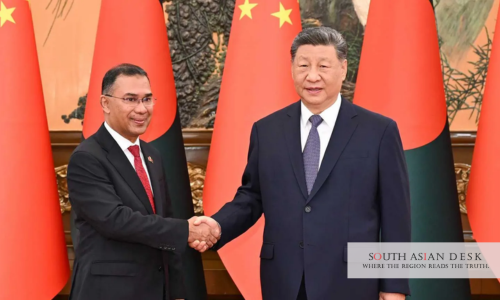
Bangladesh China ties are entering a more active phase as Prime Minister Tarique Rahman seeks greater Chinese investment and infrastructure support while also trying to repair Dhaka’s strained relationship with India.
Rahman’s first overseas official visits to Malaysia and China signalled a foreign policy shift by Bangladesh’s new government. While Malaysia was his first stop, the China visit carried greater strategic weight because of Beijing’s growing role in South Asia and its long-running competition with India for influence in the region.
The visit comes at a sensitive time. Bangladesh is trying to revive a slowing economy, attract foreign investment and manage public anger over India’s past support for former prime minister Sheikh Hasina, who was ousted in August 2024 after a mass uprising and later took refuge in Delhi.
Bangladesh China Ties and the Beijing Outreach
During Rahman’s visit to Beijing, Bangladesh and China discussed several areas of cooperation, including investment, infrastructure, trade and river management. Two issues drew particular attention: Chinese support for managing the Teesta River and a plan to develop a special economic zone near Mongla port.
Both matters are closely watched in India. The Teesta is a shared river between India and Bangladesh, and efforts to reach a water-sharing agreement have remained stalled for years. Bangladesh has long argued that the river needs dredging, desilting and wider restoration work to improve water flow for agriculture.
Dhaka says previous governments invited India to join the Teesta project but Delhi took too long to make a decision. Bangladesh now argues that China has the technical expertise and financial capacity to deliver a project of this scale.
For India, however, any Chinese role near its border is a security concern. The Teesta basin lies close to the strategically vital Siliguri Corridor, also known as the “Chicken’s Neck”, a narrow strip of land that connects mainland India to its seven north-eastern states.
Why India Is Watching Closely
India has historically seen Bangladesh as part of its immediate strategic neighbourhood. For decades, newly elected South Asian leaders often visited Delhi early in their terms. Rahman’s decision to prioritise China has therefore been interpreted by some in India as a message, especially because Delhi maintained close ties with Hasina.
The security dimension is also important. India and China have a long-running border dispute, fought a brief war in 1962 and have seen deadly border clashes in recent years. Any Chinese-backed project near sensitive Indian territory is likely to attract scrutiny in Delhi.
Beijing has tried to reduce those concerns. Chinese officials have said China-Bangladesh cooperation does not target any third country and should not be affected by outside pressure.
Still, India’s unease is unlikely to disappear. China is already Bangladesh’s largest defence supplier, accounting for more than 70% of Dhaka’s arms imports. Bangladesh also owes Beijing more than $6bn, giving China a substantial economic footprint in the country.
Bangladesh India Relations Show Signs of Repair
Despite Dhaka’s outreach to Beijing, Bangladesh India relations have also begun to improve after months of tension.
Relations deteriorated after Hasina’s removal and the formation of the interim government led by Muhammad Yunus. India avoided high-level engagement during that period, while Dhaka’s public mood turned sharply critical of Delhi because of its perceived support for Hasina.
Since Rahman’s Bangladesh Nationalist Party won a landslide election in February, both sides have taken steps to reset the relationship. Cross-border economic activities have gradually resumed, and India has restarted issuing tourist visas to Bangladeshis.
Passenger bus services between India and Bangladesh have also partially resumed after an 18-month gap. Routes are now operating between Kolkata and Dhaka, and between Dhaka and Agartala.
India also sent emergency fuel to Bangladesh through the cross-border Friendship Pipeline when the war in the Middle East disrupted global fuel supplies earlier this year. Last month, India’s new High Commissioner to Dhaka, Dinesh Trivedi, took charge, with Delhi elevating him to cabinet rank in a signal that it wants to repair ties.
Trade Remains a Powerful Link
Even during diplomatic strain, India and Bangladesh remained economically connected. Bilateral trade last year stood at around £13bn, though the balance remained heavily in India’s favour.
That trade relationship gives both governments an incentive to avoid prolonged hostility. Bangladesh depends on India for many essential goods, while India sees Bangladesh as vital to regional connectivity and security in its north-east.
However, irritants remain. Anti-India sentiment in Bangladesh has grown because of Delhi’s support for Hasina. Bangladeshi officials have also accused India’s Border Security Force of pushing people, mainly Bengali-speaking Muslims, into Bangladesh without proper repatriation procedures.
Political rhetoric in India has added to the tension. Bangladeshi analysts say inflammatory comments made by Hindu nationalist politicians during West Bengal state elections created public dissatisfaction in Bangladesh and sent mixed signals about India’s intentions.
The West Bengal Factor
West Bengal is central to the relationship because it shares deep linguistic, cultural and ethnic ties with Bangladesh. The BJP’s victory in the state in May, ending the Trinamool Congress’s nearly 16-year rule, added a new layer to Dhaka’s calculations.
Statements made during the election campaign about Bangladesh and alleged illegal migration were closely followed in Dhaka. For many Bangladeshis, such rhetoric reinforced the view that India’s domestic politics can spill into bilateral relations.
This matters because public opinion in Bangladesh now limits how far Rahman can move towards India without appearing politically vulnerable at home. As long as Hasina remains in Delhi, any visit by Rahman to India could carry domestic political risks.
China’s Expanding South Asia Footprint
China has steadily expanded its presence across South Asia, including in Bangladesh, Sri Lanka and the Maldives. It has done so through infrastructure, loans, defence supplies and economic corridor proposals.
During Rahman’s visit, China offered to develop the China-Myanmar-Bangladesh Economic Corridor, which would connect China’s Yunnan province with Myanmar and Bangladesh. Such a corridor would deepen Bangladesh’s connectivity with China and Southeast Asia, but it would also be viewed by India through a strategic lens.
For Bangladesh, the attraction is clear. China offers capital, infrastructure capacity and strategic leverage. For a government trying to revive growth and diversify partnerships, Beijing is a useful partner.
But the risks are also clear. Heavy reliance on China could complicate ties with India, increase debt exposure and place Bangladesh in the middle of regional rivalry.
Rahman’s Diplomatic Balancing Act
Rahman’s foreign policy challenge is to extract economic benefit from China without provoking a serious breakdown with India. That is easier said than done.
India is too important for Bangladesh to ignore. It is a major trading partner, a neighbour on three sides and a key factor in regional security. Stable ties with Bangladesh are also essential for India’s north-east, where several ethnic separatist groups have operated.
China, meanwhile, gives Bangladesh access to investment, infrastructure support and defence supplies. Beijing also offers Dhaka an alternative to overdependence on India.
This balancing act will define Bangladesh’s foreign policy under Rahman. If managed carefully, Dhaka could benefit from both powers. If mismanaged, Bangladesh could become another arena for India-China competition.
What Comes Next
The most sensitive issue to watch is the Teesta River project. If China moves from feasibility study to active involvement, India’s concerns will grow. Dhaka will need to reassure Delhi that the project is about water management and agriculture, not strategic encirclement.
The second key issue is whether Rahman visits India. A visit would signal that Dhaka wants a serious reset, but it would be politically difficult while Hasina remains in Delhi and anti-India sentiment remains strong in Bangladesh.
The third issue is trade normalisation. If visa services, bus routes, border trade and energy cooperation continue improving, Bangladesh India relations may stabilise despite political mistrust.
For now, Bangladesh is trying to keep both doors open. It is courting China for investment and infrastructure while cautiously rebuilding ties with India. The success of that strategy will depend on whether Dhaka can convince both Beijing and Delhi that cooperation with one does not mean hostility towards the other.
Published in SouthAsianDesk, July 8, 2026
Follow SouthAsianDesk on X, Instagram and Facebook for insights on business and current affairs from across South Asia.