Nepal electricity exports to India could increase by as much as 550 megawatts after the two countries agreed to expand the capacity of key cross-border transmission links, marking another step towards deeper regional energy cooperation.
The agreement raises Nepal’s permitted electricity export capacity through the Dhalkebar-Muzaffarpur and Dhalkebar-Sitamarhi 400 kilovolt transmission lines from 1,100MW to 1,650MW. The capacity available for Nepal to import electricity from India will also increase from 1,000MW to 1,400MW.
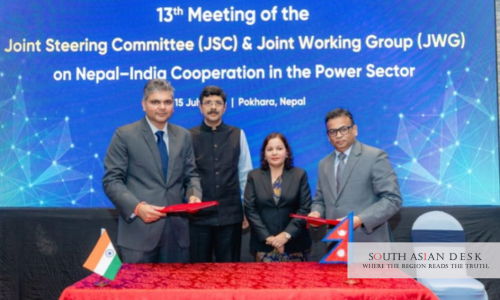
The decision was reached during the 13th meeting of the Nepal-India Joint Steering Committee on Power Sector Cooperation, held in Pokhara on 15 July. The secretary-level committee reviewed electricity trade, hydropower development, cross-border infrastructure and the operation of the interconnected national grids.
The revised limits do not necessarily mean that Nepal will immediately export the entire additional 550MW. Actual power sales will depend on available generation, seasonal domestic demand, the readiness of transmission infrastructure, commercial arrangements and regulatory approvals in the Indian market.
Nevertheless, the agreement significantly expands the technical framework supporting Nepal-India electricity trade and gives Nepal greater capacity to sell surplus hydropower during periods of high generation.
Nepal electricity exports to India gain added capacity
The new arrangement follows a technical assessment of the capacity of the Dhalkebar-Muzaffarpur and Dhalkebar-Sitamarhi transmission corridors.
The Dhalkebar-Muzaffarpur line is the main high-capacity connection used for cross-border power trade between the two countries. It has supported both Nepal’s electricity exports during the monsoon season and imports from India during periods of lower domestic production.
The Dhalkebar-Sitamarhi line is being developed as another major route between the two national grids. By assessing the two transmission lines together, officials concluded that the combined export transfer capacity could be raised to 1,650MW.
Nepal’s electricity system produces substantial surpluses during the rainy season, when river flows strengthen generation at run-of-river hydropower plants. Production falls during the dry season, however, leaving the country dependent on electricity imports from India to meet domestic demand.
The decision to increase both import and export limits reflects this seasonal structure. Nepal will be able to export more surplus power when generation is high while retaining access to increased Indian supplies during periods of domestic shortage.
The expanded Nepal electricity export capacity could also reduce the need to curtail generation when domestic demand is insufficient to absorb available monsoon power.
Cross-border transmission projects move forward
Nepal and India also agreed to advance several transmission projects intended to support larger volumes of cross-border power trade over the coming decade.
The meeting approved the detailed project report for the Chameliya-Jauljibi 220kV double-circuit transmission line. The project is expected to be completed by December 2028, subject to the correction of minor issues identified in the report.
Officials also agreed to accelerate the Inaruwa-New Purnea and Dododhara-New Lamki-Bareilly 400kV transmission projects. The lines are to be developed through joint investment structures, with special-purpose companies established in Nepal and India.
The Nepal Electricity Authority and the Power Grid Corporation of India have already signed shareholder and joint venture agreements connected to the projects. The latest meeting called for the joint venture companies to be established promptly so that implementation can move forward.
The detailed project report for the proposed Motihari-Nijgadh 400kV double-circuit transmission line was also approved. The project is expected to form part of the infrastructure required to support additional Nepal hydropower exports by 2034-35.
Further technical studies will be conducted before a final decision is made on the proposed Lucknow-Kohalpur or Lamahi 400kV transmission connection.
Together, the projects are intended to reduce transmission constraints that could otherwise limit the expansion of Nepal-India electricity trade.
Temporary arrangement for New Butwal-Gorakhpur line
The two countries also reached a temporary operating arrangement for the New Butwal-Gorakhpur 400kV cross-border transmission line.
Nepal’s section of the line was expected to be completed by August 2026, while the New Butwal substation was scheduled for completion by December 2027. Until the full infrastructure becomes available, the countries agreed to operate the transmission line at 220kV.
Under the arrangement, Nepal could import up to 130MW through the corridor from December 2026 to March 2027. It could then export up to 200MW from April to November 2027.
The temporary mechanism is designed to make use of the transmission infrastructure before all associated 400kV facilities are completed.
Officials also approved the use of high-temperature, low-sag conductors for the reconductoring of the Muzaffarpur-Dhalkebar transmission line. The technology is intended to increase the amount of electricity that can be carried through the existing corridor without constructing an entirely new route.
Nepal-India electricity trade expands
Cross-border power trade has become increasingly important to Nepal’s electricity sector and its wider economy.
According to Nepal Electricity Authority figures, the country exported 2,380 gigawatt-hours of electricity to India during the 2024-25 financial year, an increase of 22 per cent from the previous year. Nepal imported 1,681 gigawatt-hours from India during the same period.
Electricity export revenue reached approximately 17.47 billion Nepalese rupees, while the cost of imported power stood at around 12.9 billion rupees. The resulting net income from electricity trading was approximately 4.57 billion rupees.
The figures demonstrate how Nepal has shifted from experiencing prolonged domestic electricity shortages to becoming a seasonal exporter of hydropower.
However, the country remains both an importer and exporter because much of its generation comes from run-of-river plants. These facilities produce more electricity when rivers are full during the monsoon but significantly less during the dry winter months.
Greater transmission capacity can help Nepal manage this imbalance by providing access to the Indian market when it has surplus generation and enabling imports when domestic output declines.
Long-term target of 10,000MW
The latest agreement supports a broader power trade framework signed by Nepal and India in January 2024.
Under that long-term arrangement, the two countries set a goal of enabling India to purchase up to 10,000MW of electricity from Nepal over a ten-year period. Reaching that target will require major investment in power generation, substations and cross-border transmission infrastructure.
Nepal has separately set a target of producing about 28,000MW of electricity and exporting approximately 15,000MW by 2035. India is expected to remain its largest external market because of the countries’ shared border, existing transmission connections and growing energy cooperation.
Indian companies are also involved in several large hydropower projects in Nepal, including the 900MW Arun-3 project. Other projects are at different stages of planning, licensing or development.
Expanding Nepal hydropower exports could generate foreign exchange, improve the financial position of the national electricity utility and provide investors with greater confidence that new projects will have access to a large market.
For India, imported hydropower can contribute to electricity supply and provide renewable generation that may complement the expansion of domestic solar and wind capacity.
Infrastructure remains central to future trade
The latest decisions demonstrate that generation capacity alone will not determine the future of Nepal’s power exports.
New hydropower plants must be connected to strong domestic transmission networks before electricity can reach cross-border lines. The two countries must also coordinate grid operations, technical standards, scheduling procedures and market approvals.
During the Pokhara meetings, officials discussed the coordinated operation of the Indian and Nepali grids, the development of solar projects, cooperation on green hydrogen and training opportunities for Nepali specialists.
The discussions indicate that India-Nepal energy cooperation is gradually broadening beyond conventional hydropower trade.
The agreement to raise export capacity to 1,650MW is an immediate step, but its wider significance lies in the transmission network being planned around it. As new lines become operational, Nepal could gain greater access to India’s electricity market and potentially expand power trade with other South Asian countries through the Indian grid.
For Nepal, successful implementation would strengthen electricity exports as a source of national revenue. It would also help convert the country’s hydropower resources into a more dependable component of regional energy trade.
Published in SouthAsianDesk, July 17, 2026
Follow SouthAsianDesk on X, Instagram and Facebook for insights on business and current affairs from across South Asia.